Our editors share some suggestions for the season ahead
Lacey Dunham, Fiction Editor
In April, I traveled to Ireland and Northern Ireland, and I returned with a stack of books by Irish authors, from five independent bookstores. Though I haven’t yet managed to read a single one of the books yet, here’s a few that I look forward to finally settling down with this summer.
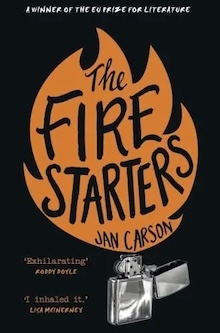
Jan Carson’s The Fire Starters (Black Swan Ireland, 2020) sounds deliciously apocalyptic and simultaneously domestic, as two fathers struggle with their children’s worst impulses against a backdrop of a burning city. The indie bookseller I spoke with said this was her favorite of the Belfast-based author’s books, and I’ll always listen to an indie bookseller.
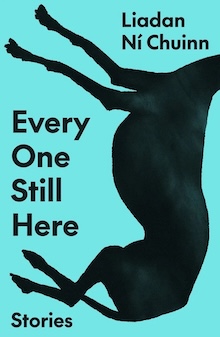
That same bookseller suggested Liadan Ní Chuinn’s story collection Every One Still Here (FSG, 2026), first published by the Dublin-based small press The Stinging Fly. An intimate collection that grapples with Irish history (and the role of the British empire in Northern Ireland’s more recent history), the author’s identity is completely unknown—a strangely exciting thing when a quick Google search takes me into the depths of most authors’ entire online histories.
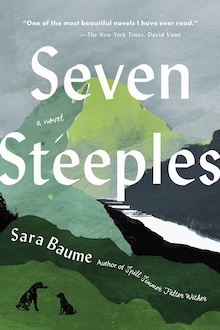
Sara Baume’s Seven Steeples (Mariner Books, 2023) came recommended by a friend. Set in the southwest of Ireland in the general vicinity of Cork, and steeped in questions of how we as humans can be better inhabitants and caretakers of the natural world, the novel follows a couple over the course of seven years as they learn to love one another against a backdrop of our current social climate. This one is also published by the independent Tramp Press, also based in Dublin.
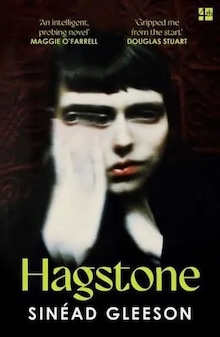
When I asked a bookseller at Hodges Figgis—an independent bookstore that has been in continuous operation since before the United States existed as a country—for an Irish Gothic novel, she handed me Sinéad Gleeson’s debut Hagstone (4th Estate, 2024). The novel combines a reclusive all-women’s community, a remote island, a possibly supernatural murmuring from the surrounding landscape, and a mysterious invitation to a Samhain ritual. I’m ready to turn off the lights, arrange a few candles, and stay up all night with this one.
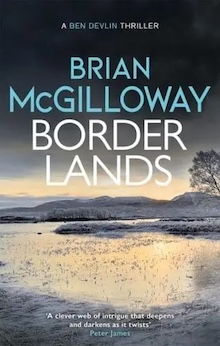
Derry-based Brian McGilloway is a thriller author who came highly recommended by the booksellers at No Alibis bookshop in Belfast. Borderlands (Constable, 2007) is one of McGilloway’s older novels but is steeped in the politically complex geography of the border between Northern Ireland and the Republic. As the bodies of murdered teenagers are discovered, a Garda Inspector faces the possibility of a twenty-five-year cover-up on a cold case.
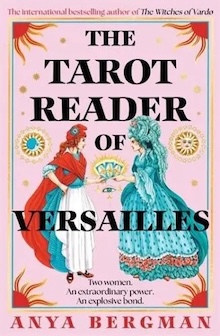
Finally, Irish author Anya Bergman’s The Tarot Reader of Versailles (Manilla Press, 2025) promises a sapphic historical mystery set during the French Revolution with a touch of the supernatural—and sounds like the perfect antidote to the pyrotechnics of the impending America 250 spectacle here in DC.
+
Diane Josefowicz, Reviews Editor
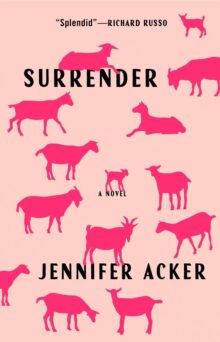
I’ve been recommending Surrender by Jennifer Acker (Delphinium, 2026) to everyone I know. In this lovely, old-fashioned novel, Lucy decides to uproot her well-ordered city existence in order to take over her family’s farm. As her retired husband, decades her senior, declines rapidly in their new situation, a vanished high school girlfriend reappears, prompting a belated erotic awakening. As Lucy discovers new aspects of herself, she becomes bolder and more intentional about when and how to break rules and risk others’ displeasure. “How do I manage my anger and despair?” she wonders. “Well, that’s why a woman has a barn.”
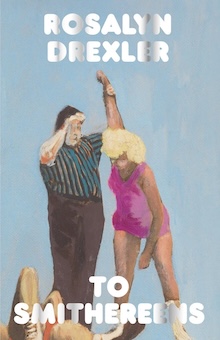
As the artist Rosalyn Drexler began her career in the late 1940s, on the streets and in the museums of Berkeley, California and New York City, her training included a stint as a pro wrestler. Drawing on the author’s experiences, To Smithereens (Hagfish, 2025) is about Rosa and Paul, who meet when Paul feels fledgling artist Rosa up in a movie theater, and Rosa takes her revenge by putting him in a half-nelson. Soon she has a new career. “Shit! Why not!” Rosa says. “I’ll do it for kicks.” Paul settles into his dual role, half art teacher and half manager, which he inhabits with a squirrelly lack of conviction. The point of view slides between them, tracking shifts in the story’s center of gravity as these mercurial lovers play each other and themselves—and Drexler, in turn, slyly plays the reader, turning the saga of Rosa and Paul into a sharp send-up of the NYC’s 1970s art scene.
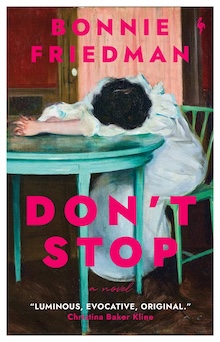
Is there anything Bonnie Friedman can’t do? The author of the classic Writing Past Dark (1993), about the pitfalls of the writing life, she followed up with The Thief of Happiness (2002), an engrossing memoir of a wild seven-year psychotherapy with a charismatic fraud, and Surrendering Oz (2014), fifteen personal essays in which she unpacked the conventional beliefs that have kept her feeling small and uncertain. In Don’t Stop (Europa Editions, 2026), Friedman’s long-awaited debut novel, forty-year-old Ina cannot own her considerable professional success; instead she engages in acts of self-sabotage culminating in a disturbing affair that threatens to destroy everything she’s worked for. Line by line, Friedman thrills. Ina’s troublesome sister is “an enormous hole covered with a vast doily.” An exhilarating moment in the classroom is “like being powdered with electric rain.” As in all her writing, Friedman is at her best when she’s writing about relationships, tenderly uncovering the lies people tell themselves in order to stay alive and together.
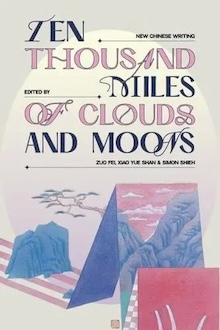
Though it also contains some striking poetry, I read Ten Thousand Miles of Clouds and Moons: New Chinese Writing, edited by Zuo Fei, Xiao Yue Shan, and Simon Shieh (Honford Star, 2025) for its marvelously exploratory prose. The opening story, “Mass in Dream of the Red Chamber,” elaborates the different world that might result if the classic text referenced in the title did not exist. The next story, “A Catcher in the Rye” by Da Tou Ma, updates Salinger’s 1951 touchstone story of teens at the end of their bored rope by giving them electric scooters and having them smash every bougie home appliance they can find. Their ennui is palpable; their rage leaps off the page. Another story, “Man and Wife,” presents a triptych of encounters that threaten the marriage at the story’s center and ends on an utterly earned note of rapprochement, as the husband looks back from a height and sees their beloved landscape and the people with whom he shares it: “Sometimes they sang, sometimes they were silent, sometimes they spoke in intimate whispers to their wives, and though I was far away, it was like everything was taking place right beside me.”
+
Michelle Bailat-Jones, Translations Editor
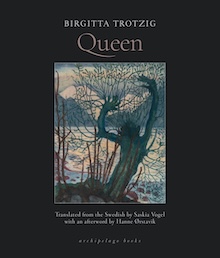
What says summer more than a cold, dark, remote coastal farm in Sweden in the 1930s? There are even a few beach scenes in this short, intense novel, so I say fair game to call it a vacation read. In terms of story, Queen (Archipelago, 2026; reviewed here) by Birgitta Trotzig, translated by Saskia Vogel has plenty: a stranger (a foreigner even!) arrives one night in search of her recently deceased husband’s family. We watch her—the narrator tells us, “Her interior had been emptied and now was full of fireshadows, shadows solely”—attempt to figure out which way to walk, where she should go. No one helps her. It starts to rain. She heads off into the dark. Trotzig then jumps us a hundred years into the past for a tale of family dysfunction, power dynamics, anger, loneliness, poverty, and economic migration. Queen was originally published in 1964, so we find ourselves in the 1860s when we meet the family at the center of this fascinating, brutal drama. Each character is chillingly dissected, while together they enact an age-old but always compelling theater of human hope and failure. Though I enjoyed the story for itself, I really appreciated Trotzig’s unusual use of a particular kind of narrative repetition. As the story unfolds, she tends to dart forward and then skip back, just a little, almost like a hemstitch, going over certain moments again or re-offering bits of information or specific character descriptions as if to give them special emphasis. Combined with the shifting close-ups into each character’s interior life, the overall effect is satisfyingly hypnotic.

Paris, 1996, in a neighborhood you’ve likely never been. Young mother Louise moves into a homeless shelter for women with Bliss, her one-year-old daughter. It’s either this or lose Bliss to social services and be sent back to Cameroon. A watcher of people and situations, a thinker and a dreamer, Louise maintains a steady focus on Bliss – food, bathing, play, wanting to maintain the simple acts of a normal life – while collecting details of the women around her. She is a fortress of one, and without restricting Bliss, keeps their little world tightly contained amidst the chaos, noise, desperation, and violence of the shelter. Something I found incredibly well done in Stardust by Léonora Miano, translated from the French by Gila Walker (Seagull Books, 2026) is how it kept two stories parallel: the mother-daughter duo’s evolving situation and a discreet but complex narrative on colonial and racial injustice. The book manages this layering while maintaining a keen, compassionate eye on questions of human dignity. Stardust is also autofiction that recounts a vulnerable, difficult period in the life of a writer who will go on to be much celebrated and successful. The manuscript was written over twenty years ago, but only published now and it inhabits that early period with real tension and emotion as much as it looks back on “the young woman” with an older, measured eye.
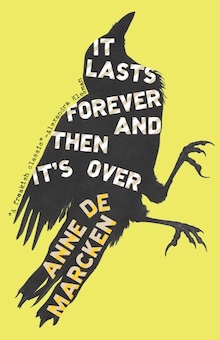
This next title got on my list somewhat by mistake because I read the whole book assuming it was a translation from another language. Then when I skipped back to the cover to see who had translated it, and learned that it was written in English. However, it was my favorite read (of recently published novels) from the first half of 2026 so it stays on the list. I am usually—no, definitely— not a fan of the zombie apocalypse novel. But the fact that this book is a zombie apocalypse novel is completely beside the point. It lasts forever and then it’s over by Anne de Marcken (New Directions, 2024) is a poetic and experimental meditation on loss; it’s also weird and strange and disconcerting and unnerving; it’s gross at some points and shockingly beautiful at others. From the moment the narrator—a zombie mourning the loss of her life, the end of the world, and perhaps most, her love—shoves, folds, and presses a dead crow into her hollow chest all the way to the final scenes when we leave her on a beach, her head on a stake, looking out at the Pacific Ocean (and more, of course, but I leave you to discover the dislocations and travels of this odd but most gentle of narrators), this book is nothing but a series of jarring excellent surprises. It would be overly simplistic to consider the book an allegory for grief; it is so much more, and so elegantly done.
+
Steve Himmer, Editor
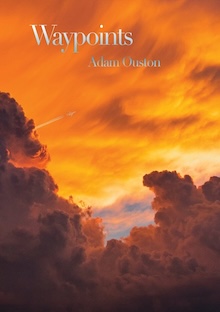
I could tell you some of the elements you’ll find in this Adam Ouston’s novel Waypoints (Splice, 2022) — Harry Houdini’s frustrated attempts at powered flight in Australia, the tragic disappearance of Malaysia Airlines Flight 370, a traveling circus and the family who own it across generations, crushing grief, and so on. But none of that would do the book justice. All I really want to tell you about Ouston’s novel is to read it, and to trust it, because in all its recursion and digression you might find yourself wondering what one thing has to do with another but once those connections start coming into view you might instead find yourself, as I did, on the verge of tears at how sublimely this book approaches some very difficult things.
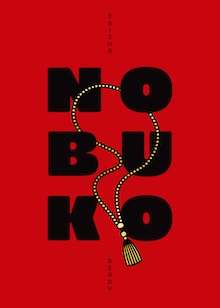
Trish Ready’s novel Nobuko (Frizzlit Editions, 2025) follows a young American woman who moves to Japan in the 1980s to teach English at a small, private school overseen by an owner whose gambling gets him into trouble with the yakuza. The lives of that gambling schoolmaster and his staff, and the friends and neighbors the narrator meets during her time in Japan, are glimpsed in small, steady snapshots of prose, 108 of them — a book structure the author has charmingly named “The Ready Sequence.” The opportunity to enjoy that structure and the endearing nerve to name it after oneself, not to mention how artfully structure and content complement one another and the irresistible writerly invitation to try writing a Ready Sequence oneself, should all be enough to convince you to read this. But if not, it’s also a bittersweet, funny, and moving story.
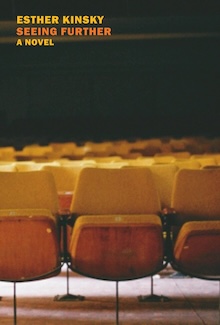
Summer is the season of beach reads and while that’s never been a category I’ve thought about much, Esther Kinsky’s novel Seeing Further (NYRB, 2024), translated from the German by Caroline Schmidt, is a book I read on a beach on vacation last winter. I read it in a single day, after claiming my spot on the sand early in the morning and keeping it until late afternoon (defending it occasionally from roaming feral chickens), and while the blue Caribbean water filling my view was just about the polar opposite of the novel’s setting, the combination was a resonant one. Kinsky’s protagonist comes upon a shuttered cinema in plains of southeastern Hungary and, almost out of nowhere, decides to stay and restore it. The people of the town offer help and return objects that came from the building, and the project moves forward in that vast, flat, supposedly empty space of the plains where, like on the ocean I read it beside, there’s always a lot more going on than it seems.
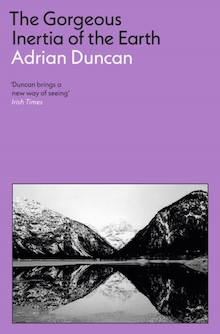
Reading the fiction of Adrian Duncan — five novels and a collection of stories, so far — always gives me the feeling of being privy to a view of the world that knows more than I do. The precision of detail and description, especially about engineering and construction and the material world of wood, stone, and metal, sometimes goes beyond my understanding but is always compelling and engrossing as the artful realization of a narrator’s (or author’s) idiosyncratic knowledge. His latest, The Gorgeous Inertia of the Earth (Serpent’s Tail, 2025), is no exception as it follows its protagonist, a restorative sculptor when we meet him, as he makes changes and choices that reveal the facets and possibilities of life like the stone he works with his chisel. I’m excited to also see that Duncan’s next novel, A Thought Without Collision, will be published later this summer so I won’t need to wait very long.