Archipelago, February 2026
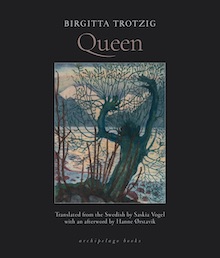
Queen by Birgitta Trotzig is a novel that churns with the logic of its landscape—beautiful, bleak, alien, cold, callous, and cruel. Here, the poverty of the rural landscape becomes a vehicle for the cycles of trauma in the text: how we become hurt, how we hurt others, and then how we cope. But just as any landscape, no matter how barren, can offer up some beauty, some sustenance, so it is with Queen which, though bleak, is also a novel about love.
The plot is minimal. A family—mother, father, three children—lives in a farmhouse in Bäck, a rural village in the south of Sweden in the 1890s. Judit, the girl known throughout the village as Queen, is the “queen of rags, of sagging, moldering roofs, of nothing.” From birth, she is identified as someone who can “shoulder and endure,” someone “to be relied upon.” Her brother Albert, though bigger and stronger, is immediately “set to one side” among “those who couldn’t be counted on.” After suffering a miscarriage, the mother gives birth to one more boy, Viktor, but remains ill. The infant is handed to nine-year-old Judit with the quip, “Take him girl—soon he’ll have no mother but you!” Immediately something passes between them: “the shining slits of his eyes held little of a gaze: it was more like a sharpness springing forth, a streak of light or gleaming water.” From that moment, Viktor belongs to Queen.
From early on, Queen felt that “there was no way out in the world for her” and “nothing to look forward to.” The mother never fully recovers from her illness, either physically or psychologically, and retreats into herself. But it isn’t until their father, while herding sheep home from the coastal wetland, grows irritated at Viktor’s crying and leaves Judit behind to tend to him, that Judit fully calcifies into Queen, shoving all of her emotion into the “desiccated rock-hard packed stratum,” the invisible dead earth of her psyche.
As the children grow up, Viktor, who inexplicably attracts the wrath and beatings of his father, becomes increasingly difficult to handle. He runs around, gets a girl pregnant, and eventually is shipped off to the United States during the Great Depression. He eventually finds comfort and respite in a woman from Poland named Lydia, and they scrape out a meager existence, eventually getting married. However, after Viktor dies in a freak building fire, the United States government decides to solve the problem of one more destitute immigrant by shipping his widow back to Viktor’s family in Bäck. There, Lydia awakens desire in Albert and, through her suffering, a single moment of kindred recognition that finally breaks through to Queen: “She is me! She is me!”
The minimal plot permits Trotzig to focus on the terrain, both exterior and interior. On the inner dust cover, Trotzig has said that “all of her writing came out of her observations about land.” In this text, the landscape is the interior, and the interior is the landscape. From the first moment, Trotzig uses the setting to evoke the dark, mythic realm of her characters’ interior lives. As a mysterious visitor arrives in Bäck in November 1930, the narrator peeks at the landscape through a set of open barn doors and previews several motifs that will recur throughout the novel—light, silence, water, decay:
The still gray sea beneath the white sky gives off a light like nothing else in the world; mild, sick; a misty white light, as mute as the blind milk of membrane around an extinguished eye; in this silent white light rests meadows so green, and the sound of steps or hoofbeats vanish without echo in the soft greensward, there reigns the silence, the birds, the scent of grass, the scent of broom, and between the people too a membrane-like silence: the white soft light upon the meadows, between the buildings, inside the buildings.
In a signature move, Trotzig’s narrator closes the passage with a stark turn inward: “[W]ords drown, the fate of the word is to drown, is it not?”
After Viktor travels to America, Trotzig turns to other settings as well. There is the grayscale gloom of New York and its many desperate, starving bodies. The Mississippi Delta is “latticework and tunnels of foliage” shot through with “marsh gas, water bloom, rush, honey moth nests, small dead fish, a baby alligator with its ballooning pale belly in the air.” A half-annihilated desert town appears beside a “miles-wide dried-out riverbed barely visible on the blinding hot ash-white plain,” and there’s blind Indian whose eyes are “a crawling, star-flickering mass.”
Plunging readers into the churning depths of each space, Trotzig simultaneously plunges them into the churning depths of each character’s psyche. She shows us how each character copes with the harshness of the world, with literal and emotional poverty. Her language thematically mirrors the landscape, which is both a boon and a weakness. At times the language hums with the atavistic mystery of an ancient, immutable landscape; at other times, it sags under the weight of repeating geographic imagery. It’s as if the book needs a little shake to get things going again. Reading Trotzig is like reading Clarice Lispector on a Swedish heath. The text is bleak and cold, with an internal logic all its own.
Those who gravitate toward novels of interiority will find Queen a worthwhile read. In her introduction, Hanne Ørstavik nicely captures its power and mystery, observing that Trotzig’s storytelling “inhabits the mythic space within us, the divine, where we all, no matter how wretched we are, are nonetheless made of light.”
+++
Birgitta Trotzig (1929-2011) was one of the 20th century’s most important Scandinavian writers. She grew up in Gothenburg and later in Kristianstad. From 1954 she lived with her family, first in Italy, then in France. Her years abroad put her in closer contact with European modernism and with the resistance to the Algerian War. On her return to Sweden, she began working as a critic and writing her debut, Ur de älskandes liv. She published the successful prose poetry collections Bilder (1954), Ett landskap (1959), and En berättelse från kusten (1961). She was elected to the Swedish Academy in 1993.
+
Saskia Vogel was born and raised in Los Angeles and now lives in Berlin, where she works as a writer, screenwriter, and translator from Swedish and German into English. In 2021 she was awarded the Berlin Senate grant for non-German literature, an English PEN Translates Award, and was a PEN America Translation Prize finalist. She was Princeton’s Fall 2022 Translator in Residence. Permission (2019), her debut novel, was published in five languages and was longlisted for the Believer Book Award.
+
Melissa Reddish’s stories have appeared in Tampa Review, South Carolina Review, and Grist, among others. She is the author of My Father is an Angry Storm Cloud (Tailwinds Press, 2016), Girl & Flame (Conium Books, 2017), and The Lives We’ve Yet to Live (Tailwinds Press, 2022). She has received residencies at Soaring Gardens and the Rensing Center.