Our Research Notes series invites authors to describe their process for a recent book, with “research” defined as broadly as they would like. This week, Aram Mrjoian writes about Waterline from HarperVia.
+
The Novel Is An Island
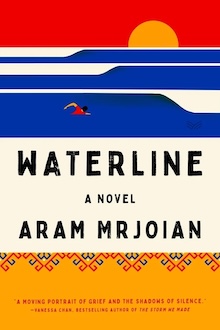
The novel you are writing is set on the island of Grosse Ile, which is nestled on the Detroit River at the mouth of Lake Erie, between Michigan and Canada. The island is slightly more than nine square miles in area. Grosse Ile boasts golf courses, yacht clubs, a municipal airport. There are plenty of paved trails for biking and jogging. Your grandparents lived on the island when you were a kid. They owned a small ranch with a big wooden deck in the backyard shaded by enormous black walnut trees. The pungent fruit plummets indiscriminately across the lawn. A favorite family story is that when you were seven or eight years old your grandfather offered you a dime for every green stink bomb you collected and you cleaned up more than 500, counting them out patiently as you filled a trashcan you dragged behind you.
You remember being awed by the river every time you crossed the bridge, how the shoreline fell away to so much sparkling water.
Decades later, water imagery floods the novel. You’ve been doing the field research since you were a kid. Water runs through the novel’s pages, a motif without singular emotional resonance or correlation. Spatially, setting the novel on an island is important to you because it hints at how your characters are isolated in their grief. For them, water is both a symbol of grief and salvation, of death and survival. You frequently consider empty spaces. The scale of the world is overwhelming and difficult to translate to your fiction. The totality of the novel is always a step out of grasp, its horizons never quite clear in the distance.
For seven years, the novel is your island.
You are isolated in anticipatory grief that inundates your writing. You’re tackling kinds of loss you haven’t yet experienced. You’re also trying to write about a fragmented past while freeing yourself from the subject matter that you’re expected to write about—you push back against every recommendation for more historical context. You don’t really know how to explain the project to friends, family, and colleagues. Everyone asks for the elevator pitch and you fall into the habit of responding, “Sad Armenians in Southeast Michigan.” You read a bunch of books and borrow materials from the university library’s archives and even develop a course you title “Contemporary Narratives of the Armenian Genocide” to try and teach your way through your self-doubt. By then, the novel has been in progress for years, and you’re uncertain it will ever get published. The island of your art is by now also the island of your profession, meaning at some point you might need to make the barren landscape hospitable enough for other folks to paddle over and help you develop it, but admitting this to yourself is difficult in part because you’ve always felt at peace being alone. The island is idyllic when it’s just you walking across its terrain without interruption or outside guidance. You are free to organize the landscape to your liking. You can peer out over the water without fear. The earth below you is solid, even if inhabited solely by you.
(Part of you already hates this extended metaphor, and that you are writing in the second person to avoid reckoning with ownership over the thing you created, and let’s be honest, other people were on the island all along, having driven straight across the bridge you built in every workshop or request for notes from a mentor or haphazard query letter. Be real. Your novel is more generous commune than deserted paradise. Countless people helped you cultivate its expanse.)
You put the island up for sale and it’s nearly nine months before you find a buyer. During your final round of edits, you book an Airbnb on Grosse Ile for the weekend and drive by yourself to tinker with the novel at the place where it is set. You pay to cross the toll bridge that you rode over dozens of times as a child. The real island is not quite as you remember, but much of it has remained the same. There are the shoreline mansions and boats of all sizes. You go for a run past your grandparents’ old house and all the giant walnut trees have been cut down. There’s an above-ground pool at the center of the bare backyard. The grand scale of your childhood is lost and you know it will never be the same. Back at the Airbnb, you shower, then spend hours on the edits, finishing late in the evening, unsure if you’ve done what you set out to do.
From there, the island develops rather quickly, and you must accept that soon it will no longer be a place for you to live in isolation. Many people will commute over and have opinions about the place that you’ve loved for the past seven years. They ask you questions about why the island isn’t bigger, or why it’s not manicured how they would have done it, or they tell you it’s beautiful and that you’re brilliant, which for some reason is more difficult to hear than various criticisms. Revisiting the island is surreal—it’s novel to everyone else but overly familiar to you. Yet, you don’t quite feel at home.
Keep going, friends suggest. You’re supposed to be hard at work on the next big thing, but treading the water of your life is proving hard enough on its own. You find so many ways to stay too busy. Nevertheless, you begin imagining what the next island could look like. You dump enough foundation to stand on and dig your feet into the sand. It’s peacefully quiet, serene. For the foreseeable future, you’re on your own.
For now, it’s just you.
+++
Aram Mrjoian teaches creative writing at the University of Michigan, where he is the managing editor of Michigan Quarterly Review. He is the editor-at-large of The Rumpus and a 2022 Creative Armenia-AGBU Fellow. Aram has previously worked as an editor at the Chicago Review of Books, the Southeast Review, and TriQuarterly. He is also the editor of the anthology We Are All Armenian: Voices from the Diaspora published by the University of Texas Press (March 2023). His writing has appeared in The Guardian, Runner’s World, Literary Hub, Catapult, West Branch, Electric Literature, Gulf Coast, Boulevard, Joyland, Longreads, and many other publications. He holds an MFA in creative writing from Northwestern University and a PhD in creative writing from Florida State University. He lives in Michigan.