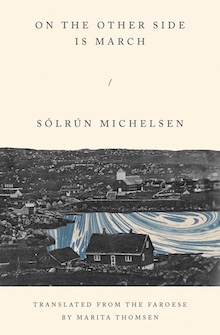
Transit Books, June 2026
Translated by Marita Thomsen, On the Other Side is March by Sólrún Michelsen is a meditation on the many losses of age and how these losses are balanced—sometimes—by insight and wisdom. This slim novel, which got under my skin and into my dreams, is also the first book by a Faroese woman to appear in English. I’m clearing my shelves in the hopes that there will be more.
There’s reason to hope: The Faroes, an eighteen-island archipelago in the North Atlantic, produce more new books per capita than Ireland. Since 1950, this literature has mainly consisted of works in Faroese, closely related to Icelandic and Old Norse.
In a series of vignettes interspersed with reflections, On the Other Side portrays a woman in late middle-age whose life is slowly being subsumed into caring for her aging mother. Her own resources—mainly money, but time too—are dwindling fast. A nursing home is under construction. Perhaps soon a place will open up. Meanwhile the stresses of caregiving—physical, emotional, financial—are heightened by the stark fact that the person she’s losing is her mother, the mainstay of all her attachments. Faced with evidence of her mother’s decline, the unnamed narrator frantically refuses it: “Not her. Not her.”
Altogether the experience of looking after her mother is brutal. She attempts to put a good face on it. “As your days, so shall your strength be,” begins one section, in which she takes stock of her situation. Her focus soon shifts to her mother’s experience, what it must be like for her to live through her own life’s end. “It takes immense strength,” the narrator observes. “The strength to remain dignified and even-tempered even as your body so utterly betrays you. As your head slowly empties. As you lie there wet and soiled and have to put up with everything not uttered in words, but plain to read in other people’s eyes.”
Mortality haunts her, but her sense of humor, inherited from her mother, buoys her and keeps the story balanced between the maudlin and the droll. “Now that we live so long,” the narrator says, tongue moving slowly but surely into cheek, “we have to squeeze childhood and youth on one side and very old age on the other. The rest is the middle,” a time that she describes, with sly ambiguity, as “the most expansive.” She doesn’t mean that it’s long—or not just that—but that it’s excessively self-regarding, a vain period of life that “considers itself the most important.” A discourse on dreaming, seemingly plucked from the air, is even funnier. “Dreams are pent-up words set free,” she says. “Sometimes birds shit on them.”
The narrator is obviously stronger than she knows, and over the course of the book, her mother is revealed as the prototype, if not the source, of that strength. Even diminished by a stroke, her mother finds ways to enjoy herself. She paints her nails pink; she retails stories of a friend who, on nights when her husband was at work, set out a special lamp as a signal to a paramour. “Then the door would be unlocked,” she says. “Lively times indeed.”
Caring for her mother, the narrator makes some discoveries about herself. She becomes clearer, for instance, about self-deception. “We are all feigning something,” she declares. “My pretend balloons float up there among all the others.” But the truth always “elbows its way down” and “sets its searchlights on me.” The book is studded with such recognitions. At times they float loose on the page, unanchored to ordinary novelistic stage business. Even dialogue tags are sparse. These dreamlike reflections might belong to the narrator or to her mother or to some consciousness that, in their new and strange closeness, they now share.
Even so, this contact will be brief, as the narrator is painfully aware. But something in the naturalness of the loss consoles her. Of her mother’s illness, she says, “I have gradually come to terms with the fact that the woman who was, is gone.” That woman now exists only in the narrator’s memory, where her parents are always “sitting on a rocky shore, she is hugging her knees. He is sitting close to her. Has one arm around her shoulders. […] He is looking at her. They smile.” The narrator “hangs” the picture in memory, “alongside the other ones in the wall-less gallery” of her mind. “It’s a good image,” she says.
In a long passage, the narrator painstakingly imagines herself once again into her mother’s experience, this time of losing her balance as another stroke overtakes her. She will fall—how can she not? But she will also “get back up again and again.” This resilience means “to keep smiling and not let your legs give way and let a wave of tears wash you clean.” This stubborn clinging to ordinary capacities—rising, smiling—finally becomes “the last weapon left in your arsenal. With your dignity,” this feisty, forlorn daughter says, “you play them check and mate.”
+++
Sólrún Michelsen, born in Tórshavn, is a bestselling author known for her poetry, short stories, and novels for all ages. She won the Faroese Children’s Literature Award in 2002 and the M. A. Jacobsen Culture Prize in 2008, and her novel On the Other Side Is March was nominated for the Nordic Council Literature Prize in 2015. Her recent works include a historical trilogy depicting the lives of women in the Faroe Islands, starting at the close of the nineteenth century.
+
Marita Thomsen is from the Faroes, where the wind often roars, and now lives in Keele, where it whispers. Her love of languages and stories has crystallized into English translations of Faroese authors, while her work as a conference interpreter satisfies her curiosity and wanderlust.
+
Diane Josefowicz is Reviews Editor at Necessary Fiction and Senior Editor of Translation for The Adroit Journal. Her second novel, The Great Houses of Pill Hill, was published by Soho Press in May.