Our Research Notes series invites authors to describe their process for a recent book, with “research” defined as broadly as they would like. This week, Emily Greenberg writes about Alternative Facts from Kallisto Gaia Press.
+
From Fact to Fiction: Letting the Research Fall Away
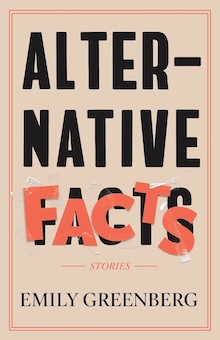
My debut short story collection, Alternative Facts, features fictionalizations of real public figures like George W. Bush, B.F. Skinner, and Paris Hilton. Because writing these stories required significant research, I’m often asked about my process. What’s fact, and what’s fiction? Which parts are real and which made up?
Answering in the abstract is difficult because my research process differed for each story. Instead, I’ll attempt to answer through example, describing my process for the first and titular story in the collection, a twelve page long stream-of-consciousness style sentence in the voice of former Trump advisor and campaign manager Kellyanne Conway.
Many readers are surprised to learn that “Alternative Facts” was the last story I wrote for the book. After re-reading the stories I had written during my MFA, I realized that many included fictionalized public figures and circled, however obliquely, around the concept of post-truth; what the manuscript really needed to tie everything together was a story more directly about post-truth. Conway, who coined the term “alternative facts” to defend then press secretary Sean Spicer’s lies about the crowd size at Trump’s first inauguration, was the perfect subject, though I didn’t yet have an idea for a story about her.
I began researching Conway online, reading everything I could and hoping some detail would spark a story idea. Eventually, I discovered a fascinating article by Chris Sommerfeldt in The New York Daily News alleging that Conway had punched a man at the inaugural ball. How had I not heard about this? The New York Daily News article quoted only a single eyewitness’s Facebook post, major newspapers hadn’t reported on it, and the trigger for the altercation wasn’t clear. There were no photos. Had it actually happened?
This dearth of information provided the perfect opportunity for me to fill in the gaps with fiction. I decided to write a story showing the lead-up to the alleged fight—I was still not convinced it had actually occurred—and speculating about Conway’s motives and mental state when she threw the first punch. However, before I could write the story, I needed to better understand my subject.
During this next research stage, I focused more on Conway’s background, pasting links and jotting notes down in a document titled conway_research.docx. Throughout my research, I looked specifically for facts that surprised me about Conway, items that didn’t square with her public persona, bits that humanized her. Here’s an example note from this very early stage, which includes some pieces that later appeared in the finished story. These details about Conway’s modest, single-parent upbringing helped me empathize with her more and would eventually form the story’s emotional core:
Daughter of a single mother casino worker, south jersey accent, from atco – short for atlantic transport company, dad had left when she was 3 and mom 26; lived with grandmother and great aunts, crucifix-lined house, and what had jfk or Reagan ever done for them, four Italian catholics, no political conversations ever, very religious, were they great aunts or aunts? Mother worked 21 years at Claridge casino in atlantic city, trump had been a casino owner in atlantic city for 25 years
As I compiled these notes, I also began rearranging them in my document, clustering together related items. The more intriguing details I uncovered, the more my research branched out in new directions. For example, after learning that Conway’s Secret Service name was Blueberry and that she had worked on blueberry farms for eight summers—experiences she credited with teaching her everything “about life and business”—I began researching blueberry picking. This research enabled me to more accurately depict Conway’s time working on blueberry farms with more realistic sensory descriptions and details.
Sometimes, I copied and pasted phrases or sentences that struck me into my notes document, such as this excerpt from a New York Magazine article about Conway by Olivia Nuzzi:
…her fighter’s instinct, which dictates that she never give an inch or even try to persuade…
I also wrote down direct quotes from Conway herself, some of which later appeared in the finished story:
I look at myself as a product of my choices, not a victim of my circumstances.
Besides reading, I also watched videos of Conway speaking to the press. After transcribing these exchanges, I analyzed how she had avoided answering the reporters’ questions. These efforts were aided by a Lili Loofbourow article in The Week dissecting Conway’s spin doctor techniques and Jarrett Berenstein’s book on the same topic, The Kellyanne Conway Technique: Perfecting the Ancient Art of Delivering Half-Truths.
Once I’d amassed enough notes, I began writing the story itself. In my earliest draft of “Alternative Facts,” the story followed Conway’s internal monologue as she watched two men arguing and then intervened. The sentences were relatively conventional—they didn’t quite capture Conway’s voice—and this nagged at me.
Setting aside this first draft, I returned again to my research notes and began thinking about how to replicate Conway’s spin doctor techniques through non-sequiturs, quick pivots, and repeating words to create an illusory flow. In my story, the Conway character would need to constantly contradict herself and then spin in a new direction.
After immersing myself more in my notes about Conway’s spin doctor techniques, I began hearing her voice in my head. She showed up when I least expected her, while I walked my dog or showered. At first, I heard little disjointed phrases in her voice, not even complete sentences. I wrote these down as quickly as I could without any idea how they would coalesce into a story.
Re-reading Loofbourow’s article, I noticed she had zeroed in on one element of Conway’s speaking style that I especially wanted to capture—her speed—noting that Conway “rarely pauses at the end of a sentence.”
Loofbourow’s syntactic observation prompted me to think more directly about the fragments I was composing. I wanted my story to have the same breathless, relentless quality of Conway’s real speaking style. What if my story, like Conway herself, rarely paused at the end of a sentence? Better yet, what if the story unfolded as a single sentence? The prospect daunted and excited me in equal measures. Was I even capable of writing such a long sentence? I didn’t know, but I decided to look up some very long sentences to see if I could understand their constructions.
In a document titled longsentences.docx, I first typed a 245-word sentence from Cormac McCarthy’s Blood Meridian that begins as follows:
A legion of horribles, hundreds in number, half naked or clad in costumes attic or biblical or wardrobed out of a fevered dream with the skins of animals and silk finery and pieces of uniform still tracked with the blood of prior owners, coats of slain dragons….
Once I felt like I understood how the sentence worked, I moved onto an even longer one: Gabriel Garcia Marquez’s epic 2156 worder from “The Last Voyage of the Ghost Ship,” which begins like so:
Now they’re going to see who I am, he said to himself in his strong new man’s voice, many years after he had first seen the huge ocean liner without lights and without any sound which passed by the village one night like a great uninhabited place, longer than the whole village and much taller than the steeple of the church….
I typed out the sentence, placing each clause on a new line, almost like a was writing a poem, so I could better understand the sentence’s movements and how the different parts built on one another. The more I did this, the more the sentence’s rhythms and structures lodged in my brain. Returning to the little phrases I had written in Conway’s voice, I was now able to extend them, layering on additional clauses and details as Marquez had done.
Around this time, I also summoned Conway’s voice more intentionally by reading my notes about her over and over again, almost memorizing them, until it became difficult to think without hearing those particular notes and phrases, like a bad song stuck in my head. At this point, I wrote whatever snatches of internal monologue came to me, not worrying about what the overall story was or how these isolated parts would fit together. Eventually, I began rearranging these fragments on the page, looking for linkages and attempting to string them together.
In those early drafts, my mind fully saturated with notes, the writing was overly factual, weighted with trivia. I was trying to convince the reader—or perhaps myself—that I had done the research and knew what I was talking about, that I had the authority and expertise to write this story so outside of my own personal experience. As I kept drafting, I grew more comfortable with the voice I was creating and more confident in my ability to channel it without notes. I put the research away.
In these later drafts, I finally moved beyond the factual circumstances of the alleged punching incident and into pure invention. No longer beholden to the literal truth—whatever that meant in the first place, given the lack of documentary evidence surrounding the altercation—I worked to reveal a deeper, emotional truth. The story’s truth. The character’s truth. In the end, letting the research fall away allowed me to more fully engage with the person I was writing about—not Kellyanne Conway herself but the contradictory, wounded fictional character emerging on the page, the character who, as a little girl, learned to lie to herself, to bend reality, thinking that her father,
…could return one day like a winning lottery ticket, bestow on them another kind of life out of the blue, that life that she could not stop imagining in the endless blueberry fields, when she would not place her dented blueberry bucket on the ground and spin as fast as she could, around and around and around, the smooth angles of the field blurring until she was no longer sure what she was looking at, was no longer sure if she had ever known what she was looking at, until a tree branch faded into sky and cloud, the clouds morphing into her own father’s grinning face as she imagined it must look—blueberry blue eyes like hers, square jawed, a little scar under the eye as a token of hard living—and her reality became something else too, a story where, as she often told news reporters these days, she was not the “victim of her circumstances” but the “product of her choices,” one of which was to keep spinning….
+++
Emily Greenberg is the author of Alternative Facts (Kallisto Gaia Press, 2025). Her writing has appeared in the Iowa Review, Electric Literature, McSweeney’s, Michigan Quarterly Review, Witness, Chicago Quarterly Review, and elsewhere. She edits short story and flash fiction collections for Split/Lip Press and the “Lest We Forget the Horrors” series for McSweeney’s. Learn more at emilygreenberg.net.