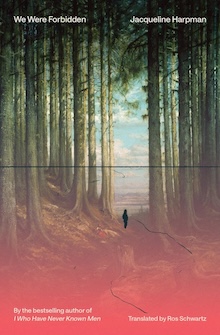
Transit Books, July 2026
This slim ninety-page volume consists of three stories and bears a title inviting feminist interpretation. We Were Forbidden is provocative: Who are “we” and what is forbidden to “us”? Raising these two questions, the author, Jacqueline Harpman, a psychoanalyst whose first novel, I Who Have Never Known Men was last year’s breakout Tiktok success, implicitly asks a third one: Who determines the prohibition?
In the collection’s first story, “The Ardennes Forest,” a woman soldier wanders the titular European forest in a mixed-gender “secret reserve force” under orders, reinforced by hypnotic training, not to emerge until “the war” has ended. The forest’s association with the Battle of the Bulge suggests a WWII setting. Hard-pressed for supplies and food, and stumbling upon long-abandoned homes that they then raid, the soldiers fear “the enemy has won.” The soldiers face a bleak, unclear, futile future, yet they push forward. This sounds much like living: We don’t have all the information, we are unsure of our purpose, we develop community, we survive, only to eventually “go off to die in a thicket.”
Superficially, the “we” of this story refers to the soldiers. On another level, it points to the current predicament of a wide swath of humanity, people who are surviving in a world that doesn’t make sense and rarely offers either answers or comfort. The soldiers’ lives highlight the absurdity of bureaucracy. As the narrator says, “we had no plans other than to carry on living and walking, as per our orders.” It is as if they have been ordered, absurdly, to stay alive. Before departing the houses they raid, the soldiers politely leave notes explaining what they took. The narrator wonders if their missives will ever matter, since “[o]nly the reader gives meaning to a written message.” With this, Harpman seems to suggest that the soldiers’ drive to communicate what they have survived might be received by the reader who is bearing witness.
A prefatory translator’s note indicates the second story, “The Outcast,” is autobiographical; Harpman’s Jewish family fled Belgium for Casablanca when Hitler invaded in 1940. In this coming-of-age tale, the narrator remembers being punished at her French school after learning the hard way that “good form imposes limits on good sense.” Read: a tenaciously smart young woman was too eager to flex her reasoning skills by pointing out the contradictory quality of her friend’s patriotism. Complicating matters, Jews at this school who valued reason over social niceties or nationalist conformity were punished, whereas non-Jews weren’t. Harpman’s skills as a writer-psychoanalyst are on full display here. The story sets the scene for something that happened to the narrator but before we even learn what, the narrator begins a rigorous examination of her younger self. What’s forbidden in this story? Willfulness, complex Jewish thought or identity, and youthful ignorance of how inconsistent and unfair life can be. In case “The Outcast” seems too much like an excoriation of adults with double standards, the narrator ends with a self-aware reflection: “I do not intend to cure myself of being reasonable and reasoning.” With this closure, Harpman suggests that what is most forbidden is being anyone but herself.
The final story is the most formally difficult and, at thirty-five pages, the longest. A playful, delightfully salacious melodrama, “The Broom Closet” begins with an older narrator imagining herself as one Madame Hortense Afflighem, a docile, married young woman who begins a racy extramarital affair in 1920s Belgium. While assuring the reader that “I have always easily been able to be two people at once,” the narrator initially pulls off this bit of identity magic. Cue the story’s formal difficulty: the first half disorients by sliding between first and third person. Oscillating between an “I” separate from Madame Afflighem and the narrator being Madame Afflighem unveils the construction of fiction as the narrator considers plot options and draws on memories. It also dramatizes the psychic separation required to create a believable character: “Hortense had gone from the first to the third person singular. I was no longer […] Afflighem, which made her all the more real.”
And what does this real character want? Sexual freedom and exuberant orgasms! Before long Madame Afflighem arranges for her husband’s murder so she can be with her lover. Naturally, the narrator celebrates Madame Bovary as an intertext, claiming Flaubert was afraid of Madame Bovary because he was afraid of himself. But Harpman is not afraid. She is drawn to desire, the force animating both literature and psychoanalysis, as she suggests in a 1992 interview with René Andrianne. Speaking of herself at age fourteen, she says:
I already knew that I was going to be a novelist and a psychoanalyst. Here is how this developed. There were not a lot of books at the Casablanca municipal library. For example, the index moved directly from ‘Fl.’ to ‘Fr.’ I therefore read Freud immediately after reading Madame Bovary by Flaubert.
Forbidden in “The Broom Closet” are dull stories, dull characters, dull sex, and dull marriages. Also forbidden: repressing one’s desires and, in doing so, reinforcing monogamy’s patriarchal foundation on docile, obedient women. In contrast, this story, like the collection as a whole, is a triumph of women’s independence, pleasure, complexity, and their ability to contain multitudes.
+++
Jacqueline Harpman was born in Etterbeek, Belgium, in 1929. Her family fled to Casablanca when the Nazis invaded, and only returned home after the war. After studying French literature she started training to be a doctor, but could not complete her training due to contracting tuberculosis. She turned to writing in 1954 and her first work was published in 1958. In 1980 she qualified as a psychoanalyst. Harpman wrote over 15 novels and won numerous literary prizes, including the Prix Médicis for Orlanda. I Who Have Never Known Men was her first novel to be translated into English, and was originally published with the title The Mistress of Silence. Harpman died in 2012.
+
Ros Schwartz has translated numerous works of fiction and non-fiction from French, including Jacqueline Harpman’s I Who Have Never Known Men, several Georges Simenon titles for Penguin Classics, a new translation of Antoine de Saint-Exupéry’s The Little Prince and, most recently, Mireille Gansel’s Translation as Transhumance. The recipient of a number of awards, she was made a Chevalier de l’Ordre des Arts et des Lettres in 2009 and received the Institute of Translation and Interpreting’s John Sykes Memorial Prize for Excellence in 2017.
+
Brianna Thompson has taught English at universities, colleges, and high schools; ask her about weight lifting, food, or her TBR pile. She’s published on nineteenth-century American women’s literature and contemporary authors like Octavia Butler. Her fiction has been featured in Fish Barrel Review and Blue Villa.