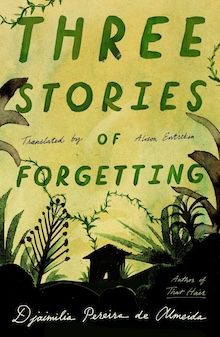
FSG Originals, December, 2025
What becomes of awful people? The Angolan-Portuguese writer Djaimilia Pereira de Almeida’sThree Stories of Forgetting, sensitively translated from the Portuguese by Alison Entrekin, offers one answer, in the form of a triptych of novella-length character studies of more-or-less awful men. All are old enough to be constantly dogged by rumors of their own mortality, and each has participated in different ways in Portugal’s brutal colonialism. Their crimes and misdeeds prompt the reader’s aversion, while their ordinary commitments to family and friends generate an awkward, uncomfortable sympathy. Eliciting this complex response, the novel invites reflection on the systems that produce opportunities for people to be awful and to prosper in their awfulness, as well as what it means to be complicit in the functioning of those systems.
That awful people do awful things seems hardly to require explanation. More mysterious, perhaps, is how they live with themselves. As Pereira de Almeida’s characters approach death, their powers of avoidance and denial weaken, making their memories—particularly of violence they’ve visited on others and themselves—urgent and palpable. Impending death prompts fresh degrees of self-awareness in these men. But they have lived a long time, and their defenses against knowledge and recollection are equally well developed. Much of the story’s tension derives from Pereira de Almeida’s repeated staging of this conflict between knowing and not knowing, remembering and forgetting.
The first story, “A Vision of Plants,” follows Captain Celestino, a slave trader who has retired to his childhood home where he tends his garden and waits to die. He does receive the occasional visitor, a village priest and reader stand-in with whom Celestino at once remembers and avoids remembering all the awful things he has done. The middle story, “Seaquake,” concerns another old man, Boa Morte da Silva, an Angolan who helped the Portuguese colonize Angola and is now working in Lisbon as a valet. In between jobs, Boa Morte, whose name means “Good Death,” retells the story of his life in communiqués to a distant daughter to whom he feels he must explain himself. Like Celestino, he avoids making the connection between the choices he’s made and his need to justify them.
The third story, “Bruma,” titled for the main character, a slave whose which means “mist,” is inspired by an autobiographical passage by the Portuguese writer Eça de Queirós (1845-1900), of being introduced to French literature by the slave who cared for him; apparently the man shared everything he knew about French history while keeping the Portuguese stories back. With this story, Pereira de Almeida suggests the complex reasons for that loquacious silence. When the elderly Bruma is alone in the one refuge he has—a cabin in the woods—he reads voraciously, devouring medieval legends of Charlemagne. Unlike Celestino and Boa Morte, Bruma is not really an awful person, but he has been brutalized by colonialism and must find ways to live with its effects on his entire existence, inside and out.
Pereira de Almeida’s genius is that she tempts the reader to feel for her characters—even for the awful Celestino. He dotes on his plants; he develops relationships. Perhaps he was not totally villainous but a slave and a pawn in his own way? Not at all: Pereira de Almeida is not letting him off any hooks. An old man “busy with preparations for his own funeral,” enclosed within the shell of his childhood home, Celestino feels protected. “Though its walls were scorched like the captain’s skin,” the house retains an innocence that Celestino has long ago lost. Among other things, the house helps him to avoid his memories and the pricking of his conscience to which those memories inevitably give rise; it doesn’t “remind him of the eyes writhing with larvae that he’d seen on his travels.” Oh, to avoid those eyes! “All [the house] had was the tattoos of time and the nests of swallows,” which have made their homes in the roof, birds that “had soiled the eaves as a soul soils itself.” With his crimes, Celestino has invited sparrows to roost in his soul, to deposit their excrement there. He carries his crimes, the memory of them, as the house gives shelter to this foul nest.
Of the three, the middle story, a journey through the Lisbon underworld, is perhaps the weakest. Boa Morte makes his way around the city, feeling hunted and suffering from a hernia. A “sinister man” passes by, raising goosebumps, like “a dark cloud that rains only on my street.” The figure might stand in for death or reckoning—the two are indistinguishable for Boa Morte. There’s a kernel of importance here, but the story devolves into picaresque as Boa Morte seeks out his friends, in particular a woman for whom he feels responsible, whose circumstances are even more precarious than his own. As Boa Morte rests briefly aboard a train, the focus slips, and Pereira de Almeida’s incisive narrator forgivingly smears the lens: “Boa Morte was a tired old man at the window,” sighs the narrator, but in that moment he also, antically, distractingly, becomes several other things: “a greyhound chasing a hare, a rich man looking for the eye of a needle, a master key, a finger on the trigger.” These images are not innocent, but their profusion diffuses their impact.
To what end? Bruma provides one answer: He has been unambiguously harmed by the brutal system from which the other two men have profited. Worse, because Bruma has been compelled to perform emotional labor for his captors, threatening his ability to have an inner life at all. What is the use of an inner life, of autonomous private commitments, when all one’s skill at sustaining those commitments is put to the use of one’s masters, whom one cannot leave on pain of death?
This brutalizing experience will never leave him. But neither will Bruma leave those others—not because they’ll kill him but because, and this is the truly diabolical part, the work of caring for them has eventuated in actual caring. His attentive servitude has made them whole: “He was their buttons and the thread that stitched them to the overcoat of their souls […] His voice was the last one they heard each night when, like a friend, he prayed for their souls. Their last friend before they closed their eyes, their first friend when they awoke.” He is nothing less, in fact, than “their conscience.” With this passage, which occurs toward the end, Pereira de Almeida comes full circle, returning to the question of conscience, of how it is that awful people manage to live with themselves.
As death nears, Celestino becomes confused, mixing up the names of plants, and everything in his narrowing world takes on an increasingly nauseating and sinister cast. “At the end of the world there are no people,” he observes from the depths of this muddled funk, “just sick tree trunks scattered about, fish hands, a soup of water lilies and cockroaches, mouse skeletons, fungi, thorn-eating snakes.” But Celestino is alone in this befuddlement. Neither the narrator nor the reader is confused. There is fourth story in Three Stories of Forgetting—the story of the reader’s excruciation, swinging between judgment and mercy. If one feature of a functioning conscience is the impulse to muddle, to mercifully smear the lens, then the opposite feature—moral clarity— is not just a nice-to-have. It’s an imperative. Compared to narcotic fuzziness, such clarity is cold comfort. But it’s better than the insensate consciousness of Celestino, for whom life finally becomes “a stream of Sundays,” empty, dull, and dreadful with the promise of only another awful week to come.
+++
Djaimilia Pereira de Almeida was born in Luanda, Angola, and raised in Portugal. She is the author of acclaimed novels including That Hair, a finalist for the PEN Translation Prize, and her work has won the Vergílio Ferreira Prize and the Oceanos Prize. Her stories and essays have appeared in Granta and Words Without Borders, among other publications.
+
Alison Entrekin is an award-winning translator from the Portuguese. Her translations include Clarice Lispector’s Near to the Wild Heart, Paulo Lins’s City of God, and João Guimarães Rosa’s modernist classic Vastlands: The Crossing. Her work has earned her the New South Wales Premier’s Translation Prize and Sydney PEN Medallion, and the 2022 Australasian Association of Writing Programs–Ubud Writers & Readers Festival Translators’ Prize.
+
Diane Josefowicz serves as Book Reviews Editor at Necessary Fiction and Senior Editor for Translation at The Adroit Journal. Her second novel, The Great Houses of Pill Hill, is just out from Soho.