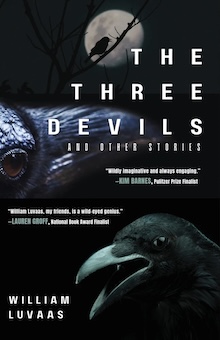
Cornerstone Press, 2025
William Luvaas’s Three Devils is a collection of five stories set against the backdrop of a Southern California landscape ravaged by climate disaster, where every shared resource has been exhausted or destroyed. As human as it is haunting, the collection offers a vision of a future that many readers may feel is already upon us. Yet even in the darkest corners of these tales, Luvaas offers glimmers of a raw, unwavering connection to life itself—particularly the need for community and the redemptive power of art.
Three Devils shows a world in which survival is not just physical but emotional and creative. In the title story, Willy Jefferson grapples with how to survive the toxic Foul Air—an odor that envelops the planet and threatens global health. Fueled by conversations with his deceased wife, Jefferson joins his neighbors to act against the threat:
They stood on the street, on their balconies, in backyards and parks—seven billion people—all blowing at once, pushing Foul Air out to sea. The most remarkable act of human unity in history, which suggested that people
could cooperate if it was in everyone’s interest to do so.
His story is emblematic of Luvaas’s ability to inject moments of connection and purpose into an overwhelmingly grim situation.
Driven by a fundamental need to find meaning in chaos, Luvaas’s characters hold out for a better present. In “The Los Angeles Culture Depository,” Luvaas introduces Dugan, a cultural guardian working in a vault beneath UCLA. Here, Dugan safeguards artwork, manuscripts, music, and artifacts as a form of resistance to cultural obliteration driven by authoritarianism. This story is reminiscent of John Freeman Gill’s The Gargoyle Hunters (2018), in which endangered architectural relics are rescued from a casual attempt to erase the history of New York City. Both stories highlight how small acts can pause an overwhelming tide of collapse.
Three Devils also resonates with Luvaas’s earlier work, Welcome to Saint Angel (2018), in which corporate greed and environmental collapse lead to a takedown of billionaires. Three Devils, by contrast, offers a bleaker vision. All seems lost, yet individuals nevertheless band together to face their collective helplessness with quiet toughness. Luvaas’s vividly drawn characters embody the diverse ways people cope with a world in decay—through religious fervor, pragmatic survivalism, intellectual analysis, escapism, or embracing illusions and delusions.
In “Dr. Doom & The Messenger,” Minah transforms from a benumbed college student to a forceful figure who refuses to accept doom. The story culminates with Minah’s reunion with her Aunt Laney, who is determined to replant burned forests. As Minah surveys the ruined world around Aunt Laney’s mountain home, she finds “a graveyard of charred stumps, thick trails of ash where trees had fallen, the white-washed gray sky stretching out over the valley, barely distinguishable from the ground beneath it.” In her reunion with Aunt Laney, Minah renews her belief in enduring personal ties, a theme Luvaas echoes throughout the collection.
Both mesmerizing and deeply unsettling, Luvaas’s prose mirrors the stark realities of a landscape devastated by climate change. What makes Luvaas’s vision eerily powerful is not only his dismal portrayal of a waning California—a reality faced by many Los Angeles residents at the moment of the book’s release—but also his ability to inspire hope in connection with others. Surviving against insurmountable odds, aware that they are likely the last people on Earth, Luvaas’s characters discover optimism in community and find redemption in small, reparative actions.
These stories are neither warnings nor predictions but visions of a calamitous future, after the time for prevention has passed. Luvaas weaves a flickering humanity into his stories about the end of the world, reminding readers that even in the darkest times, art and community can offer solace, if not salvation.
+++
William Luvaas is the author of four novels, The Seductions of Natalie Bach (1986), Going Under (1994), Beneath The Coyote Hills (2016), and Welcome to Saint Angel (2018), and two story collections: A Working Man’s Apocrypha (2007) and Ashes Rain Down (2013), which was The Huffington Post’s 2013 Book of the Year. He lives in Los Angeles with his wife, Lucinda.
+
Elan Barnehama has published two novels, Escape Route (2022) and Finding Bluefield (2012). His flash fiction collection is forthcoming in January 2026 from Poets Wear Prada. He teaches online workshops in flash fiction, and his writing has appeared in numerous publications, including Gooseberry Pie. Paris Lit Up, Synchronized Chaos, 10×10 Flash Fiction, Boog City, Jewish Fiction, Drunk Monkeys, Rough Cut Press, Boston Accent, Red Fez, Syncopation Lit, HuffPost, public radio, and more. Elan served as the flash fiction editor at Forth Magazine LA, was a radio news reporter, and a mediocre short-order cook. Learn more about him at: https://elanbarnehama.com.