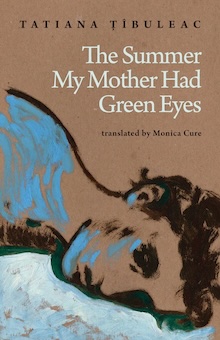
Deep Vellum, January 2026
Marcel Proust, while famously reflecting on a madeleine dipped in tea, wrote in Swann’s Way that attempting to recapture the past “is a labour in vain” because “the truth lies not in the cup but in myself.” Unlike Proust, who remembers his mother with an obsessive fondness, Aleksy, the narrator of Tatiana Țîbuleac’s brief novel, The Summer My Mother Had Green Eyes, grapples not with a lost beloved mother but with an intense childhood hatred of her.
Aleksy hates his mother, but he also can’t do without her. He has long used painting and objects to keep his dead mother present, saying “Mum’s turban watches me,” he says. “I keep all her dresses—folded on top of each other—like a condensed summer.” These objects sustain him until he becomes unable to paint, and his psychiatrist instructs him to write as a way of deciphering the mother he did not love until she was almost gone.
Originally written in Romanian and translated into English by Monica Cure, the book begins with eighteen-year-old Aleksy being sprung from reform school by his mother. “That morning,” he says, “when I hated her more than ever, Mum turned thirty-nine. She was short and fat, stupid and ugly. She was the most useless mother who ever lived.” Why does Aleksy despise her with such venom?
The narrator, thirty-something Aleksy, who is now a wealthy painter, tells his story with the cool detachment of Meursault in The Stranger. While summer in France might evoke images of Riviera beaches or Provençal markets, Aleksy’s memories are rooted in a mundane northern village filled with quirky characters like the shop owner Karim, who connives to sell Aleksy questionable sausage for a good price, but who is also reliable and large-hearted in times of need, something the troubled Aleksy is not used to experiencing.
At once judge, witness, and accused, Aleksy expresses a relentless chauvinism even as he works towards a fragile peace. Of his mother he callously says, “She had always been a second-rate daughter, wife, and mother”—while having no expectations of his father. He can be cruel, especially about women, making comparisons like “The rain—light and warm like punches from a girl—fell meaninglessly” or “interviews—that all resemble each other, like unloved women.” His belief that a pretty woman should not bother working as a cashier but let people pay to look at her breasts instead, is terrible. As the point of view shifts between that of a rage-filled adolescent and that of an emerging adult, his comparisons only become more off-putting.
Aleksy’s lack of empathy, especially for his mother, can be jarring, until he explains how abandoned he felt in the wake of his beloved sister Mika’s death. Țîbuleac’s skill is such that the revelation feels breathtaking, and annoyance is replaced by pity for this perpetually aggrieved man who was once such a needy, small boy, and who is still such a needy, small boy. If this novel is Aleksy’s attempt to compensate for being unable to understand his mother, it is also how he finds and forgives his lost self, how he grows beyond his trauma and his hatreds.
It is sometimes unclear who Aleksy is writing for: himself, his psychiatrist, or the reader whom he will occasionally address directly. While the insane artist trope at times feels like a stereotype, there are moments of genuine tenderness between Aleksy and his mother as he begins to fear her death. There are also deeper moments between Aleksy and his future wife, and between Aleksy and the townspeople, who increasingly care about him. As Aleksy is transformed, yet more tragedy awaits.
Țîbuleac pushes as far as she can in telling a story about a hateful character whose moments of revelation feel earned. Aleksy makes enough claims that may or may not be true that it is evident he is speaking from the stunted, hurt places of his worst moments. Surprised by how well his mother knows French, he reveals that, despite how much he may have pined for her affection and felt spurned by her as she navigated her own grief and mental illness, he has never really tried to know her. As she dies, Aleksy seems not to know his purpose if she is not there for him to hate. Eventually his point of view becomes more wry and less hateful. For example, at a church gathering he drily observes that the space was “full of women with chrysanthemums and men in tracksuits. The young priest, who knew the cost of things better than the old one, was on duty. All the attendees were invited to buy at least two candles and light them, and only after that did the mass begin.”
By the end, The Summer My Mother’s Eyes Were Green becomes more than just a story of a troubled boy whose parents did not meet his needs. It is, rather, the story of an immigrant family struggling to exist among people who reject them, like the neighbors in London who spit on Aleksy’s grandmother’s door. Aleksy’s mother reflects: “If Mika had lived, we wouldn’t have ended up here,” But where else might they have been? Shortly after Mika’s demise, although Aleksy insists he no longer expects or wants anything, he seems to want something, which finally materializes when he meets his future wife and begins to paint while institutionalized. The occasionally trite, one-line chapters about his mother’s eyes loop together at the end, as if Aleksy is sewing up his wounds and has found his purpose at last.
“Don’t write, Aleksy, please,” his wife admonishes him. “Colours can be forgotten—words can’t.” Even so, he persists in trying to “rewind that summer like a recording,” wanting “to unhate [his mother] and tell her that she has beautiful eyes before she asked me.” Since he cannot rewind, he acquiesces, saying that she looked like a “houseplant that has been taken out to the balcony.” Whereas, he confesses, “I looked like a lobotomised criminal. We were, finally, a family.” Any attempt to relive or change the past might be impossible, as Aleksy learns, but Țîbuleac’s novel shows that the effort of healing from it is not.
+++
Tatiana Țîbuleac is the Moldovan-Romanian author of a story collection, Modern Fables, as well as two novels: The Summer My Mother Had Green Eyes and The Glass Garden, winner of the 2019 European Union Prize for Literature. She was born in Chișinǎu, Moldova, where she began her career as a journalist, working in print and television. Her books have been translated into seventeen languages. She lives in Paris.
+
Monica Cure is a Romanian-American writer, translator, and dialogue specialist, as well as a two-time Fulbright grant award winner. Her poetry and translations have been published in journals internationally, and she’s the author of the book Picturing the Postcard: A New Media Crisis at the Turn of the Century. Her translation of The Censor’s Notebook by Liliana Corobca won the 2023 Oxford-Weidenfeld Translation Prize. She lives in Bucharest.
+
Margaret Monteith earned a BA from USC, an MFA from Brooklyn College, and a Masters degree from Columbia University. She has been awarded support from the NEH as well as several residencies, including the Kenyon Review Writing Retreat, the Cuttyhunk Island Residency, and at the Wassaic Project. Her writing has appeared in McSweeney’s, BOMB, Fugue, Evergreen Review, Gargoyle, and elsewhere. Her short story, “Borders,” was selected for the podcast series Fiction for Driving Across America, and her flash fiction piece, “Green,” was included in Microchondria II: 42 More Short Short Stories Collected by Harvard Book Store.