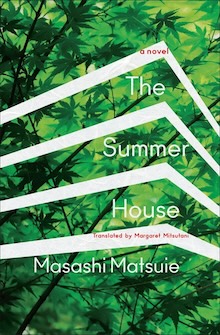
Other Press, June 2025
In The Summer House, Masashi Matsuie depicts a young architect’s coming-of-age. The novel follows Tōru Sakanishi at his first job out of architecture school, as he joins a Tokyo-based firm, Murai Office, on their annual summer retreat to a mountain town. While at the Summer House, the team enters a highly-selective competition to construct a public library. Tōru’s months on this project and at the Summer House expedite his development as he is led to reckon with the architect’s role in the communities for whom he works.
Tōru’s youth is striking. At the Summer House, Tōru learns everything from how to stumble through a crush to how to structure a workday. Importantly, Tōru’s innocence contains hints of arrogance. During the early summer, he wonders “what exactly the difference [is] between an architect and a painter.” Both are artists, he reasons, but unlike painters, “who can paint without being asked to,” architects can only design buildings on their own. They cannot perform what he believes to be the job’s most essential part — construction — without the help of others.
While the point that a structure cannot be built by a single person is inarguable, Tōru’s assumption, that the architect and painter share artistry, puts him at odds with his boss, Sensei, who holds a very different view. An accomplished architect who studied under Frank Lloyd Wright, Sensei quietly guides Toru, and this guidance becomes central to Tōru’s growth.
Sensei repeatedly reminds his younger employees that “architecture isn’t art at all. It’s function.” This fundamental belief underpins Sensei’s humility and eventually comes into Tōru’s development as well. Under this mentorship, Tōru appears to realize his role in a larger group, whether that group is the present one, at the office, or some unknown future group of people who might study or live in one of Tōru’s own architectural projects. The purpose of architecture, he learns, is not to indulge the artistic pursuits of the architect, but to design an edifice that can perform its function for its intended audience.
When Tōru joins the small group of coworkers at the Summer House, the group’s members range from middle-aged men to Sensei’s niece, Mariko, who is around Tōru’s age. They cook together and tend to the house in shifts, forming a unit into which Tōru eventually fits. Each character is three-dimensional and knowable, and their relationships to one another are essential to the success of their work. The believability of the characters breeds fascinating dialogues on wide-ranging issues, each of which feels like a tiny gift to the reader.
The culture of Japan is undeniably present, though at times key elements are so subtle as to feel elusive. The story is set in the early 1980s, with the horror of World War II lurking in the memories of older Japanese people. The contest that the office enters specifically requires that the library will contain only books published after the war, and the design implications of that stipulation are immediately understood by the applicants.
For those readers unsure of how to understand the war’s effects on Japan in the eighties, Harue Nomiya, a client of the firm who is also a novelist, offers insight. She explains to Tōru that, from her vantage point, “the war could have been stopped much sooner but [her people] kept on fighting even after [they]’d been bombed to ruin.” “That failure,” she tells him, “came from turning against cool, rational thought.” Sensei never offers his perspective, but for Nomiya, at least, stubbornness and sentimentality brought unneeded ruin. In the aftermath of such pain, a deep-seated reverence for humility seems like a natural, if not obvious, response.
The Summer House is a subtle text, but Matsuie keeps the story moving, producing a plot-driven novel, complete with love triangles, competition, and a hate-able rival architecture firm. Yet for all the excitement of its plot, the characters’ development is paramount and artfully done. In appreciating this success, credit must also go to Margaret Mitsutani, whose translation preserves the cultural implications of characters’ discussions with one another and the internal dialogue of Tōru. The reader is immensely rewarded for the effort taken to understand these nuances as he is led to wonder whether Tōru’s dilemma—that the architect’s plans often goes unbuilt—holds any relevance at all, or if the architect should instead be judged solely on the integrity of his intended design.
+++
Masashi Matsuie began his literary career as a fiction editor for the Shinchosha Publishing Company, where he worked with writers such as Yoko Ogawa, Banana Yoshimoto, and Haruki Murakami and launched Shincho Crest Books, an imprint specializing in translations of foreign works. His debut novel, The Summer House, received the Yomiuri Prize for Literature, an award that normally goes to seasoned authors who are well along in their careers.
+
Margaret Mitsutani is a translator of Yoko Tawada and Japan’s 1994 Nobel Prize laureate Kenzaburō Ōe. She was a finalist for the National Book Award for her translation of Yoko Tawada’s Scattered All Over the Earth and winner of the National Book Award for her translation of Yoko Tawada’s The Emissary.
+
Mia Carroll is an engineer and writer. She lives in Manhattan with her husband.