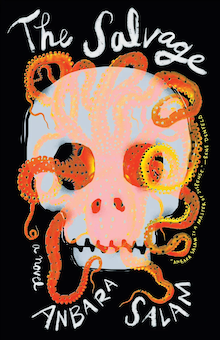
Tin House, October 2025
In 1962, temperatures plummeted across the United Kingdom, ushering in one of the country’s coldest winters in nearly two hundred years. Rivers froze. Some places were buried in more than twenty feet of snow. The extreme cold persisted for months, a period that came to be known as the Big Freeze. Anbara Salam’s The Salvage—a novel that’s equal parts historical fiction, gothic thriller, and haunted whodunnit—is set within this icy winter.
Steering the novel is Marta Khoury, a marine archaeologist who travels to Cairnoch, a small island off the eastern coast of Scotland, to salvage a Victorian-era shipwreck that has been towed from Arctic waters at the request of the ship captain’s wealthy descendants. Though Marta is hired to find artifacts and Captain Purdie’s remains, she arrives on Cairnoch seeking escape too: from her husband-slash-boss, Alex, and from marital problems caused in part by her affair with one of the island’s now-deceased residents, Lewis.
Unfortunately, Marta finds little reprieve within the insular community. She feels like an outsider from the start—not unlike how she describes feeling throughout her childhood in brief flashbacks. On Marta’s first dive down to the shipwreck, the past continues to haunt, in the form of surprisingly well-preserved relics, and in the shadowy figure that Marta swears is a literal ghost. What follows is a series of strange occurrences, beginning with the disappearance of several valuable artifacts and the island’s imminent freeze.
Throughout The Salvage, the past resurfaces in many ways. Alongside the Big Freeze, historical moments like the Cuban Missile Crisis bear on Marta’s story. Other episodes of historical violence—from, for instance, the colonialist whaling industry—haunt the novel’s pages in found artifacts, such as the entries from the captain’s log that precede each section:
LATITUDE 81°, LONGITUDE -65°1’.
Ice set fast around ship. Fired the engines day and night for four days but no movement. Ordered rudder and…raised. Enough provisions for a year with tinned stores and hard biscuit pemmican. Interrupted insubordinate discushions in the saloon, men whisper we should have turned back at 72° and not proceeded through the straits in search of further recruits […]
Much of the haunting, however, is confined to the personal, in the form of Marta’s ghosts. As the novel’s narrator, Marta makes her insecurities evident. She suffers from fears of inadequacy as well as the constant worry that her messy past makes her present self unworthy of good fortune and healthy relationships. Her prolonged stay on the often-isolating island of Cairnoch only multiplies her anxieties—and as the freezing winter ramps up, so too does the mystery of the missing artifacts, as well as the mystery of what Marta is searching for personally.
As the sea surrounding Cairnoch undergoes a state change, from liquid to solid, Marta ironically experiences the inverse. The morally-gray protagonist’s thawing is largely thanks to Elsie, an island local whom Marta befriends and with whom she later enters into sexual and romantic relations. Interestingly, the novel’s historical setting has little bearing on the queer relationship that develops, as neither character especially fears their relationship’s discovery by the extremely religious islanders. Many of Marta’s stressors—particularly as a bisexual woman of color among an otherwise homogenous Scottish population—remain interior. Perhaps because the novel takes place on a small island, Marta’s emotional isolation is all the more evocative. As Cairnoch becomes ever more suffocated and wind-whipped, so too does Marta.
In the latter half of the novel, Marta’s emotional journey coincides with a geographical excursion inland as she searches for the missing artifacts away from the dark sea and icy shore. Even before this trek, though, the spaces Marta occupies are temporary containers, liminal places of transit: the ferry she arrives on, as well as the ferry that never departs; the hotel where Elsie works and where Marta finds temporary residence; the sunken ship where whalers lived, died, and remained up until Marta’s excavation. As the novel’s climax approaches—a ship rounding over the horizon—the question of whether or not Marta is able to step outside of the containers she creates for herself, and for others in her wake, takes precedence.
Marta eventually realizes that it is impossible to stop digging up the past without first choosing to dive into the present. Her recognition underscores key questions raised throughout the novel: What is preserved? What do people choose to safeguard? What solidifies, and what rigid structures desperately need to thaw? When does preservation go too far? What if it comes at the cost of something or someone else? The Salvage insists that preservation requires more than favorable physical conditions; there must also be a desire to preserve. Just as a Victorian-era ship does not sail to Cairnoch without the capitalistic Purdies willing it so, and an extremely religious social order does not persist without pews upon pews of followers, a congregation on their knees, a Cairnoch islander does not jump into a queer relationship without first deciding to eschew heteronormative constructions and prescribed social roles.
+++
Half-Palestinian and half-Scottish, Anbara Salam grew up in London. She is the author of Hazardous Spirits, Belladonna, and Things Bright and Beautiful. She has a Ph.D. in theology and lives in Oxford, England.
+
Court Ludwick is the author of These Strange Bodies and the founding editor-in-chief of Broken Antler. Her writing has been nominated for Best of the Net, the Pushcart Prize, and Best Microfiction, and can be found in EPOCH, Washington Square Review, Denver Quarterly, Hawaii Pacific Review, Oxford Magazine, Potomac Review, and elsewhere. Court’s visual work has shown at the Louise Hopkins Underwood Center for the Arts, and appears in publications like diode, Harpy Hybrid Review, and body fluids. She is the recipient of a Sioux Falls Arts Council Artist Grant and has taught workshops on hybrid writing and experimental form, most recently for The Dakota Writing Project and Vermillion Literacy Project. Court holds an MA from Texas Tech University and is a Ph.D. student at the University of South Dakota. She is currently based in Minneapolis, where she is working on a novel, a poetry collection, and ongoing experiments in new media.