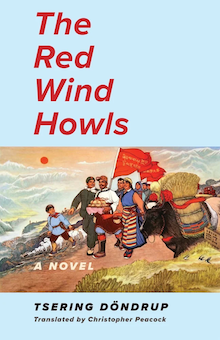
Columbia University Press, May 2025
In 1958, the diverse population of Amdo—one of the three Tibetan regions, spanning modern-day Qinghai, Gansu, and Sichuan, and home to Tibetans, Han Chinese, Hui Muslims, and Mongols——rose up against the Chinese Communist Party in response to the party’s attempt at collectivization. The Red Wind Howls tells of the rebellion’s aftermath, during which Tibetans suffered hunger, violence, and mass imprisonment. In his transportive novel, Tsering Döndrup beautifully depicts this terrible moment in history and suggests that in the face of even the worst oppression, the greatest suffering comes from the disillusionment of discovering that one’s own beliefs and community are corruptible.
The novel is split in half, with the first part taking place in a Communist labor camp and the second in the newly occupied region of Amdo. In the first half, Alak Drong, believed to be the reincarnate lama, is among the most powerful men in Amdo. When he is offered the chance to elevate his fellow prisoners, making them prison guards in exchange for their devotion, Alak Drong immediately sells out. His choice would be disturbing, were it not for Döndrup’s comedic artistry, which instead creates a funny character whom the reader not only forgives but sometimes even roots for.
Döndrop’s depiction of the pain that the prisoners endure is one of the book’s most compelling features. Rather than being indulgent or unnecessarily gory, these descriptions pull readers into a convincingly bleak world in which the prisoners cry out for “the Lord of Death” to put a speedy end to their misery, “to come as quickly as possible.” In one such passage, Döndrup writes of a terrible hunger that “torment[s] them for weeks and months […] After several days of diarrhea [comes] a horrible ringing in the ears,” followed by additional miseries until “you lay in a state between sleep and consciousness, between living and dying, for a day or two, or three of four, or five or six.”
Döndrop emphasizes that the greatest suffering in the camps comes not from physical pain, though it is immense, but instead from the psychological toll of the “study sessions, or political inquisitions,” sessions that end by “crushing a person’s body and spirit even more thoroughly than hard labor.” It is at these times that the prisoners are “forced to denounce each other,” even if they are members of the same family. Out of these sessions come the greatest betrayals, ones that lead young, previously faithful Tibetan Buddhists to grow increasingly despondent, sapping them of their will to live.
The second part of the novel follows Lozang Gyatso outside the camp, in his occupied homeland, as he tries to remain faithful to his Buddhist convictions. Lozang Tsültrim, Gyatso’s cousin and a close companion of Alak Drong, spends his time tormenting Buddhists who continue to adhere to their faith.
Lozang Tsültrim lusts after the woman who develops a close partnership with his cousin, Lozang Gyatso. The conflict fuels Lozang Tsültrim’s petty ire toward the latter. As a result of both Lozang Tsültrim’s close relationship with the Chinese leaders in Amdo as well as Lozang Gyatso’s commitment to his faith, Lozang Gyatso suffers immensely after the uprising. His pain mirrors that of the prisoners as he works in harsh conditions with little food or shelter. Just like his prison counterparts, however, the physical hardships pale in comparison to his eventual realization of the injustice around him. Lozano Gyatso remains faithful to Buddhist teachings throughout his days of labor and starvation. His steadfastness falters only when he sees his cousin and Alak Drong reinstalled as leaders of his region. Then he must reckon with the betrayals he’s endured.
In China, discussion of the Amdo uprising is highly restricted, and Döndrup has paid for his honesty. Though he published the book himself, the Chinese government eventually discovered it, and the author has been strictly monitored ever since.
The novel’s incredibly complex, rarely-told historical context would be lost on the average reader outside of Tibet, but Christopher Peacock, the text’s translator, offers a robust thirty-page introduction which explains the intricacies of the backdrop. Peacock’s assistance is needed not only for this history, but also for his clear translation. Each half of the novel unfolds as if in one breath, interrupted by neither chapters nor page breaks, making for a unique read that requires deep concentration on the reader’s part. The tale is not told chronologically, and single events prompt wandering reflections on other moments that have already been recounted, deepening their significance.
Peacock’s careful translation prevents this challenging read from being a frustrating one while capturing both its dark humor and its honest portrayals of the sufferings of the people of Amdo. As the tale unfolds, the reader understands the suffering that the Tibetan people endured at the hands of not only their occupiers but also one another. With richly drawn characters and compelling storytelling, The Red Wind Howls immerses readers in an important and often overlooked moment of Tibetan history.
+++
One of modern Tibet’s most celebrated writers, Tsering Döndrup is the author of several novels and collections of short fiction. His work has been translated into numerous languages, and he is the recipient of several literary awards. He self-published The Red Wind Howls in 2006 because no publisher would risk accepting it. When the authorities caught on, all copies were confiscated and the author faced severe reprisals, which continue to this day.
+
Christopher Peacock is assistant professor of East Asian studies at Dickinson College. Among his translations are Tsering Döndrup’s The Handsome Monk and Other Stories (2019) and Tsering Yangkyi’s Flowers of Lhasa (2022).
+
Mia Carroll is an engineer and writer. She lives in Manhattan with her husband.