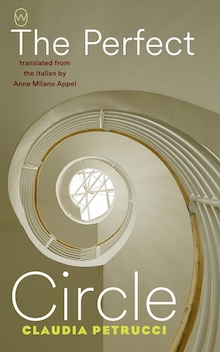
World Editions, April 2026
Having neither a beginning nor an end, a perfect circle is continuous—a loop made of points equidistant from a fixed center. How fitting, then, that Claudia Petrucci’s The Perfect Circle, translated from the Italian by Anne Milano Appel, resists a singular beginning.
Instead of starting from a single point in time, the novel cycles between two timelines that orbit the same center. In one, the narrative moves counterclockwise, tracing the fatal fall of twenty-one-year-old Lidia Castelli in 1986 before rewinding through the events preceding her death—such as the construction of the round house she dies within, as well as her affair with the project’s married architect, Dario Sartorio. The other timeline looks ahead to a near-future, in a dystopian Italy shrouded in literal and metaphorical fog, where a forty-something real estate broker named Irene Sartorio sells foreclosed properties to wealthy clients amid climate catastrophe.
At the novel’s center is 7 Via Saterna, a house that’s “square on the outside and circular on the inside” which Irene is asked to inventory and sell decades after her father (unbeknownst to her) designs and constructs it for Lidia. This ambitious project, as Petrucci’s narrator describes, was “based on that deception, on the assurance of a certain presumption […] and the subsequent unmasking of preconception, the crumbling of logical deduction.”
Such “crumblings” abound throughout the novel. Of these, perhaps the most visible might be the collapse of its two alternating timelines. In the “milky impenetrability” of a future Milan, the past does not stay buried; rather, when Irene arrives at 7 Via Saterna, she discovers Lidia, a squatter on the property whose appearance uncannily matches that of the young woman described in the sections unraveling across the mid-1980s. Irene asks, “How did you get in?” The stranger replies, “From the back. I have the key.” But might Lidia mean that she comes in from the past as well?
Petrucci’s language is frequently directional: “specters mov[e] quickly in all directions,” Lidia is often described as emerging or moving “to the left.” Irene follows, “as if Lidia were ferrying her into a dream.” These recurring, descriptive moves that cause the past to feel increasingly present.
If a circle possesses a center from which every point is equidistant, then Lidia and Irene initially occupy positions on opposite sides of that center, mirroring one another across time as their characters move through the same (albeit changed) space. As the novel’s separate temporalities begin to crumble, however, Lidia and Irene exist less on parallel lines and more on converging ones. In this way, Petrucci seems to set the circle of time upright, allowing it to roll like a hoop whose highest and lowest points continuously exchange places—and, when viewed from above, whose opposite points appear as one, as bookends of a diameter speared through (and connecting) both.
The house at 7 Via Saterna is particularly charged. Beyond being marked by Lidia’s death and the past’s lingering presence, the house comes to represent a failed domestic ideal—a tragic repository riddled through with loss and absence—as Dario’s ambitious construction, conceived as an expression of love, instead memorializes a disastrous extramarital affair. In Petrucci’s hands, the house undergoes a symbolic inversion, shifting from a place of permanence and stability to one characterized by alienation and loss.
This inversion nods toward ecological precarity as the erosion of the domestic mirrors the erosion of the natural world and its similarly collapsing foundations. In Irene’s timeline, the house acquires yet another meaning, as a commodity to be catalogued, auctioned, and preserved solely for a select few. As Irene’s father, Dario, insists while critiquing her “salvage dealer” occupation: “The properties you sell to the highest bidder don’t belong to individuals, but to history, to the past, to a past that is also yours. Houses are not objects, they’ve been homes.” The question of the home becomes a question of habitability. What of the larger “home” that humans inhabit? What of the planet itself, a home equally vulnerable to neglect and exploitation and eventual and potentially irreversible collapse?
Unfolding alongside the planet’s ecological hemorrhaging are other deaths as well as potential births. Lidia’s death is juxtaposed with Irene’s movement toward motherhood. In one intimate scene, the two characters occupy positions evocative of mother and child:
Irene pulls her close, pressing a hand on her head. The girl responds by sliding her mouth to the nipple; taking it between her lips she begins to suck gently […] innocently, under Irene’s petrified gaze, until she’s satisfied, then remains still with her face on her breast. As if she had performed the most natural act in the world, she falls asleep there.
Elsewhere, the novel repeatedly (and sometimes playfully) tugs on the division between endings and beginnings. One paradox that emerges is the mathematical construction invoked by the novel’s title itself, for perfect circles do not exist in the physical world. They exist only where abstraction allows for a recognition of patterns that reality can only approximate, in mathematics, in language, in literature—as in Petrucci’s The Perfect Circle.
+++
Claudia Petrucci studied Modern Letters in Milan before moving to Perth, Australia. Her reportages and short stories—which range from realistic to experimental to science fiction—have been published in Cadillac, minima&moralia, and elsewhere. Her debut novel, The Performance, also published by World Editions, was shortlisted for the John Fante Award and won the prestigious Premio Flaiano Giovani in Italy.
+
Anne Milano Appel, based in California, has translated works by a number of leading Italian authors for a variety of publishers in the US and UK. Among her recent translations are works by Antonio Scurati, Claudio Magris, and Paolo Maurensig. Her awards include the Italian Prose in Translation Award, the John Florio Prize for Italian Translation, and the Northern California Book Award for Translation.
+
A multimedia artist currently based in Minneapolis, Court Ludwick is the author of These Strange Bodies (ELJ Editions, 2024). Her writing has been nominated for Best of the Net, the Pushcart Prize, and Best Microfiction, and can be found in Washington Square Review, EPOCH, Denver Quarterly, Permafrost Magazine, and elsewhere. Her visual and html work has been supported by the Louise Hopkins Underwood Center for the Arts and the Sioux Falls Arts Council, and has appeared in publications like Reed Magazine, diode, and Quarterly West. She has taught workshops on hybrid writing and experimental form, most recently for The Loft Literary Center, the Dakota Writing Project, and as a guest lecturer at Rhode Island College. Court currently teaches at Augsburg University, where she is working on a novel and ongoing experiments in new media.