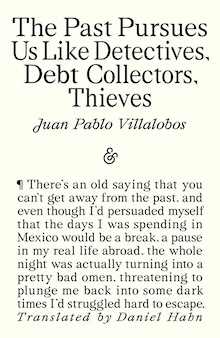
And Other Stories, July 2026
In migration tales, a distinction prevails between those called “immigrants” and others known as “expats.” The latter are usually white and rich, or at least, richer than immigrants. Implicit in their privilege is the fact that desire, not need, has compelled them to leave their home countries. They can also choose to travel between their adopted countries and home—and they can return. Part autofiction and part whodunnit, The Past Pursues Us Like Detectives, Debt Collectors, Thieves suggests the impossibility of returning to the past, of returning home, while expecting to find the place, and oneself, unchanged.
JP, the novel’s narrator, is more of an expat than a migrant. As the novel opens, JP has returned home to the provincial town of Lagos, Mexico to visit his family and help care for his mother, who needs an expensive medical procedure. In JP’s mind, the trip is merely “a break, a pause in my real life abroad.” But when he accepts an invitation to have a drink with his childhood “frenemy” Everardo, his plans unravel. JP punches Everardo in the face. When Everardo turns up dead the next morning, JP is the obvious suspect.
Attempting to avoid blame for Everardo’s death, JP makes choices that suggest he is guilty and increasingly unstable. While the police are looking for him, he leaves the city with his mother, only to find himself unable to pay for her medical treatment because his account has been mysteriously emptied. Yet his acquaintances keep asking him for money. They also keep giving him white pills, sometimes claiming they’re to calm his nerves, other times saying they’ll energize him. Photographs of these pills and of a bullet casing appear throughout the text. All this makes for a humorous take on the classic whodunnit.
Whether he is guilty of Everardo’s death or not, guilt over having moved abroad haunts JP throughout the novel. His adopted country remains unnamed. (For those looking for traces of autofiction, the author, who shares the initials of his narrator, lives in Spain.) He becomes annoyed when people repeatedly accuse him of misunderstanding Mexico because he no longer lives there; defensively he replies that he still follows the local news. “I knew more,” he insists, “about the disputes between the cartels for control of the town than people who still lived here, who preferred not to know, not to look into it, so they could go about their lives without being constantly terrified.” Among those who still live there is JP’s family: his parents and the four siblings who care for them in an old house with an unreliable water supply. Is JP’s defensiveness a manifestation of the guilt he feels for leaving? Is his offer to pay the family’s medical bills an act of atonement?
What is clear is that JP is struggling to square his memories of Lagos—the Lagos of the past—with his present experience. He admits this sometimes, though only to himself. “However much it went on describing itself as a small town,” he thinks, “and however much in my head, in my memory, that’s what it always was […] there was almost nothing left now of the little peaceful provincial town I’d grown up in.” He seems almost offended by the new bars that have opened on the waterfront serving expensive “craft beers and chicken wings.” Even his argument with Everardo stems from conflicting versions of a story from their past. “How’re you gonna remember if you’ve been away so long?” Everardo asks, moments before JP lands his blow.
As much as JP is haunted by his past, though, the novel makes little room for melancholy. Villalobos constantly flexes his knack for dark humor. At one point, JP’s aunt picks up a bullet casing from the ground and laments that she doesn’t “understand where this place is headed these days.” JP thinks that, “Considering that piece of evidence, its indisputable materiality, there was only one place, if we were just being logical: the cemetery.” Daniel Hahn’s translation retains the casual and self-effacing humor of the narrator’s Spanish. After referring twice to “old sayings,” JP realizes that “once you’ve got two sayings in a row, well, then you’re on your way to having a whole system of prejudices, so probably best for me to stick to the facts.”
The facts unfold over two hundred and forty pages. Villalobos is stretching himself beyond the novella-length works that earned him early accolades. His widely acclaimed first novel, Down the Rabbit Hole (2011), shortlisted for the Guardian First Book Award, was only ninety-eight pages long. While this stretch is welcome, there’s a hint of the author’s discomfort in sustaining such a long narrative. The conclusion arrives a little too abruptly, a little too easily, leaving some central mysteries unresolved. The result is an uncertainty about whether the stakes were ever that high for JP, and whether he has earned the insight he claims at the end.
All of which is fair and, arguably, intentional. Villalobos seems more interested in subverting the conventions of crime and autofiction to build the novel’s arguments. That the novel makes only a half-hearted attempt at resolving the murder case mirrors the Lagos police department’s inefficiency. The near total absence of JP’s wife and children from the pages of the novel, and his refusal to name the country where he lives, illustrate how strictly he experiences the bifurcation between his past life in Mexico and his present one as an expatriate. And the increasingly absurd plot conveys JP’s disorientation; after every twist and turn, he seems to arrive at the same place.
+++
Juan Pablo Villalobos was born in Mexico in 1973. He’s the author of the novels Down the Rabbit Hole, Quesadillas, I’ll Sell You a Dog, I Don’t Expect Anyone to Believe Me and The Invasion of the Spirit People, and of the non-fiction book The Other Side: Stories of Central American Teen Who Dream of Crossing the Border. His books have been translated into more than 15 languages. Down the Rabbit Hole and I Don’t Expect Anyone to Believe Me were adapted for film and premiered on Netflix. He lives in Barcelona, where he teaches writing.
+
Daniel Hahn lives in the UK and translates from Portuguese, Spanish and French. His translations have won the Independent Foreign Fiction Prize and the International Dublin Literary Award and been shortlisted for the Booker International Prize.
+
Krista Timeus Cerezo is a Guatemalan literary critic and fiction writer whose work has appeared in AGNI, Puerto del Sol, Words Without Borders, World Literature Today, and elsewhere. She splits her time between Guatemala City and Barcelona. She holds a PhD in Public Policy from the Hertie School in Berlin and an MFA from NYU.