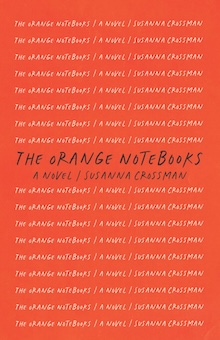
Assembly Press, September 2025
If grief has a color, it just might be beige. Or blue. Or black. Or white. Or perhaps grief, like color, resists the singular. Unstable and splintering, grief shifts: at times saturated and entirely too present; at other times the exact opposite, a washed-out absence.
Susanna Crossman’s novel, The Orange Notebooks, is a compelling study of grief’s many colors. After the death of her six-year-old son, Crossman’s narrator becomes consumed by beige. A “bland stifling of everything,” Anna deems beige the color of desaturation, of lack, of that which remains after a life has been sapped away. And yet, something else (something orange?) surfaces across the stack of notebooks Anna keeps during her four-month stay at a French psychiatric hospital. In flickers of memory, there is a residual warmth. And in that which surrounds absence—as grief’s image is one created by relief—is a reminder of the life (and love) preceding loss.
Where Crossman’s novel truly begins, however, is in the front matter. In a “Draft Archive Note,” which functions as a Pale Fire-esque framing device, Anna’s psychiatrist comments on “former patient No. 123A78” and briefly situates “the enclosed” notebooks and accompanying letter—the epistolary, elegiac story to come. After that, Anna’s fragmentary and recursive voice takes over; in the following twelve sections (as many as there are colors on the basic color wheel), Crossman paints grief and love in undulating shades of orange and blue.
Similarly fractured in structure, the novel slips between different time slices: Anna’s childhood; her university years; work experiences first aboard a ferry and later as a language teacher in the classroom; her memories as a mother, of her son Lou. As Anna sifts through her past, she remains simultaneously unmoored from the present, troubled by the future, and resistant to the inevitable forward rush of time.
At the center of such resistance is Anna’s desire to “undo” Lou’s death. In his absence, Anna struggles to navigate an “upside-down world.” As Anna is tossed on grief’s ever-rolling sea, amidst “wave after wave of beige,” a lifeline appears: the titular orange notebooks. With them, the grieving mother seeks to “assemble Lou” by stitching “every memory, recollection” back together, by ordering that which feels disordered. Often, Anna writes as though language might be able to resurrect her son. This is but one of many heartbreaks painted by Crossman—a mother’s desperate attempts “to write you [her dead child] into being.”
In this way, Crossman’s narrator unspools but also knits together. Didion-like lists frequent The Orange Notebooks’ pages, constructing meaning through accumulation. In an early fragment, Anna catalogues the items in Lou’s bedroom: “A cocoon of fuzz: three stars from his godfather Miguel. A teddy. Two unicorns. Beside me is Lala, a small fluorescent pink rabbit […] White stuffing leaks from a rip. Absentmindedly, I tug at this hole.” Although Anna’s lists are altogether elegiac, each is particular in its effect. The above, for instance, enacts a desire for relocation as Anna imagines herself folded away into a softer space. A longing to return to innocence briefly surfaces as Anna occupies a child’s place, buried among plush toys and artifacts of a childhood.
Alongside her son, Anna mourns other, smaller losses that, when stacked, become unwieldy and insurmountable. The death of Princess Diana—on a date coinciding with the day Anna meets Antton, one of her great loves, as well as Lou’s father—situates personal grief amid collective loss. The timing of Anna and Antton’s meeting, too, complicates clear-cut notions of “beginnings” and “ends”—two temporal bookends that Anna frequently tries to locate and catalog in the orange notebooks, in her wide-ranging attempts to navigate away from grief’s beige, quicksand middle. Nonhuman losses also abound. She worries about pollinators—“I wondered what humanity would do without the bees?” —and the limits of language: “Why are there names for someone who loses a spouse, or a parent, but no name for a parent who has lost a child?”
“The bees” are one refrain, a constant hum. Acting as both metaphor and contrast, the bees swarm alongside Anna’s interior fragmentation and detachment, her feeling of being “outside and not with-the-world.” Bees refuse to work at night; Anna writes through the dark. Most bees live alone; Anna’s grief feels comparably isolating. And in a strictly solitary species, whereas a mother bee lives and “dies without ever having contact with […] her offspring,” Anna refuses “to abandon her child [a]lone in the underworld.” Quite literally, too—as Anna’s grief comes to a crest on a voyage with Yann, a fellow patient and boatman, as they sail to the deepest part of the Channel in an Orphic journey that unravels in the book’s last sections.
By the novel’s end, nothing is resolved (nor could it be). Rather, The Orange Notebooks attends to process, to grief’s movement. The channels Crossman traverses—nonhuman, mythic, philosophical, linguistic, and multi-colored—show grief as a plurality, as that which exists between. The novel’s ironic ending underscores the between-ness of it all. As the last sentence trails off in an ellipsis—nodding toward the ongoingness of grief, life, and time—I can’t help but return, like Anna, to the bees. See also: a child’s drawing, a lopsided, yellow-orange bee spiraling; a body drawn before its movement is tracked; and then a series of dashes that might also be a series of absences; and a looping path shifting up and down and around the page.
+++
Susanna Crossman is an essayist and award-winning fiction writer. Her acclaimed memoir, Home is Where We Start: Growing Up In The Fallout of The Utopian Dream, was published by Fig Tree, Penguin, in 2024. She has recent work in Aeon, The Guardian, Paris Review, Vogue, and more. A published novelist in France, she regularly collaborates with artists. When she’s not writing, she works on three continents as a lecturer and clinical arts-therapist. Born in the UK, Susanna Crossman grew up in an international commune and now lives in France with her partner and three daughters.
+
Court Ludwick is the author of These Strange Bodies and the founding editor-in-chief of Broken Antler. Her writing has been nominated for Best of the Net, the Pushcart Prize, and Best Microfiction, and can be found in EPOCH, Washington Square Review, Denver Quarterly, Hawaii Pacific Review, Oxford Magazine, Potomac Review, and elsewhere. Court’s visual work has shown at the Louise Hopkins Underwood Center for the Arts, and appears in publications like diode, Harpy Hybrid Review, and body fluids. She is the recipient of a Sioux Falls Arts Council Artist Grant and has taught workshops on hybrid writing and experimental form, most recently for The Dakota Writing Project and Vermillion Literacy Project. Court holds an MA from Texas Tech University and is a Ph.D. student at the University of South Dakota. She is currently based in Minneapolis, where she is working on a novel, a poetry collection, and ongoing experiments in new media.