Scribe, July 2025
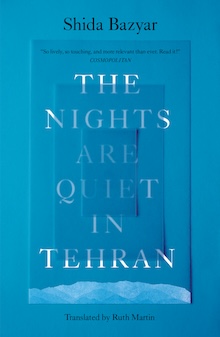
In this era of bite-sized attention spans, certain novels remind you that it’s worth appreciating, from time to time, the distinctive power of the form. Along with the television series, where writers have resources to probe extended storylines and complex characters, the novel is well suited to negotiating our stickiest quandaries. The Nights are Quiet in Tehran, by German-Iranian author Shida Bazyar and translated by Ruth Martin, is just this sort of novel, eschewing easy answers in favor of exploring questions—in this case, at the intersection of the personal and the political.
The story starts in 1979, in the thick of the Iranian Revolution. American-backed Shah Reza Pahlavi has been ousted, creating a power vacuum in which the exiled Ayatollah’s hardline Islamic movement is gaining strength. Behzad, an idealistic student, throws himself into the communist movement, charging ahead even when he does not know what he doesn’t know. Bazyar captures the contours of his youthful confidence, at once earnest and arrogant. “What actually happens after a revolution?” Behzad wonders. “I could ask, though we’ve answered that question too many times already for the question to be asked: class struggle, radical change in the institutions, a dictatorship of the proletariat.” Amid the rabble-rousing, Behzad falls for a female comrade, the intelligent Nahid, whose values align with his.
The timeline shifts to 1989, and the narrative torch then passes to Nahid, to whom Behzad is now married. Her revolutionary spirit has been dampened by having lived for many years in West Germany. Exile, she says, “seems like a frozen state, in which I am supposed to try to move about just the same.” Friendship with other Iranians is unlikely when they support the Shah she loathed. Where Behzad’s perspective opens a window on the dangers of regime change, Nahid’s begins to answer the question Behzad was too afraid to raise out loud: After revolution, what comes next?
For Iranians back home, the answer is the iron rule of religious clerics. In Nahid’s case, it means a lonely life in the decadent West, a place her family had once derided. Nahid’s reflections—carefully relayed by an author who is getting out of the way of both her characters and her audience—reveal the nuanced mystery of the life that Behzad thought he had all figured out. In one scene, Nahid, socializing with a German neighbor, notices the woman’s utilitarian appearance. “In Iran I could tell a person’s class instantly. In Germany, they all look like they belong to one big class,” she observes. “[N]o one here looks very rich or very poor, and actually all the groups here look very similar, in the way they dress, their habits.”
Her once-brilliant husband is now defanged, a beer-drinking Joe Schmoe. Attempting to discuss his children’s German storybooks, he becomes a blowhard know-it-all: “Erich Kästner, Bezhad explained, was a great opponent of the Nazis,” even though, as Nahid points out, “he doesn’t know any more” about the author “than this one sentence.” Later Nahid, observing Bezhad discussing Bertolt Brecht with their neighbors, shifts delicately between admiration and contempt. “They must be thinking Bezhad is the perfect Iranian version of them,” she muses. But she would “never have the nerve to speak about German writers” in front of them.
The next two parts, told through the eyes of her children, Laleh and Morad, advance the narrative while adding new details about Nahid and Bezhad. Laleh is encumbered by her foreign parents and bewildered by a trip to Iran, a place where she feels she might belong but in fact does not. Then there is Morad, “Mo,” caught between observing his fellow German students protesting for free tuition and young people on television, across the Middle East, agitating during the Arab Spring. On the phone with his sister, Mo wonders “what she would say if she knew that just the day before yesterday I googled exactly what the Islamic Revolution was.”
It’s a minor quibble, but Bazyar’s sleepy title, “The Nights are Quiet in Tehran,” doesn’t quite capture the essence of this sprawling novel, which pulsates with life and is jammed with ideas. Bazyar’s epic is a reminder that political events reverberate beyond the public sphere; these are also private matters, playing out in conversations in kitchens and bedrooms, and with neighbors over the grill.
+++
Born in 1988, Shida Bazyar studied writing in Hildesheim, and has worked in youth education for many years. Her first novel, Sisters in Arms, translated by Ruth Martin, was published in 2024. The Nights Are Quiet in Tehran won the Blogger Literary Award, Ulla Hahn Prize, and Uwe Johnson Prize, among others, and has been translated into Dutch, Farsi, French, and Turkish.
+
Ruth Martin studied English literature before gaining a Ph.D. in German. Since 2010, she has been translating fiction and nonfiction, including books by Joseph Roth, Hannah Arendt, Volker Weidermann, and Shida Bazyar. Formerly co-chair of the Society of Authors Translators Association, she has taught translation at the University of Kent and the Bristol Translates summer school.
+
Megan Peck Shub is a writer and producer who has won Emmy and Peabody awards for her work on “Last Week Tonight” with John Oliver on HBO. She has written and/or produced work for PBS, ESPN, New York Magazine, Story, The Independent, McSweeney’s Internet Tendency, The Missouri Review, and the Jewish Book Council, among others. She is based between New York and Seoul.