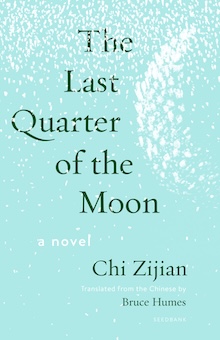
Milkweed Editions, January 2026
In Chi Zijian’s The Last Quarter of the Moon, the nameless narrator, an elder of the Evenki – nomadic reindeer herders in northeast China – recounts her ninety years of life. The loves and losses of her private world reflect outward changes as modernity, nation-building, and the extraction of local natural resources encroach upon her people.
The Last Quarter of the Moon debuted in 2005 and won the Mao Dun Literature Prize in 2008. The English translation by Bruce Humes was first published in 2013 and has just been reissued by Milkweed Editions. Published in numerous editions and translations into ten different languages, The Last Quarter of the Moon celebrates the folklore of the Evenki, their rich oral traditions, animistic beliefs, and shamanistic practices.
Like other indigenous groups of Siberia and the Far East, the Evenki are experiencing a gradual erosion of their folklore traditions. Zijian’s book contributes to the restoration of a culture that has eroded due to external geopolitical pressures and the encroachment of modernity. It also works to preserve the cultural traditions and history that remain, just as Shiban, the narrator’s great-grandson, aims to “render our Evenki language in a concrete written form and ensure that it could be passed on to future generations.”
As the narrator relays various dramas, tragedies and romances, she plots significant moments, large and small, on the timeline of her life. Historical events meanwhile anchor readers in a wider geopolitical context. First the Russians interact with the Evenki for trading purposes. In the early 1930s, the Japanese arrive, forcing Evenki men to train with their soldiers. Next come the Soviets. By the end of the elder’s tale, most of the Evenki have relocated into permanent settlements, and loggers have stationed themselves in the mountains, laying waste both to the land and to the Evenki’s traditional way of life: “Because of all the logging, trees have grown sparser in recent years, and there’s less and less game too […] the annual decline in edible moss means that we are forced to relocate more frequently with our reindeer.”
For the Evenki, cinders are kept burning for decades and passed down through the generations. The Evenki view the fire as an entity that is alive, and they likewise demonstrate deep reverence for its continuity, preserving embers as sacred links to the past and to one another. “The fire I watch over is as ancient as me,” the narrator says. “In the face of fierce winds, heavy snow, or torrential rain, I never let it die out. This fire is my beating heart.”
Traditions like passing on cinders make Evenki cultural traditions appear timeless; however, outside of their urirengs (clans), China is undergoing colossal changes. Amidst continuous change, the narrator is comforted by her people’s interdependence with and enormous respect for the natural world. Her granddaughter Irina says it best: “I’ve finally grasped the fact that the only things one never tires of are reindeer, trees, rivers, the moon, and the cool wind.” Nature both sustains the Evenki and humbles them through tragedy, like when the narrator loses her second husband, Valodya, to a bear attack, or when the reindeer herd falls victim to a deadly epidemic.
The elder’s life story is shaped by the supernatural as much as by love, grief and catastrophe. For her, life and death exist in the same moment, in the same breath. The narrator recalls attending both a wedding and a funeral in the same day, followed by a night so dark “you become the night’s darkness.” This orientation aligns with a tradition: whenever an Evenki shaman saves a dying person, another must die in his or her place. The narrator accordingly understands life as being ordinarily full of paradox, and in this way she is aligned, as a member of an ancient nomadic tribe, with matter-of-fact modern readers: “There are births and there are deaths, sorrows and joys, marriages and funerals, and there needn’t be so many taboos.”
For the Evenki, everything takes on metaphorical resonance shaped by natural phenomena. Because nature stands personified, its importance approaches that of human life. The narrator animates the inanimate and sees the spirit in all things, even in the practical: “The birch tree is a fine tailor who cuts clothes to suit herself,” she says, in reference to the way its transformation into objects of practical value, boxes, baskets, and canoes. Nature even takes on the aggression of men, as the river rises like “a courageous warrior,” and the trees are “vanquished soldiers.”
Above all, the Evenki do what they can to protect their reindeer, sustainers of life and the Evenki lifestyle. Wherever the reindeer go, the Evenki follow. “Reindeer were certainly bestowed upon us by the Spirits,” the narrator says, “for without these creatures we would not be.” When wolves surround the shirangju (the Evenkis’ movable dwelling place made of birch) and threaten their reindeer, the Evenki keep the bonfire blazing for “as fierce as a wolf’s eyes are, wolves still fear the fire’s eyes.” They, like the Evenki, revere the fire that is alive. Like the cinders Evenki carry with them across space and time, The Last Quarter of the Moon illuminates the darkness and a life distinctly foreign yet familiar.
+++
Chi Zijian received the Mao Dun Literary Award—the highest honor for a novelist in China—for The Last Quarter of the Moon, which has been translated into ten languages. She is known for her writing that touches on the folklore of Northeast China and is the only Chinese writer to have won the prestigious Lu Xun Literary Award three times for outstanding accomplishment in short fiction and novella. Her other work includes Manchuria; Atop the Mountains; and White Snow, Black Raven, and has been translated into many languages. Zijian was born in Mohe, China, in 1964 and splits her time between there and the city of Harbin.
+
Bruce Humes is the translator of the bestseller Shanghai Baby and now specializes in translating writing by/about China-based Altaic peoples and Silk Road culture. Since 2009 he has hosted the blog Ethnic ChinaLit. He lives in Taiwan and is studying Turkish.
+
Katy Dycus holds a Master of Letters from University Glasgow and writes for the Department of Anthropology at Texas A&M University. Her essays and reviews appear in Appalachia, Harvard Review, and The Wild Detectives, among others.