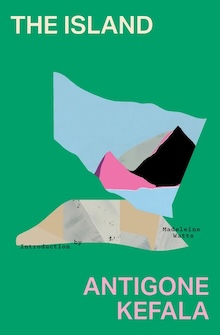
Transit Books, 2025
The past endures. A major theme of the work of the late Australian poet, novelist, and diarist Antigone Kefala, the past’s inescapability is at the fore of her early novel The Island, published in 1984 and recently reissued by Transit Books. This edition, with an introduction by the novelist Madeline Watts, provides a long-overdue introduction to a unique and under-recognized writer.
Kefala was born in 1931 in the Romanian city of Brăila to parents of Greek heritage. She and her family fled Romania amidst political unrest, going first to Greece, where they lived in refugee camps, and then to New Zealand; she settled in Australia in 1959. Throughout her career, Kefala wrote eloquently on themes related to this experience—about foreignness and displacement, and the persistence of memory—across several genres, bringing out five books of poetry, three of fiction, and two collections of memoir.
The Island roughly tracks the life of its author, following a university student, Melina Pappa, the child of a family of immigrants who have moved to the unnamed, titular “island,” an apparent stand-in for Australia, largely scrubbed of proper nouns and identifying details. The Island is thoroughly a poet’s novel, with more attention paid to its finely-wrought language than to its plot—which, as Madeline Watts writes in her introduction, “is light” and “not really the point.” Rather, Kefala’s writing is engaged with “the process of “becoming.” Indeed the novel might be considered a Bildungsroman, a narrative of a young person’s becoming.
From the outset, The Island is suffused with the lethargic haze of an Australian summer. The novel progresses in a slow, dreamlike flow of images, associations, events, and memories. Written with a poet’s economy of language, Kefala’s descriptions are spare, precise, and evocative, and her turns of phrase are often surprising. See the following example from early in the novel of the narrator describing a Saturday morning: “It was a beautiful morning. Fresh, with a perfect blue sky, deep and tight, stretched across the dome of the horizon. The path and the little bridge waited wisely between the heavy green of the trees, a rich plumage breathing unheard in the morning silence, the leaves transparent in the light.”
Amidst this hazy environment, the novel unfolds in a kind of dream-time. Events follow each other without much causation and with even less exposition. Kefala drops the reader into situations, providing little context, often in media res. Her narrator habitually leaves out the beginnings of stories, explaining that “the beginnings were lost somewhere at home.” As the novel unfolds, meaning accumulates less as the direct consequence of events than via a kind of associative osmosis, as images, themes, and motifs recur.
The novel is chronically backward-looking. Continually thrust back to the past, Melina and her family are rarely truly in the present. The past lingers in objects, dreams, and places. Throughout, memories of family act as a kind of Greek chorus. Melina’s mother returns to their former home in her dreams: “Every night she seemed to return home, walk in the old streets, meet acquaintances to whom she explained that we now lived in this far away country.” A family friend is forced to relive her late husband’s death every night, also in her dreams.
The narrator, however, has little direct access to her family’s past in the old country. “All the exciting things had happened before I was born,” she reflects. To those with immigrant parents, the experience will be familiar—hearing stories of far-off places you’ve never been and people you’ll never meet. For those who can remember, the past conjures, among other things, rage, melancholy, sorrow, and nostalgia. “The past,” Melina’s mother says, “is here to torture us all the time.” Hearing this, Melina takes a bath.
A young woman coming into herself, trying to define herself against the burdens of her family’s past, Melina feels stifled, “full of longing for unknown things.” She wants more for herself, even if she can’t quite imagine what that is. Her family is idiosyncratic and charming, and she is close to them, but she experiences their anachronistic habits and mores as restrictive. She rebels by quietly developing her own beliefs. She becomes skeptical of the value of her university education, feeling that it unnecessarily intellectualizes her experience: “I found everything superfluous, all this paper analysis that prepared us for nothing.” She reacts against her family’s Christianity as well, calling it a “cult of suffering.” “I had no original sin,” Melina proclaims. “I was born free.”
Melina finds companionship and, temporarily, freedom in her relationship with Dinos, a young man who emerges as a love interest in the novel’s closing section. Kefala writes beautifully of the heady early days of romance. Kissing Dinos for the first time, Melina feels herself “turning round and round in this whirlpool of offering, this richness of offering that burdened me, excited me, made me feel guilty, demanded my attention, this offering that shaped me anew and in which I turned totally without defence.” The romance shifts Melina’s attitude toward the past, making her feel less stifled, with expanded possibilities. On the beach, she looks out on the horizon and muses: “I felt that the past had been so small, so narrow, so mean. This morning it seemed to me that the earth contained only riches, riches which were offered so nobly, so naturally with such ease.”
But Dinos proves unreliable, and Melina quickly moves past him. With this development Kefala seems to suggest that romance can offer only a temporary reprieve from the burdens of the past. Whether Melina can ever escape them remains an open question. Melina and her family are caught, out of time. Their lives are always distinctly split, in two places at once: the bright land of the present and the shadowy realm of the past. But then again, Melina’s aunt muses, “most lives are anachronistic.”
+++
Antigone Kefala (1931–2022) was born into a family of musicians in Brăila, Romania. Following the occupation by the Soviet Union, her family fled to Greece. In 1959, Kefala moved from New Zealand to Sydney, Australia, where she lived until her death. A poet, novelist, and diarist, she has been described as “one of the most significant of the Australian writers who have come from elsewhere” and a “cultural visionary,” mapping the experiences of exile, displacement, and otherness.
+
Thomas Mar Wee is a writer living in Brooklyn. Their writing has appeared in Antiphony Journal, Document Journal, the Los Angeles Review of Books, Spittoon Monthly, the Cleveland Review of Books, and elsewhere. They currently are pursuing an MFA in Fiction at Hunter College. Learn more about their work at: https://thomasmarwee.com/