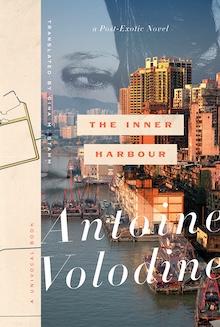
University of Minnesota Press, October 2025
In 1999, as Macau teeters on the edge of its handover from Portugal to China, an assassin named Kotter interrogates Breughel, a failed novelist, in a grimy room tucked away in a dingy alley. Kotter is looking for Gloria Vancouver, Breughel’s lover, who has embezzled a large sum of money from a shadowy international syndicate. They have sent Kotter to find her, to recover the money, and to deliver retribution. Such is the premise of Antoine Volodine’s The Inner Harbour, a novel of stories within stories, revealing a web of betrayals, longings, and half-truths. Merging post-apocalyptic melancholy with artistic defiance, this noir-inflected tale resists a simple resolution. It is a novel that refuses to settle, even after the last page.
Antoine Volodine is a pseudonym; behind it stands a French-Russian author who writes under various male and female pen names and has published numerous books across these collective identities. The novel’s subtitle bills the work as “post-exotic,” by which Volodine means a form of writing apart from genre that does not aim to replace or compete with other literary forms. While it may include different writing styles, post-exotic writing is characterized by a grounded surrealism and rooted in revolutionary and anti-authoritarian themes. Evoking a range of works, from Mikhail Bulgakov’s The Master and Margarita to the novels of Milan Kundera, post-exotic prose blends the socio-political with the mundane and the mysterious.
A self-invented form of literature risks veering into the idiosyncratic or opaque. In The Inner Harbour, Volodine deftly counterbalances this tendency by anchoring the narrative with a handful of recognizable and even conventional elements. The city of Macau is real, as is the historical context, which lends the story a tangible framework distinct from pure surrealism. The characters, steeped in moral ambiguity and existential fatigue, conjure the brooding atmosphere of noir. Volodine’s post-exotic sensibility asserts itself when the narrative repeatedly breaches these conventions. For example, by permitting a character to speak from different points of view, Volodine creates an uncanny effect, deepening the emotional resonance while making the reader scramble to keep up.
The narrative voices are elusive. During the interrogation, Breughel tells Kotter that Gloria Vancouver is dead, killed in a traffic accident in Seoul; some of the embezzled funds have been spent, and now he, too, awaits death. The story is plausible, but Kotter can’t shake the feeling that it’s a fabrication. If his love is truly gone, why doesn’t Breughel leave Macau, or take his own life, instead of sticking around in solitary squalor? As Kotter presses Breughel at gunpoint, the world outside becomes a pervasive presence. Volodine’s sentences ramble through the city, which
buzzes and buzzes, incapable of experiencing anything but broken sleep, divided into multiple attempts interrupted carelessly by distant bellows, calls, then the indecent clamor of a television set, the whine of a saw attacking metal, and then the murmur and clinking of a meal being eaten, or the blows of a hatchet on a chopping block cutting up black market pork, or the maneuvers of a pickup truck in front of a shop, then the crisp detonation of a pack of firecrackers that a lucky or unlucky gambler has lit upon leaving a gaming room, in front of the floating casino or elsewhere, then the siren of a police ambulance.
Breughel, with a cord around his neck and confined to a chair, seems to have lost his will to live. Again and again, he asks when Kotter will execute him. His confessions range from hesitant to overly detailed. He describes how he met Gloria, recalling the passion they shared, how she made him complicit in her trespasses against the syndicate, and how another shady operative—the Brazilian, Machado—helped them into hiding. Breughel laments the depth of his love while simultaneously reveling in it. Kotter, for his part, is a wary yet meticulous interrogator.
All the characters are differently unreliable, so whose account should be trusted? The wily Breughel, who invents stories for a living and is “caught up in an adventure that required of me the same qualities that my characters had to display in my novels,” seems unpromising. So is the sinister Kotter who, as Breughel eventually realizes, is brandishing a toy gun. Perhaps it is Gloria Vancouver, who was experiencing a mental breakdown or “psychological disturbances” before her supposed death.
Breughel is a man whose only goal is to protect the woman he loves, no matter the cost. “She exists, she doesn’t exist. And it’s for her, only for her,” he says. Yet his conventional point of view does not dominate. Redemption, courage, and sacrifice remain open-ended questions. As each character’s thoughts flow, river-like, merging and overlapping, and as their emotions shift from pessimism to hope to nihilism, the post-exoticism of The Inner Harbour resists the familiar architecture of plot. Despite the presence of the strong narrative forces of abandonment and transformation, the stories here remain unfinished and infinitely revisable.
+++
Antoine Volodine is the primary pseudonym of a French-Russian writer who has published twenty books under this name, of which several are available in English translation: Minor Angels, Radiant Terminus, Bardo or Not Bardo, Writers, Solo Viola, and Mevlido’s Dreams. His many literary awards include the 2014 Prix Médicis for Radiant Terminus.
+
Gina M. Stamm is associate professor of French at The University of Alabama and translator of Volodine’s Mevlido’s Dreams (2024), also published by the University of Minnesota Press.
+
Tania Malik is the author of the novel Hope You Are Satisfied (Unnamed Press/Verve Books UK), which was recommended by NPR and named one of the best espionage novels of 2023 by CrimeReads. Her previous novel, Three Bargains (W.W. Norton), received a Publishers Weekly Starred review and a Booklist Starred review. Her writing has appeared in Electric Literature, Lit Hub, Split Lip Magazine, The Brooklyn Rail, Off-Assignment, Write or Die Magazine, Full Stop Magazine, Salon.com, Calyx Journal, Baltimore Review, and other publications. She lives in San Francisco’s Bay Area. www.taniamalik.com.