Roxane Gay Books, January 2026
Sara Levine has mastered at least two of the linchpins of compelling fiction: an irresistible narrative voice and a fatally flawed protagonist. Her debut novel, Treasure Island!!! (2011) featured an unreliable (and unhinged) narrator who kickstarts her life by embracing what she considers the “core values” of Robert Louis Stevenson’s original Treasure Island: “Boldness! Resolution! Independence! Horn-blowing!” As she buccaneers her way through safe-and-sound suburbia, she alienates those who care about her, blaming them for her own failures to launch.
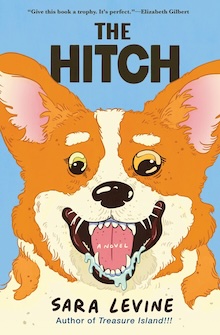
Treasure Island!!! might actually be heartbreaking, if Levine’s writing were not so hilarious. Levine’s protagonists are as funny as they are broken, and each one tells a bonkers story. In her new novel, The Hitch, Levine offers a variation on this theme. The novel unfolds another plot gone bananas—omniscient dog ghost possession! exorcist! dolphin attack!—and anchored by a self-absorbed protagonist with more opinions than self-awareness.
Forty-something Rose Cutler runs a successful yogurt business called The Cultured Cow and furnishes her magazine-worthy home with a Louis XIV silk couch, mid-century ceramic elephants, and “identical twin lamps on fraternal twin tables.” She prefers classical music, identifies as an antiracist environmentalist, and subscribes to strict veganism. Her yogurt business, which predates the veganism, is a thorn in her side. As her best friend, Omar, observes: Rose has many thorns. As for reliability? That’s overrated—at best.
Rose’s swanky self-presentation and shit-together vibe conceal—spoiler!—a lonely orphan held hostage by her own prejudices. Her dog, a Newfoundland named Walter, offers companionship. But where human connection is concerned, it’s slim pickings. While she is in regular contact with Omar, he listens to her blustering but demands little in return. She can barely tolerate her own employees. Although Rose adores her six-year-old nephew, Nathan, she only sees him for a couple of hours on Saturdays, and she finds his parents insufferable.
What precisely is Rose’s problem? For one thing, she has exacting standards, as is clear from the book’s first page, where she criticizes how Nathan is parented. Intentional about everything, Rose is exasperated by everyone else’s failure to see the light. Seven years after the fact, Rose continues to criticize the haphazard quality of her brother Victor’s wedding: “They married three months after they met—county clerk, no guests allowed—bought a house they couldn’t afford, and produced a child as if picking one more feature: We’ll have granite countertops and, oh yes, a baby boy. That’s how they roll. No forethought. Make it up as you go along.” Rose would never make it up as she goes along—until one fateful day, when she finds herself facing the unforeseen without a playbook.
Rose is babysitting Nathan for a week while his parents vacation in Mexico. On their first afternoon together, Walter kills a corgi named Hazel at the park, and Hazel’s soul lands inside Nathan’s body. Rose had big plans for her week with Nathan—like undoing all the bad parenting he’d endured in his life so far. A canine poltergeist was not her agenda. For the rest of the novel, Rose’s unexpected quest is to expel Hazel from Nathan’s body before his parents return from Mexico. In the process, Rose battles several antagonists: Hazel, “blending” with Nathan, cracking nonsensical knock-knock jokes, and rattling off unknowable, or at least very private, facts, at one point including the recent sexual conquest of Rose’s best friend Omar, which he’d been keeping secret from Rose; Nathan, who happens to love Hazel and thinks the new arrangement is the best thing ever; and of course, Rose herself. Her rigid ways are no match for Hazel’s chaos, and she’s unprepared to take on an exorcism. The crux of The Hitch isn’t Hazel. The crux is Rose accepting that she can’t control Hazel, or Nathan, or anybody. She can hardly manage herself.
As with any work of fiction, the suspension of disbelief is a prerequisite for enjoying The Hitch. But in this respect Levine sets an unusually high bar, obscuring what exactly readers are meant to believe. Perhaps the dog possession actually happens, or perhaps Nathan is experiencing an extended episode of pediatric psychosis, or perhaps the problem is that Rose is having an epic nightmare. Regardless, the details are wonky, and the ending does not tidy up into a neat bow.
Rose is reminiscent of a classic sitcom character whom viewers can’t help but love, despise, and love to despise. She evokes the cringing guffaws prompted by the ensembles of Seinfeld and The Office. Such characters reflect our horrifying shadow selves, rendered ridiculous on the page or small screen even as we secretly recognize that we have also felt those estranging tendencies before we got therapy, sobered up, or read the Brené Brown book—before we looked hard in the mirror and accepted our reflection.
+++
Sara Levine is the author of the novel Treasure Island!!! and the short story collection Short Dark Oracles. She holds a Ph.D. in English from Brown University and teaches at the School of the Art Institute of Chicago.
+
Edith-Nicole Cameron reads, writes, and mothers in Minneapolis. Her work appears in various journals, including Literary Mama and River Teeth’s Beautiful Things.