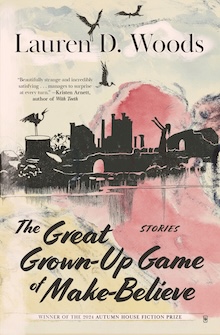
Autumn House Press, October 2025
In “Domestication,” one of the twenty-eight stories in Lauren D. Woods’s smart and memorable collection, The Great Grown-Up Game of Make-Believe, two adolescents play in an abandoned house that’s surrounded by coyotes. The pair pretend to be married, although the unnamed protagonist qualifies that she and Christopher “aren’t in love and don’t want to be.” In The Great Grown-Up Game, characters chafe against restrictive social norms. Aware that conforming would keep their lives small, they work towards freeing themselves of others’ expectations, however they define that liberation.
For the most part, these stories center on recognizable conflicts, like navigating cliques at school or maintaining identities outside of parenthood. In “Domestication,” as Christopher moves through the house, discussing decoration and repairs, the protagonist secretly envisions a different life for herself, one where she escapes their stifling suburb. As the coyotes draw closer, the protagonist reveals that she sometimes fantasizes she is one of them, “unafraid of the night and impossible to trap,” and she wonders if her mother ever felt the same way.
The collection’s freshness stems from its remarkable playfulness. Woods frequently employs magical realism, and the collection includes micro stories, faux quizzes, and how-to guides alongside lengthier works of psychological realism. Because these stories are often humorous, Woods broaches weighty subjects like gender and bullying with impressive levity.
The stories are light on dialog and heavy on description, which works well given that Woods’s characters are introspective. For instance, in “The Shape-Shifter,” a female shape-shifter marries a man “during her horse era.” Eventually he asks her to become a swan. While she acquiesces and initially feels “a little more beautiful,” he then wants her to become a snow leopard after meeting one at a party. Perceptive, the shape-shifter realizes that her husband’s whims change according to the woman he desires. In defiance, she transforms into an emu because “she liked being tall, high on spindly legs.” Although he wishes she adhered to traditional, feminine beauty standards, she relishes her beautiful and ugly forms equally, calling attention to how empowered she feels as a vulture or a bat.
The pressure to adhere to gender norms shapes the exploration of masculinity in “Nine-Hundred Miles to Tampa.” Its protagonist, a nineteen-year-old father named Kevin, struggles to raise his infant son, Mason, while living with his parents and working at a call center. As his stresses mount, his boss urges him to “sit down and have a cry and let it all out.” Kevin realizes that he never cries because his own emotionally repressed father “turned away in embarrassment” whenever he saw his son’s tears. By contrast, Kevin, who deeply loves Mason, had memorized his son’s different cries by the time Mason was four months old. When Kevin’s dad angrily insists that he quiets Mason’s crying, Kevin stands up to him, breaking the cycle of fathers teaching their sons to suppress their emotions.
Not every character in Woods’s collection purposefully defies social convention, however. In “Randomized Trial,” Ivy, an eccentric fourth grader, doesn’t fit in with her classmates and is falling behind in school. She spends her recess “using blades of grass to make duck calls” instead of playing games, and she randomly performs headstands “for upwards of ten minutes.” Eventually, when her teacher stops curtailing her exuberance, Ivy excels, leading her classmates, teacher, and principal to wrongly assume that her success derives from her headstands. They begin to copy her, adding “upside-down strengthening positions […] to the curriculum,” while the administrators insist that Ivy must assume leadership positions to positively influence other students. The story criticizes bullying, as the kids rapidly move from disliking Ivy to admiring her, while satirizing narrow education standards that only allow for a single model of student success.
While these stories showcase characters forcing others to conform, the collection’s best story, “Evening by the Lake,” demonstrates the benefit of seeing people as they are. This story follows Jane, a preteen who suppressed the memory of her mother’s deceased boyfriend, Justin, with whom they lived when her parents temporarily separated. Many years after his death, her mother drives Jane back to the condo they once shared with him, triggering memories “that receded so far to the background” that Jane had “started to doubt all of it ever happened.” Faced with these new memories, Jane struggles to align them with her belief that she and her mother have nothing in common. Realizing that they actually share the memories of a man who was important to them both, Jane recognizes that her mother, who was happier with Justin than she is with Jane’s father, has different versions of herself. Rather than wave this complexity away, Jane embraces it. With her newfound appreciation, she is able to see her mother as someone who balances motherhood, grief, and disappointment. Like so many stories in this insightful collection, “Evening by the Lake” encourages readers to embrace people as they are, rather than hope they’ll change.
+++
Originally from the Dallas area, Lauren D. Woods now lives and writes in Washington, DC, where she was a 2024-25 Arts and Humanities Fellow for Fiction. Her writing has appeared in The Best Small Fictions, The Antioch Review, The Normal School, Passages North, Hayden’s Ferry Review, Red Rock Review, Southern Humanities Review, and Lunch Ticket, among others. Lauren works in consulting and lives with her husband, four children, two cats, and a guinea pig. The Great Grown-Up Game of Make-Believe is her debut collection.
+
Emily Hall holds a Ph.D. in contemporary Anglophone fiction from The University of North Carolina at Greensboro. Her creative prose and book reviews have appeared, or are forthcoming, in places such as Portland Review, Passages North, 100 Word Story, Cherry Tree, Blood Orange Review, and Flying South, where she was a finalist for their 2024 creative nonfiction award.