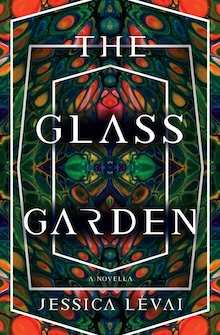
Lanternfish Press, 2025
In Jessica Lévai’s novella, The Glass Garden, scavengers travel to another planet hoping to excavate a work of art, only to discover that it’s an illusion. The titular glass garden is a bioluminescent image mysteriously projected onto a cave floor. Despite its strangeness, the scavengers try to remove the garden, hoping to sell it. Altogether the novel explores a timeless question: What makes something valuable?
Spanning science fiction and horror, The Glass Garden takes a familiar trope—people encountering the unknown on a strange planet—and infuses it with literary explorations of value, ownership, and wonderment. Characters’ diverging ethics about excavation drive the conflict. The scavengers want to sell the garden, but their excavation efforts are thwarted by the protagonist, Therese, an academic who is asked to join the team by her sister, Lissy.
Whereas some of the scavengers value the glass garden for its monetary worth, Therese considers the garden priceless, arguing that it adds value to the planet itself, which is otherwise “desolate, desert-like, with not much to see besides rocks.” Advocating that they must at least try to understand the garden’s origins, Therese focuses on activities like surveying and recording, “chemical sampling and analysis.” The scavenging team has no patience for these interventions; they simply want to remove the garden. While this conflict may seem muted to some readers, The Glass Garden is engrossing and suspenseful. Interacting with the garden leads to horrifying consequences for the crew members, and the story’s tension is amplified by its deft pacing.
The Glass Garden is at its strongest when it explores the dynamics amongst the characters, all of whom are simultaneously presumptuous and compassionate. Therese is an outsider, both new to the team and highly educated, with Ph.D. and a teaching job “back on the home world.” The other crew members are suspicious of her education, a problem worsened by Therese’s tendency to observe more than she speaks. Aware that she seems like an “older, sexless, eccentric professor,” Therese tries to minimize her accomplishments, hoping to appease the others. She doesn’t realize that her methodical nature makes her stand out regardless.
Lévai’s secondary characters are substantially developed for the most part. Daniel Tsieh moves between shame that he never finished his Ph.D. in gemology and relief that he left academia to pursue exploration. His nonbinary romantic partner, Dana McArdle, is stoic, even in moments of crisis, but they are deeply vulnerable with Tsieh, creating important complexity. That said, Lissy’s characterization is more thinly sketched, probably because Therese interprets Lissy’s behavior for the reader, so her own frustrations with her sister inflect her point of view.
Because The Glass Garden is a story about illusions, Lévai plays with this by having the crew project their own issues of self-worth onto each other. For instance, Tsieh is tense and defensive around Therese, convinced that she judges his inability to complete his Ph.D. Then there’s Lissy, who brashly tells others that her sister “doesn’t like anyone who isn’t published,” because Lissy is convinced that Therese is a snob. Mundane sisterly squabbles are intensified by each character’s presumption that the other has an easier and more meaningful life. When the two finally confront one another’s assumptions, the scene is heartbreakingly honest, as they admit they crave validation from one another because each is jealous of the other’s achievements.
Although the characters clash because they misread each other’s intentions, Lévai resists making her characters unlikeable. Lissy, for instance, is bold and impatient, but she is also loyal and quick to point out that Therese is “someone I can trust.” And while Tsieh worries about Therese’s aloofness, the two still bond over their mutual love for exploration. These moments of tenderness soften the tension while blurring the boundaries that the characters draw between themselves and the kinds of knowledge and experience they value.
Despite their differences, no character in this novella is immune to the wonderment that the otherworldly setting inspires. When Therese looks to the stars, she imagines that “the sky was a fresh set of paints. You could play and create whatever images you wanted to.” When the team finds the garden for the first time, they admire its patterns, which resemble insects crawling along vine-like “strands echoing and twisting with no beginning or end,” even as they know they’ll have to eventually sell it. Their collective desire to experience new places shapes the characters’ motivations, bonding them in unexpected, and sometimes tragic, ways. The Glass Garden is a transfixing and climatic novella, and when it ends, its readers will be sorry that they have to leave the crew behind.
+++
Jessica Lévai has loved stories and storytellers her whole life. After a double major in history and mathematics, a Ph.D. in Egyptology, and eight years of the adjunct shuffle, she devoted herself to writing full-time. Her writing has appeared in Strange Horizons, Cossmass Infinities, and Reactor Magazine. Her first novella, The Night Library of Sternendach: A Vampire Opera in Verse, won the Lord Ruthven Award for Fiction. She dreams of one day collaborating on a graphic novel and meeting Stephen Colbert. Learn more at: JessicaLevai.com.
+
Emily Hall holds a Ph.D. in contemporary Anglophone fiction from the University of North Carolina at Greensboro. Her creative prose and book reviews have appeared, or are forthcoming, in places such as Portland Review, Passages North, 100 Word Story, Cherry Tree, Blood Orange Review, and Flying South, where she was a finalist for their 2024 creative nonfiction award.