Scribe, June 2026
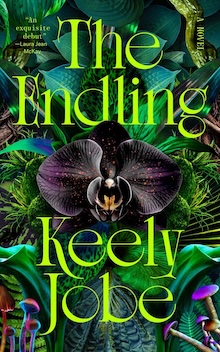
In a remote Australian mountain forest there is a black orchid. It is the last of its species: an endling. As Keely Jobe’s debut novel The Endling begins, the orchid decides that “for the sake of its kind, it will hold on a little longer. It won’t flounder. It will remember the way the orchids once spread. It will remember when they ruled the world.”
Also vying to rule the world, or at least a corner of it, is a commune of women in the same forest. They’re feminists who’ve left society with the goal of creating their own, one that is safer, kinder, and—most importantly—free of men. Through alternating perspectives and a complex, woven narrative, Jobe explores the women’s struggles with nature and with each other.
Frank, one of the older members, having grown jaded with the others’ self-aggrandizing politicking, has isolated herself in a tent a few hours’ hike from camp. Her niece Mila has remained despite similar misgivings. Seeking to distance itself from manhood, the group has nevertheless defined itself by maleness. They implement bans on all non-handheld machines due to their loud, violent “masculinity,” encourage avoidance of an abandoned logger’s cabin because of the “dick-swinging, tree-murdering, rapist energy” they sense within its walls, and they prohibit all subjugation of animals, from hunting them to keeping them as pets—even as Frank keeps a secret dog named Chicken Midnight. When not performing tasks for basic survival, the women debate, do psychedelics, and have sex. One day, during a burst of “bacchanalian lunacy,” the group is inexplicably struck by a wave of arousal that drives them to masturbate in the woods. Some time later they all find themselves pregnant. Only Frank, off in her hideaway, is spared.
Mila gives birth to the only male child. Finch is born as silent and strange as the other children, a gaggle of little forest spirits wholly uninterested in the group’s hierarchies. Still, Finch’s very presence on the mountain lays the women’s bioessentialism bare. To Mila’s horror, they ignore Finch, forbid him from interacting with any of the young girls, and once go so far as to lock him in a dog cage to keep him separate. The heated discussion of values that follows illuminates the culmination of the group’s uncompromising ideology: a kind of mystic belief in the divine feminine, not any meaningful critique of societal patriarchy. One woman, Luna, proclaims proudly that Finch lacks the creativity inherent in anyone with a uterus. Disagreeing, Mila is reminded of “Luna’s atrocious artworks—plywood offcuts soiled with beige skids of paint, more mud slick than art, more shit stain than creative expression.”
Jobe is at her best when demonstrating the alternating horrors and blessings of activist community. The women on the mountain are not always ridiculous; they’re sometimes completely correct about the violent misogyny of the society they’ve fled. Mila acknowledges that “that’s the thing about utopia—the best of it lies in the potential, in that heady, fleeting moment of conception. It’s forever bound to an end that never comes.” The problem is not with feminism but with internal conflict and self-policing. There is nothing feminist about locking a toddler in a cage.
Jobe’s smooth, psychedelic prose does not quite hold together all of the novel’s many threads. There are themes of environmentalism, herd mentality, and motherhood, but there are loose ends as well. Not every revelation feels connected. Yet although plot falters, Jobe’s writing enthralls, bringing to life the hot, horny organism that is the Australian wilderness. Here, an umbilical cord is as “limp as an unfilled sausage” and a placenta is a “meaty thing […] dropped in the mud for birds to peck at,” but there is beauty, too, in this “tiny, perfect ecosystem […] something about the cloistered air and rounded sounds, the shapes of perpetuity, the way the land seems to curl in on itself like a snail shell.”
Is feminism needed in a world without men? Should womanhood be defined by what it is or what it is not? The questions raised by The Endling are as important as they are clever. A knowing wit pervades this immersive and sweltering novel, and if its conclusion fails to land, its images persist, like this one, of the women “clustered together like starlings,” forging their way through a forest that lived long before they came and will thrive long after they leave.
+++
Keely Jobe is a writer of fiction and nonfiction living on the east coast of Lutruwita/Tasmania with her partner and two Staffies. Her work has appeared in The Monthly, Island Magazine, Australian Geographic, and Cosmos. She holds a Ph.D. in English and Creative Writing from the University of Tasmania and serves as the nonfiction editor of Island Magazine. The Endling is her first novel. She lives in Tasmania.
+
Noelle McManus is a writer from New York. A 2024 NBCC Emerging Critics Fellow, their literary critiques have appeared in publications such as Alta Journal, On the Seawall, and LIBER: A Feminist Review. More of their work can be found at noellemcmanus.com.