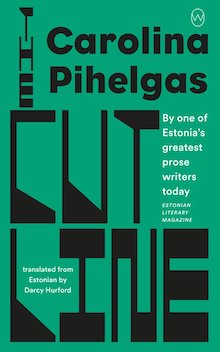
World Editions, February 2026
Carolina Pihelgas’ The Cut Line is two things at once: a classic story about a bad breakup, and thoughtful geopolitical fable. Gorgeously translated from the Estonian by Daisy Hurford, the novel follows Liine, a middle-aged woman who flees her life in the city of Tartu, in southern Estonia, in an attempt to escape an abusive relationship. The soured relationship provides the lens through which Pihelgas invites the reader to consider larger questions about boundaries and borders. Sometimes the distinction between a permitted incursion and a subtler, more malign encroachment is very fine indeed.
Which is not to say that the novel is didactic or abstract. As a story of one woman’s journey toward a contented solo life, The Cut Line is in fact perfectly satisfying. Pihelgas shows Liine doing the work, earning her happiness by learning to be both safely alone and with others. But as Liine extends her escape to the family’s cottage in the countryside, the rural idyll is interrupted by the noise of an expanding nearby military base, evidence of a growing wider conflict with Russia. Like her abusive ex-boyfriend, Tarmo, the neighboring country also pushes boundaries and behaves in provocative ways. These intrusions invite reflection on the ways in which Liine, like Estonia itself, has been repeatedly invaded and overrun.
Appropriately for a book that traces a series of shifting boundaries, Pihelgas begins slowly. The slow burn brings Liine into focus, anatomizing her interiority as she grieves the loss of her long-term relationship. Despite its obvious awfulness, her fourteen-year relationship with Tarmo was substantial, and Liine has much history to revisit. Mainly what she mourns is the idealized future she had imagined for herself. This future, she now feels, “has drowned, sank to the bottom and no longer exists. The most awful thing about breakups is losing what you imagined.”
Despite her efforts, Liine finds peace elusive. The cottage is a family property, and family members do come to visit, disturbing Liine’s recovery. Her irritating mother shows up early with clanking bottles of wine, many sausages for the grill, and unannounced plans to renovate the garden. “Mom’s in full swing,” Liine observes ruefully. “She carries branches and old half-rotten planks to the campfire site and saws up a dried-out guelder rose bush.” It’s just like Christmas, Liine reflects, a sad and empty time when “the spruce branches went up inside and the lights were up, but there was no Christmas feeling.”
Soon Liine’s mother is finding things to criticize about Liine and pestering her to get back with Tarmo. The onslaught unmoors Liine. “I’m like an unknown continent,” she says. Partly the problem is that she feels herself to be a stranger in the cottage, a place with a long history that precedes her. It’s something she holds in common with the cottage, as she comes to learn. Like her internal landscape, the cottage is a place “where everything already exists and where the paths have long been trampled on.” From here it’s a short step to self reflection: “But the explorers who arrived by ship have given the rivers and lakes and mountains names that are unsuited to them; they’ve infected me with their language, they’ve colonized me.”
Liine returns obsessively to her decision to leave Tarmo. His abuse has left scars that are so deep, she is still arguing with him in her mind. Her conversations with herself still include Tarmo, as here: “I need to go back to my beginnings and I need to rediscover my own eyes and purge myself of your judgments.” Of your judgments: With this dizzying slip, from monologue to direct address, Liine arrives at something new, a fresh task: “Purge myself of Mom.” Beyond her problems with Tarmo, Liine has unfinished business with her family of origin. She has come to the right place for concluding that business. The family summer home holds many secrets. As Liine digs deeper into the history of the house and her family’s history in it, she finds that she must also lay those ghosts.
Liine’s interior landscape contrasts with the universe of the woods around the bouse. This classic expressive contrast—Thoreau, for one, famously relied on it—is here refreshed as Pihelgas turns her attention to the details of the Estonian countryside, a place of nettles, marigolds, wasps, cranes, “veteran trees,” and above all, vast fields of waist-high cow parsley that approach the family cottage. Climate change threatens all of it. But the cow parsley continues to flourish. It always needs to be cut back, but because it belongs there, the procedure is more than a chore. It’s a ritual.
But there is more going on here than a drama of personal growth. Marshy and forested, Estonia is located north of Latvia on the Baltic. To its north is the Gulf of Finland, and to the east is Russia. In The Cut Line, loud and disturbing military exercises are occurring on this latter border all the time, perpetually reminding Liine of historic threats that persist into the present and raising questions about how to live in the face of them.
To these question, Pihelgas suggests there are no simple answers. The novel bears an epigraph by the Argentine writer Ariana Harwicz who, like Pihelgas, holds violence as a central concern: “The reflection of the first knife / I ever dreamt of was in my hand again” (translated by Carolina Orloff). Restated less poetically, the point seems to be that people really can be haunted even by the boundaries they have needed to set for themselves, by all the hard decisions they’ve learned to make in order to save their own lives.
+++
Carolina Pihelgas is a prize-winning Estonian writer, poet, translator, and editor. In 2020, she was appointed Tartu’s City Writer Laureate. The author of seven collections of poetry, she published her first novel Vaadates ööd (Watching the Night) in 2022. The short novel The Cut Line is her second work of prose and her first work to be translated into English.
+
Darcy Hurford translates from Swedish, Finnish, and Estonian into English. Originally from England, she is now based in Belgium, where she worked for more than a decade. She studied modern languages at the University of East Anglia and comparative literature at Åbo Akademi University in Finland. Her translations have appeared in Asymptote and Ellipse Magazine.
+
Diane Josefowicz is Reviews Editor at Necessary Fiction and Senior Editor of Translation for The Adroit Journal. Her second novel, The Great Houses of Pill Hill, was published by Soho Press in May.