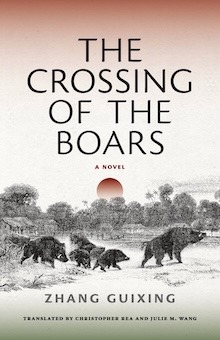
Columbia University Press, October 2026
The Crossing of the Boars is the seventh novel from Zhang Guixing who, as a Mahua writer, is an ethnic Malaysian writing in Chinese. Zhang’s rich novel takes place in a fictional village called Krokop on the Southeast Asian island of Borneo, centered on the period of the Japanese invasion of the island during World War II. In this story of warriors, prostitutes, villagers, and invaders, the landscape is the protagonist. Its people are simply embedded within it, often proving weaker than the animals and plants.
As the translators note in their introductory note, this text “rewards close and repeated readings.” Much of the complexity derives from the novel’s many characters, nonlinear chronology, and magical realism in the style of folklore. Characters have pseudonyms and alternate identities, and the story constantly blurs the edges between reality and fiction.
The setting of Borneo itself provides layers as well. Control of this enormous, resource-rich island has long been contested. Today the island is split between Indonesia, Malaysia, and Brunei, but others have also invaded and settled there, most notably the British, Dutch, and Japanese. Most of the characters in this story are not the indigenous Dayaks, but instead the Hakka Chinese who have come to the island and into the territory of the island’s boars.
The reader meets this piece of jungle before this group of humans have named it Krokop, and through this land’s resilience and fierceness, readers are repeatedly reminded that it will outlast its biped inhabitants. The boars are the villagers’ first and most persistent enemy, though the Japanese, whom the villagers simply call “devils,” entirely disrupt the villagers’ lives.
The book opens in 1952, with the suicide of villager Guan Ah-fung. In the days leading up to his death, Ah-fung’s son and his friends find a collection of toys that, by unexpectedly reminding Ah-fung of the Japanese invasion of the island, cause his mental state to erode. He tells his son that he sees “a headless man circling the jackfruit tree and playing a Japanese folk song on a charred harmonica [and] a bicycle squadron of Japanese soldiers riding over a pile of children’s corpses.”
Throughout his son’s childhood, Ah-fung had attempted to teach his sone how to listen to his surroundings. While his son heard nothing, Ah-fung heard a cacophony: boars foraging, birds building nests, and children fishing in the distance. His knowledge made him acutely aware of a danger embedded in his home. After opening with Ah-fung’s suicide, Guixing leads his reader back in time, and the images that pervaded Ah-fung’s final days begin to make sense.
Ah-fung’s father, Red-Face Guan, is among the first human settlers of Krokop, and altogether they are the group who have to fight off the boars. The boars are as worthy an enemy as any human opponent. The animals devise a night raid, which the villagers recognize as the “king’s masterstroke,” the scale of which only a “boar among boars would have been able to command.” Ah-fung’s battle with the jungle begins at birth. When his mother dies in childbirth, her final image is of the boars surrounding her home. While Ah-fung’s adulthood is spent combatting the Japanese enemy, he often has to continue his father’s battle against the boars of Krokop as well.
The villagers lives communally. They protect each other, forage for food together, and care for one another’s children. Ma Po-po is an elderly villager woman whose life represents the generations of invaders and attackers in Krokop. In her youth, she falls in love with a British military officer. Years later, during the Japanese occupation, she serves as the primary guardian of the village’s children while their parents are out fighting. Finally, during the Allies’ liberation in 1945, her house is bombed to obliteration. All the while, she is entirely dependent on opium, like the rest of the village. Her life serves as a snapshot of the horrors that the people who come to Krokop endure and cause one another.
Opium is omnipresent in the village. The villagers’ opium highs enclose them in fantastical daydreams that seem to bring them closer to the jungle’s central force. Their withdrawal periods bring immense pain and suffering and cause the trances to turn violent and dark. The drug serves as a bridge between reality and fantasy, and in the blurred state, villagers claim to be able to stay underwater until they are “reborn” and to observe animals with acute precision.
The early chapters are written as though short folk tales in themselves, told out of chronological order and using concise, specific imagery. They open with introductions to features of Borneo. The white stork, a migratory bird that is considered a vagrant in Southeast Asia, is also the name given by the Allied forces in the Pacific for the Japanese aircraft. Orang Minyak, or Oily Man, is a “Malay supernatural being endemic to the South Seas that can assume human or spectral form.” “River thunder” refers to the bursting of dams that at times sounds like a “stampede of boars” and has the potential to kill both people and animals. These features of Krokop are all depicted in the same tone and style, without any distinction between the real and the fantastical. This mighty jungle has both realms at its disposal.
In a land that continues to be tightly contested, Zhang poses the question of how one can understand ownership of land. The people of Zhang’s Krokop are beholden to the British, to Japanese “devils,” to the island’s flora and fauna, to opium, to mythology. Meanwhile, nature simply persists. People kill one another and sometimes themselves, making them one of Krokop’s weaker inhabitants.
+++
Zhang Guixing (張貴興) was born in Sarawak, Malaysia, in 1956, and came to Taiwan twenty years later to attend university. His works center on life in the rainforests of Borneo and the challenges faced by ethnic Chinese living in Southeast Asia. His writing is poetic and known for its rhetorical flair and richness. He is a recipient of the Newman Prize for Chinese Literature, among other awards.
+
Christopher Rea is a professor of Asian studies at the University of British Columbia.
+
Julie M. Wang is an educator and translator based in Vancouver, Canada.
+
Mia Carroll is an engineer and writer. She lives in Manhattan with her husband.