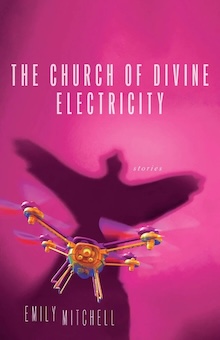
University of Wisconsin Press, November 2025
In the title story of Emily Mitchell’s most recent collection, The Church of Divine Electricity, a young woman returns to the home of her parents, and her life, once troubled, seems back on track—that is, until she shows up with an eight-pointed star on her forehead that signifies her decision to volunteer for the transhuman surgery that will mark her initiation into a futurist religious cult. In this gut-wrenching scene, Mitchell uses the visual tools of the science-fiction writer—the disturbing mark of the star and the body enhancement it represents—to amplify what is, at its core, a familiar story of estrangement within families. Such a fine balance between literary and science fiction writing is rare, but Mitchell strikes it throughout her collection.
Many of the stories take place in near futures marked by major, but imaginable, differences from the present. “Life/Story” is set in a New York City beset by floods, as well as buzzing swarms of tiny video drones. In “Mothers,” the protagonist works as a cleaner for a company that makes giant, matronly animatronics. These mother figures look like museum pieces but can be rented by any wealthy person who happens to want to be raised like a baby into the comforting arms of such a creature. With a voice and humor reminiscent of the early stories of George Saunders, “The Assistant” is written from the perspective of a “fully integrated Subcutaneous Assistant” installed to help a patient recover from surgery by speaking, directly in her mind, words meant to be soothing but which take on increasing menace.
Although Mitchell’s writing is careful and restrained, and the interior worlds of her characters thoughtfully rendered, wild and fun ideas appear here and there, unobtrusively lending her prose the dynamism of science fiction. When he first accompanies his daughter to church, the father in the title story sees a man handing out pamphlets whose fingers “are lengthened and strange. Instead of being joined they are tensile, as if they have no bones in them at all.” Mitchell doesn’t over-describe; she employs just a few evocative brushstrokes. In a light-hearted story called “In Which I Try to Save the World,” an alien getting shown around New York City by the story’s protagonist begins at last to tell her about his own world, where
all cities are vertical and built into the sides of giant trees. Because they are constructed from a living substance, their inhabitants are healthier than us, and also calmer, more patient and kind. They don’t have crime or violence to speak of and their settlements are shaded by the city-tree’s enormous, heart-shaped leaves.
Like a skilled SF writer, Mitchell uses her future worlds to exaggerate and examine phenomena present in our own. In the long and vividly rendered “Life/Story,” that phenomenon is on its surface reality television, a well-worn subject, but it’s also the rampant practice of what might be called “storification”: the pitching and packaging of content as story in order to grab and hold attention, manifest today in the idea of the “customer journey” and in the overuse of the word “story” to describe, for example, batches of disappearing photos on Instagram. “Life/Story” is about a man chosen to be considered for a hugely popular reality TV show that presents a year in a person’s life as a single episode. For one year he’ll be followed everywhere he goes by the tiny buzzing drones. He knows he must make his life worthy of their attention, but he struggles to come up with a story for himself. His wife, a bigger fan of the show, thinks he’s wasting his opportunity: “I knew you were not the most ambitious, go-getter type when I married you,” she tells him. “But, Martin, really, EVERYONE has an idea for a Life Story!” The situation destabilizes their relationship. He cheats on her, they separate, and his “story” becomes TV-worthy only when he must rescue her and their children during a flood.
Two stories, “Her Face I Cannot See” and “Becoming a Cat,” draw less overtly from the conventions of science fiction while continuing to engage with dimensions of the fantastic.
“Her Face I Cannot See” is at its heart a ghost story, and “Becoming a Cat” enters the realm of the literary speculative by describing the steps one must take to become an actual cat. “Forgotten Pastimes of the Victorians” fits the collection less well, since it’s basically a humor piece, but Mitchell’s vivid, meticulous prose connects it to the rest of the book at least superficially. The strongest stories, however, are the ones that give Mitchell space to render characters who draw our empathy. That’s a quality unique to good literary fiction, and any fan of the literary short story will appreciate this collection. Fans of literary SF (in addition to Saunders, Julia Elliott and Kazuo Ishiguro) might especially enjoy it.
+++
Emily Mitchell’s stories have been published in Harper’s, Ploughshares, New England Review, and elsewhere. She teaches at the University of Maryland. Her novel The Last Summer of the World was published in 2007. She lives in Washington, DC.
+
Bradley Bazzle’s second collection of stories, In the Shadow of the Architect, will be published in September. He’s also the author of Fathers of Cambodian Time-Travel Science (2020) and the novel Trash Mountain (2018). He lives with his wife and daughter in Athens, Georgia, where he teaches improvisation. Read more at bradleybazzle.com.