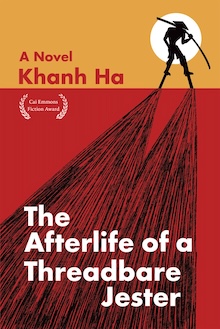
Red Hen Press, May 2026
After years of working on media stories about hotly contested political situations, I’ve learned that sometimes telling the truth about a situation will make people mad. As I read Khanh Ha’s “The Afterlife of a Threadbare Jester,” a harrowing tale of political imprisonment in communist Vietnam, I wondered if the author got any hate mail.
Ha pulls zero punches in his blistering portrayal of North Vietnam’s Communist government after the American withdrawal. His novel follows Brother Khang, a former Republic of Vietnam intelligence officer rounded up in a ruthless scheme to “reeducate” political dissidents according to communism—or, at least, their vision of it. Beginning in 1978, we meet Khang at Cổng Trời (“Heavenly Gate”), which is in fact the hellish prison camp he’s just tried and failed to escape. In a scene evoking the Biblical New Testament’s crucifixion, Khang and his two fellow escapees, the defiant Captain Bé and Father Ninh, “a goner,” hang butterfly-tied to poles, foreboding examples to any fellow prisoners with designs on freedom. It’s a portentous signal of religious persecution as the government attempts to purge its populace of European Christianity, a pesky siphon of loyalty from a political party that needs total dominion. “Whoever robs you at night is just a thief,” spits Captain Bé at his captors, “but if they rob you in daylight, they are your Party officials.”
Khang is thrown into solitary confinement, his conditions relayed by Ha with unblinking specificity, the horror continuing with minimal relief for the novel’s duration. “I saw a spider on the wall crawling towards a cockroach,” Khang observes of his captivity. “I made out some smeared words handwritten in blood and coal.” Piss and shit (and blood and vomit and every possible bodily fluid) abound throughout Khang’s ordeal; he’s perpetually fighting the fight to be not just a body reduced to basic survival functions, but a whole human person possessing the interior life voicing this novel.
Branded in his file an “incorrigible element,” Khang is shuffled like livestock from one prison camp to another, without charges or trial salvaging him from the dungeon of the state. In his abjection, Khang balances dignity and despair—and this is key to the novel’s buoyancy. Ha resists making his characters into boilerplate figures of resilience or villainy. At one point, Khang helps a young prison guard remember the lyrics to a song. “I will never forget the words he said,” Khang says of the guard, “that we inmates were prisoners on the inside, while he and his fellow youth guards were prisoners on the outside.” Whether prisoner or guard, all are ensnared in the unforgiving vicissitudes of power and politics.
At times, Ha wades into exposition. Stilted conversations do occur, in moments when author is trying to relay information to a reader who may not have grasped the relevant historical facts. I read these moments with ambivalence. Understanding the Vietnam War has always felt a little intimidating to me, as an American raised on Forrest Gump. Getting a handle on the history of the conflict isn’t necessarily easy. Perhaps a little extra information, clunky or not, is helpful.
Khanh Ha, a Vietnamese-American who has written a several novels about Vietnam, said in a 2023 interview that he was born in Hue to a father exiled for his anti-communist political activities, and a grandfather beheaded by communists for his affiliation with the French. Though fictional, The Afterlife of a Threadbare Jester reads like a memoir—so much so that I wondered about protagonist Khang’s creative genesis. Is he based on a single person or is he composite character formed from real-life stories Ha has absorbed?
In a novel written with so much painstaking detail, I felt the ghosts of the people and places of postwar Vietnam brought back to life, taking shape in my imagination as Ha’s finely wrought cast of prisoners, priests, and prison cadres, as the wives and children marooned in the violence. Reading such a work feels like more than reading; it feels like bearing witness.
+++
Award-winning author Khanh Ha is a ten-time Pushcart nominee. He is the recipient of the Sand Hills Prize for Best Fiction, The Robert Watson Literary Prize, The Orison Anthology Award, The James Knudsen Prize, The C&R Press Fiction Prize, The EastOver Fiction Prize, The Blackwater Press Fiction Prize, The Gival Press Novel Award, The Red Hen Press Fiction Award, The Unleash Creatives Fiction Prize, and The Next Generation INDIE Book Award. Ha was born in Vietnam and is now living in New Jersey.
+
Megan Peck Shub is a writer and producer who has won Emmy and Peabody awards for her work on “Last Week Tonight” with John Oliver on HBO. She has written and/or produced work for PBS, ESPN, New York Magazine, Story, The Independent, McSweeney’s Internet Tendency, The Missouri Review, and the Jewish Book Council, among others. She is based between New York and Seoul.