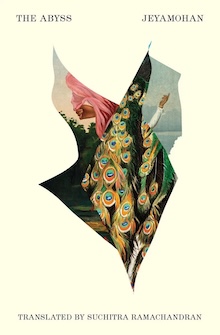
Transit Books, April 2026
The central premise of The Abyss by the Tamil writer Jeyamohan is the philosophical question of existence: What makes us human? Or, to put it more bluntly, as Jeyamohan lays out in an interview with his translator, Suchitra Ramachandran: “If you subject human beings to an acid test, what remains?”
To explore this question, Jeyamohan strips his characters of everything: comfort, privilege, status, caste. The Abyss follows Pothivelu Pandaram, who has taken control of a group of people with various disabilities and disfigurements, whom he compels to sit outside temples all day, begging in the hot sun. Pandaram and his associates treat these men and women as subhuman, referring to them as “items,” trading and selling them at whim, and forcing them to reproduce like cattle in order to create similarly disfigured children. However, the story is not a simple account of cruelty, nor is it poverty porn. Rather, it is an exploration of what it means to be human in a society that treats you as anything but.
Pandaram’s “items” include characters like Muthammai, a woman who has just given birth to her eighteenth child, a son she refers to as her little prince, Rajinikanth; Ramappan, a Kannadiga man with leprosy; big-bellied Kuyyan, sarcastic and ribald; and Ahmedkutty, a Muslim with testicles grossly enlarged by elephantiasis who reads the newspaper every day. The heart of the novel, and the person who sets the plot in motion, is Mangandi Samy, a man with one arm, no legs, and a “little head on top” who sings beautiful, sad, semi-divine songs that he invents. Pandaram considers Samy his “good luck charm,” and everyone who listens to his songs is moved to tears or silence.
The novel begins with Pandaram checking on Muthammai, who has just given birth, and then preparing the group for a trip to the festival of Thai Poosam in celebration of Lord Murugan, god of war and wisdom. Murugan is a favorite deity of Tamils, commemorating the day his mother, Goddess Parvathi, gifted him a divine spear to defeat evil.
It is supposed to be a time of fasting, penance, and prayer as well as celebration, but the temple is a site of debauchery and corruption was well as religious fervor. Devotees in turmeric paste with metal spears through their cheeks, lips, and tongue dance in religious ecstasy while cops demand bribes and menace the mendicant women. At this festival, Pandaram sleeps with several women, drinks heavily, and then—partly on a whim, and partly because he needs money for his daughter’s wedding—he trades away Mangandi Samy, and that is when his luck begins to change.
Pandaram faces one setback after another. His oldest daughter, Subbammai, receives a marriage proposal from a young man with a stable government job—except, as Pandaram soon discovers, he is actually a low-paid temporary worker. And the soon-to-be mother-in-law is a shrill, cruel woman who threatens to smear the family’s good name if Subbammai doesn’t go through with the wedding. Meanwhile, Pandaram’s middle daughter, Vadivammai, steals her sister’s wedding jewels and runs away with a thug who has been to prison twice and already has two wives. Pandaram’s associate, Madhavaperumal, is beaten by several mendicants passing through, and Pandaram himself contracts a sexually transmitted disease.
After facing all of these setbacks, Pandaram meets a man who has something new to sell: children who are not bred but created (at an extremely low cost) because they have been kidnapped and violently disfigured. But even Pandaram considers this a bridge too far, a step too deep into the bottomless darkness.
By the novel’s end, Pandaram has the chance to change his fortune, at least a little. It turns out that after Mangandi Samy was sold, he was installed as a genuine spiritual guru and given all the food and riches he could want. In response, Samy stopped singing and began to beg. Samy’s worth evaporates, and his new owners are willing to sell him back for a low price. Pandaram buys him back, and once Samy is restored to a life of penury, he begins again to sing. And yet, this does not signal a change of heart for Pandaram, as one might expect, for he also sells Rajinikanth and forces Muthammai to have another child.
However, this plot is not the entirety of the novel. Much of the book is focused on the small moments between the major plot points: the interactions of the men and women that society has cast aside. They talk, laugh, spar, joke, dream, and comment on each other and the world around them, often with deliciously black humor. Take, for example, this exchange, tinged with eroticism, which occurs when everyone reaches the festival and they set up shop on a hill:
‘Kuyya, you do see the railing over here? All the ladies who’ll be climbing tomorrow will stop there a minute to rest.’
‘Good thinking,’ said Kuyyan.
‘Last Poosam I saw a foot. You should have seen the toes on it! All white and bright, like peeled shrimp. Like glass. Shit, it drove me into a frenzy!’
Sanappi, who had picked out a spot opposite to his, grinned. ‘What do you do then? Hump a rock or something?’
But enjoying moments of ribald humor is not the only purpose of conversation. Some exchanges, such as this one, between Thorappu, who is blind and hump-backed, and Muthammai, the mother of his son, are touching. Thorappu wants to interact with his son, and Muthammai encourages him:
‘Come on, feel the baby. Touch him however you like. He’s your son!’
‘Does the baby have eyes?’
‘Yes.’
‘A hump?’
‘No. He’s like me. No hump.’
‘That is all right. He has eyes. That means all the world is his.’
Later, when Kuyyan is denied the feast he was promised at Pandaram’s daughter’s wedding, the outcasts band together to raise money for a special meal at a restaurant.
In each of these interactions, humane treatment of others shows itself to be the heart of this novel: the capacities for humor, care, dignity, and love that no amount of inhumane treatment or exploitation can strip away. Translator Suchitra Ramachandran notes that, in these interactions, the outcasts’ sharp eyes subject the “holy idols of religion, caste, society, scholarship, capitalism, and communist progressive politics to a complementary acid test that succinctly reveals the foibles and limitations of those ideas and institutions.” In the end, the reader’s sympathy rests much more with these characters than with those having money or status.
In the final chapter, several characters discuss why Samy stopped singing when his life was materially much better. It is another outcast, Erukku, who provides the answer, which also articulates Samy’s role in the book: “Samy is the god of the sinners. Beggars need a god too, don’t they? Pickpockets and prostitutes and pee-scrapers need a god too. Let him be here.” Although little has ostensibly changed, and their suffering continues, so too does their love, their tenderness, their wild hopes and crazy jokes, and the yearning that suffuses all of these other emotions that will never be extinguished. This is best encapsulated in Samy’s final song.
Moonlight, don’t you know, the agony of my burning heart?
These sobs, these tears, won’t they reach the heavens above?
Will he forget his promises? Will he abandon his love?
What now, fair moon? I’m yearning, I’m burning.
+++
Jeyamohan is a preeminent writer in modern Tamil literature. His works of fiction examine fundamental human questions while being rooted in the spiritual, cultural and literary traditions of India. He is the author of Venmurasu, a reimagination of the epic Mahabharata over a novel-series of twenty-six parts, as well as the novels Vishnupuram, Kottravai, Pin Thodarum Nizhalin Kural, Kaadu, and Ezhaam Ulagam (published in English as The Abyss). He is the founder of several important cultural initiatives in Tamil, including a literary organization called the Vishnupuram Literary Circle, an encyclopedia of Tamil culture called Tamil Wiki, and an institute that offers courses in philosophy, cultural and religious studies called Nityavanam. The Abyss is his second work to be available in English, following his short story collection Stories of the True, which was a finalist for the National Translation Award in 2023. Jeyamohan lives in Nagercoil, India.
+
Suchitra Ramachandran writes fiction in Tamil and translates between Tamil and English. Her work has appeared in literary magazines including Asymptote and Narrative Magazine. She won the Asymptote Close Approximations Prize for Fiction Translation in 2017. The Abyss is her first full-length translated work. She lives in Bengaluru, India.
+
Melissa Reddish’s stories have appeared in Tampa Review, South Carolina Review, and Grist, among others. She is the author of My Father is an Angry Storm Cloud (Tailwinds Press, 2016), Girl & Flame (Conium Books, 2017), and The Lives We’ve Yet to Live (Tailwinds Press, 2022). She has received residencies at Soaring Gardens and the Rensing Center.