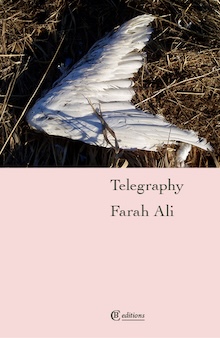
CB Editions, January 2026
Farah Ali’s Telegraphy pulls off quite the literary feat: it manages to make a ghoulish fascination with human bodies—living, dead and transitioning from the former to the latter—into something ethereal, a necessarily spiritual preoccupation.
Sustained by the remarkable, otherworldly voice of its narrator, Telegraphy tells the story of Annie, a woman born in Pakistan in the second half of the twentieth century, as she embarks on one last, hazily-defined adventure in the Middle East, during which she hopes to be reunited with Adam, the love of her life.
The two plotlines, Annie’s memories of her life and her experiences in the present, are interspersed with vignettes from other times and places. While these scenes effectively foreground the novel’s underlying themes, especially the connection between anatomical phenomena, ailments and spiritual concerns, they also feel a little forced, leaving the reader hankering for a stand-alone volume of these vivid micro-fictions.
Having lost her mother as a young girl, Annie is absent-mindedly neglected by a grief-stricken father. After her aunts thwart his attempts to bring her up at the radio station where he works, she develops into a smart, sickly, and dreamy child prone to hallucinations and migraines that defy medical explanation. She has recurring visions of a Wim Wenders-esque figure: “Driving back from a visit to the doctor, I saw a tall man with wings. The man was walking with long steps, dirty white wings curving out of his back.”
Unsurprisingly, the experience inspires a religious response that never quite develops into orthodox faith. Rather, it is deepened and enhanced by sightings of ghosts and harrowing experiences with relatives for whom mental illnesses are all too readily explained as the work of mischievous demons.
At university, Annie meets Sarim, a musician whose band also includes the aforementioned Adam, the lead singer and songwriter. Ali chronicles the band’s initial struggles and their subsequent rise and fall. Tellingly, it is only after Adam attempts suicide that the band garners any media attention. Their arc is mirrored by the love triangle that forms between Annie, Sarim, and Adam.
Although it is Annie and Sarim who marry, the relationship is doomed by a fundamental lack of understanding. Sarim’s patriarchal attitudes pose a problem, as does the fact that Adam and Annie are clearly soul-mates: “Adam had once tried to see what his nerves looked like, he’d told me. He dug into his forearm with the curved blunt tip of the cleaning part of a nail cutter […] for three days he dug a little every day but got no closer. Instead blood began to obscure anything he could have seen […] I saw it once […] that sight of a tiny excavation, and I’d felt a thrill.” Far from being shocked at this act of self-harm, “excavation” seems an entirely natural impulse to Annie, who is also prone to the odd bout of auto-anatomical experimentation.
Meanwhile, in the present, Annie is renting a room in Turkey, suffering from ill-health and memory lapses, and pining for Adam, who has inexplicably disappeared. Annie is helped through her difficulties by her increasingly concerned landlady and her son but there is no doubt that the narrator’s youthful disconnection from reality has only grown more acute with time.
This is both a blessing and a curse. While at university, Annie’s unique relationship to reality creates a mental space that allows her to process a sexual assault and beating during a student protest as well as to publish a slim volume of poetry. But it also has darker implications. If, as she explains, “there was an edge to the fact of my existence,” there was also “a tug from it, a sort of unsaid invitation toward looking over it into an empty space and letting myself lean too far, lose my footing and fall over into it.”
As the plot progresses, inevitable personal tragedies, replete with martyr-like body-play, unfold against a backdrop of civil unrest and war. Many of the major events of recent Pakistani history are satisfyingly woven into the background, giving a compelling portrait of the evolving society of the time. Eventually, the focus returns to the older Annie, who has moved on to Damascus with the gory goal of visiting one of the possible resting places of the head of Saint John the Baptist, a trip that she is confident will bring back Adam from wherever he has gone missing. It’s a fitting end to this strange, eerie novel whose originality and compelling prose are bound to delight many readers.
+++
Farah Ali is a writer and translator from Pakistan. Her books include the short story collection People Want to Live and the novel The River, the Town. Her fiction has appeared in The Pushcart Prize, Best Small Fictions, Virginia Quarterly Review, Kenyon Review, and Ecotone, among others. She is the co-founder of Lakeer, a digital space for writing and art from Pakistan.
+
Kit Maude is a translator based in Buenos Aires.