7.13 Books, October 2026
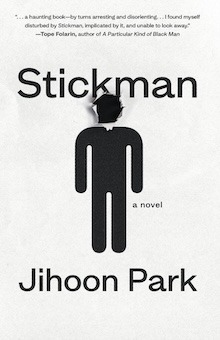
For Juni, the Uber-driving protagonist of Stickman, the wry new novel by Jihoon Park, a ride-sharing gig is the only way to propel himself forward in a life turned static. For someone like Juni, who is just going through the motions in life, driving a car is certainly one way to raise the stakes.
But there are other, more violent methods—and the appeal of that violence is one important focus of this novel. Like a goldfish dumped from its bowl, Stickman kicks readers out out ordinary reality to ask: What is the psychic landscape of a person who knows no society except one seething with potential mass shooters? How might that person be like ourselves?
Born in Korea to a family who immigrated to California, Juni has not quite developed into the shining star for which his parents hoped. His career prospects are dim, not that he cares. The role of an “Uberman” suits Juni just fine. “I’m good at driving for Uber,” he says. “When I’m driving, I feel like a game NPC,” he continues, referring to the expendable secondary characters in a video game, “like an innkeeper from World of Warcraft.”
Juni lives with his ex-girlfriend, Min Jung, and an elderly dog, Frances, who survives only through medication. “I figured I’d learn to change diapers when Min Jung and I had a baby,” he says. “Now it feels appropriate that I’m putting a diaper on for an old, dying dog.” Min Jung describes Juni as a “slightly sentient rock,” and the description echoes Juni’s of himself as “not a big talker.” It is his taciturnity that, as he notes, is one secret to his success as an Uber driver:
[N]ot talking gets you good ratings on the app. That’s one rule for getting a five-star rating. Don’t initiate conversations. But the other rule for getting a five-star rating is, if a passenger does initiate a conversation, try to keep it going. Agree with whatever ideas and thoughts the passenger expresses and match their emotions. It helps to not have any strong opinions or thoughts in general.
His only spark of interest is an abiding fascination with his childhood classmate, Lee Jung Hwan, who infamously shot up his university years before, in a fictional “deadliest U.S. school shooting in history.” For gravitas, Juni tells himself and everybody else that he is writing a book about the incident, but the work is a slow, half-hearted cover for indulging his interest. At one point he’s asked to share some of his work and he has nothing to show—a painfully familiar observation. The best part of writing, as they say, is having written.
Juni is as merciless with the world as the world is merciless to him. He is at his most narratively entertaining during his dry, unsparing observations of his adopted country. Juni embarks on a dubious odyssey through the tasteless delights of contemporary middle America: DiGiorno’s frozen pizza, Las Vegas, Long John Silver’s. Park isn’t pandering for laughs, but his details land like punchlines. What could be funnier or more crass, in concept alone, than the American fast-food restaurant, Long John Silver’s, named for Robert Louis Stevenson’s fictional sea pirate, where one can order a six-piece box of chicken wings called “peg-legs”?
Jumi’s vision (or lack thereof) proves as tragic as it is hilarious. In America, violence is not a defect or a bug but a feature. Just as some people are too young to know a world before cell-phones, many cannot conceive of a world without random mass shootings and the almighty NRA. Juni tosses off references to shootings as someone of an earlier generation would baseball statistics or World War Two history. Juni’s isolation is notably heightened by his absent parents, who are some of the nearly 50,000 Korean Americans who have reverse-migrated back to Korea. I live in Seoul and, anecdotally, improved safety and benefits are the top reasons people tell me they have moved back from America.
Martin Scorsese’s Taxi Driver (1976) is the obvious comparable work, but Stickman is by no means simply an update. Stickman funnels the violence bottled up in de Niro’s Travis Bickle, the film’s eponymous taxi driver, into Jung Hwan, a “quiet, nervous, socially inept, unfuckable man who turned out to have a depraved, dangerous side.”
Jung Hwan represents the spectre of an alternate life for Juni. The two of them, as new Korean immigrants, once sat side-by-side in their elementary school ESL class. They attended the same Korean church. Juni describes his disconcerting attraction to Jung Hwan’s story as “[a]n infinitely long piece of string that I can’t cut off” and as something “that constantly bothers me.” Juni’s obsession contains a touch of fear and possibly, in his darkest moments, admiration. Horrible as it was, at least Jung Hwan had taken a monumental action.
Uberman literally crashes out, and from here the story’s contours begin to wobble like an intoxicated driver. Park’s practical realism turns trippy and weird. I can’t interrogate the author’s intentions, but I did wonder if he knew all the ways he did not want to end this story—nothing tidy, saccharine, derivative—and decided to swing for the fences. With time, as the novel settled in my brain, I couldn’t shake the ending. Make no mistake, Stickman has muscle.
+++
Jihoon Park is a writer from the Bay Area. Stickman is his first novel.
+
Megan Peck Shub is a writer and producer who has won Emmy and Peabody awards for her work on “Last Week Tonight” with John Oliver on HBO. She has written and/or produced work for PBS, ESPN, New York Magazine, Story, The Independent, McSweeney’s Internet Tendency, The Missouri Review, and the Jewish Book Council, among others. She is based between New York and Seoul.