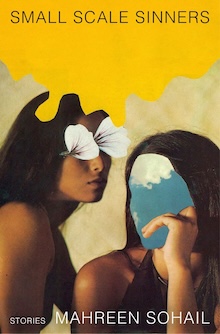
A Public Space Books, September 2025
Varied as the “sinners” in this collection, the stories in this debut collection are anything but small. With a strong voice and engaging characters, Sohail writes stories that are frightening, funny, wistful, and bold. Her protagonists are usually female, and she’s particularly concerned with their liberation—and with the pitfalls they encounter on their way. The ghost of Shirley Jackson floats through this collection; Sohail shares Jackson’s talent for seeing what lies beneath the banal details of our everyday lives.
“Our School Year” opens the book, featuring the collective voice of a class—a pack?—of bright sixth-grade girls whose attention is captured by shy twins who are new to their all-girl school. The twins reside in a hostel on the school property, leading the narrators, who are day students, to believe the twins are orphans in need of protection and care. The girls become dead-set on the twins sharing the role of Cinderella in their class play even though the twins demur. As the collective narrator’s obsession intensifies, the story becomes a fairy tale gone awry. This story leaves no doubt that wickedness can come in small packages.
Originally published in Granta, “Hair” is another devastatingly good story. In it, Sohail addresses life-and-death issues alongside the mundanity of hair styles and sexual aesthetics. A young man intends to donate his own hair for a wig for his dying mother. He brings his girlfriend along, but the stylist says his hair is not long enough for the purpose. His girlfriend takes his place in the beauty parlor chair. Her true motivation, however, is to secure her boyfriend’s loyalty and move their relationship into more committed territory. As the stylist “cuts it all off in two quick strokes,” she shuts her eyes. “Really she feels like a saint. She feels quite amazing, as if she has finally transcended petty relationships and is now in the midst of the truest, greatest love she is capable of.”
Per the stylist’s suggestion, the woman agrees to shape her remaining hair into an asymmetrical bob, which the young man finds repulsive. Perhaps it’s the sense of obligation the woman’s sacrifice has created that is the unacknowledged source of his repugnance. Such an unintended consequence and the sacrifice of a beautiful head of hair suggest a skewed kinship with O. Henry’s well-known “The Gift of the Magi.”
“The Newlyweds” describes a young couple brought together for an arranged marriage. A few days before the wedding, the bride and her friend watch a porn DVD they found in the bride’s brother’s room:
A man pushed into a woman from behind, holding onto her hips as if she were a misshapen anchor. His face stayed taut like cutlery in the small, blue-white screen. After the movie was over, the girl sat cross-legged on her bed, facing her friend. She practiced whispered moaning sounds. At first they laughed, but soon became serious about the sounds. They practiced for thirty minutes and then went to sleep.
The couple keeps a goat in their back yard, which is unusual in their neighborhood. When it’s the young wife’s turn to host the neighborhood women for a luncheon, the husband comes home early to help. He arrives in time to rescue the goat from several girls, guests along with their mothers, who are tying it up in ropes: “The goat was thrashing, one knee bent underneath it as the girls pulled from either end, their faces rapt and gleeful.” Later, in bed, the couple agrees that the girls are monsters. Afterwards, they make love, touching “each other less cautiously than before.” Observing the girls’ cruelty and the goat’s predicament has awakened something in them, something they’d not understood about their own sexual natures.
Sohail is Pakistani-American, and the stories I’ve mentioned so far seem to be set in Pakistan, given the character’s names and the story’s atmosphere and situations. “The Park,” however, takes place mostly in Fatima Jinnah Park, a spruced-up public space in Islamabad, re-named for the woman Pakistanis consider to be the mother of their country. After her own mother announces they will go live in this park, the narrator worries that it has been built over a graveyard. Her mother is unconcerned: “All places are built on the back of someone else’s death.”
The narrator and her mother are churails—mythical witches created when women or girls die tragically. The word has intriguing resonances: “chur in the name reminding little girls and boys clinging to their parents of rats sucking on skin, the ail, of a long, unending wail.” They patrol the park one Sunday, looking for a certain type of man. They find him easily—he verbally abuses his wife before slapping her face. The narrator shapeshifts into a beautiful woman, and the churails easily lure the man into a secluded place where his fate awaits him. What feminist among us does not feel a frisson of satisfaction when the tables are turned against an abuser?
Reflecting on “Hair” in Reverse Engineering (Scratch Books, 2022), a collection of stories accompanied by interviews with their authors and edited by Tom Conaghan, Sohail declared, ”It’s exciting for me, the possibility that you can, if you do it well, do anything.” In this collection, Sohail demonstrates extraordinary skill as she reveals truths that often go unacknowledged. Never didactic, these powerful stories ring long and true.
+++
Mahreen Sohail was born in Islamabad, Pakistan. She has an MFA from Sarah Lawrence College, where she studied as a Fulbright Scholar, and was a Writing Fellow at A Public Space and a Charles Pick Fellow at the University of East Anglia. Her work has appeared in Granta, The Kenyon Review, Pushcart Prize XLII, and elsewhere. She lives in Washington, DC.
+
Sarah Holloway lives in Savannah, GA. Her work has appeared in SmokeLong Quarterly‘s blog, Roi Fainéant, Emerge Literary Journal, The Argyle, the Ekphrastic Review, Cowboy Jamboree, and elsewhere. She’s @sarahholloway.bsky.social.