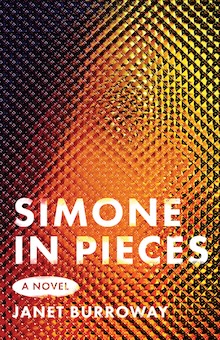
University of Wisconsin Press, November 2025
Simone in Pieces tells the story of Simone Lerrante, a Belgian war orphan and child refugee. Her story unfolds through multiple points of view, shifting between the Simone and those whose lives intersect with hers. These shifting perspectives invite the reader to build their own understanding of her, piece by piece, in a process that mirrors the traumatized Simone’s gradual reconstruction of her identity. The result is a subtle and layered novel in fragments.
Simone first appears through the testimony of a British woman interviewed in 1964 about her time with a trawler crew rescuing escapees from the coast of Nazi-occupied Belgium. This opening sets the tone for the rest of the novel; the reader’s understanding of Simone will always be mediated, with many of her life’s key events absent from the text. The circumstances of Simone’s rescue—a moonless night on the water—further obscure her. “The waves were thick,” the narrator says, “and the black shore, and now there’s this girl, maybe nine or ten, gawky little tyke, slogging through water up to her coat hem.” Expecting Simone to be traveling with her father, but hearing the sound of dogs barking nearby (“you never knew the meaning of dogs”), the narrator relates Simone’s first and only words of the voyage: “[M]y father arrives not. I arrive alone.” Her accent is suggestive: “She says ‘My Fah-zer.’ I knew better than to ask.”
Eventually Simone attends university at Cambridge, travels to America on a scholarship, marries, divorces, and toils in academic obscurity at a small Missouri college. Responding to her shifting identity, the novel’s focal characters often ascribe to her creative or generative powers. An American serviceman billeted with her initial foster family, away from his wife and a baby girl he has not yet met, describes Simone as speaking “a more formal English […] more words, more phrases, more flourish.” She seems to know more about him than she should. “‘Are you bereft of your baby?’ she asked him once, and he knew only in the vaguest terms what she was asking, but it also seemed exactly to describe that tingly dread.” Darla, the daughter of her foster parents in Hertfordshire, describes Simone as having ”extraordinary powers of transformation,” a person who gave others “the gift of concentration, that loss of self that makes this mundane world disappear.”
Burroway’s skilled characterizations allow the story to move effortlessly through these shifting perspectives. She presents her characters as full individuals whose understandings of their own lives reflect the novel’s core themes. Helping Simone and her husband after their car breaks down in Lovelock, Nevada, a gas station owner’s thoughts turn to his daughter, who resents working in the family business. “She’ll go off to college,” he muses, “and she’ll come back spouting smart, not bringing her friends because she don’t want them to see where she comes from, and not staying long because she don’t come from it anymore.” As a counter-narrative to the novel’s concerns with the meaning of home, this interlude rings a cautionary note: to be from a place can bring with it shame, confusion, and a sense of loss all its own.
It’s also through these multiple perspectives that readers apprehend the passing of time. Burroway so compellingly depicts the texture of life in various periods and social milieus that when she chooses to highlight artifacts of advancing time, such as the presence of flip phones or the debates around deconstruction and academic postmodernism, these elements feel like unnecessary signposting. In a less skillfully written novel these indicators might be needed to help readers situate themselves in a historical period, but Burroway’s writing of everyday experience is so strong and adaptable that the mention of these things are among the few instances in the novel where credibility is strained.
Simone does eventually recover some of her lost past through a set of coincidences. Characters return in unexpected ways. Some of these ways are apparent to Simone, others are clear only to the reader. That the characters are partially unaware of these coincidences provides structural satisfaction without tying the story’s emotional arc to unrealistic plot devices. In one of the novel’s more explicitly metatextual passages, Simone calls out the danger that coincidence poses for narrative. “I think that death put in its appearance increasingly as the jackboot crossed Europe and my mother’s health began to fail,” she says. “I also think that such a memory partakes of the same insidious process that drives people to the Tarot pack and the horoscope: to make coincidence a cause.” If one of the novel’s conceits is that identity becomes intelligible by threading parts of the self into a cohesive story, the prose after Simone’s reawakening becomes increasingly lucid as her capacity to craft such a narrative grows. This final confirmation of Burroway’s command of characterization sets the stage for Simone to live out the last years of her life inside a story that is at once both satisfying and believable.
+++
Janet Burroway, the author of Writing Fiction: A Guide to Narrative Craft, has written eight previous novels, as well as a memoir, plays, short fiction, children’s books, and more. Recipient of the Florida Humanities Council’s Lifetime Achievement Award in Writing, she is Robert O. Lawton Distinguished Professor Emerita at Florida State University at Tallahassee.
+
Martin Horn‘s writing has appeared in The Worcester Review, Passengers and Short Fiction Journal. He lives in Montreal, Canada.