Our editors share a few of the most memorable books of the year
(we also shared our recommended reading from the first half of the year a few months ago)
Michelle Bailat-Jones, translations editor
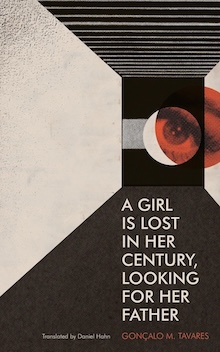
One of the most interesting short books I’ve read in years, A Girl is Lost in Her Century, Looking for Her Father by Gonçalo M. Tavares, translated by Daniel Hahn (Deep Vellum, 2025) expands like unfolding a piece of complicated origami. The story begins with Marius as he finds 14-year-old Hanna on a street holding a box of instructions “for people with learning disabilities.” Hanna, who has Down syndrome, says she is looking for her father. After a few unsuccessful off-the-page attempts to locate where Hanna might have come from and to return her safely there, Marius sets off with her to Berlin, ostensibly to find this missing and mysterious father. Their path is filled with rich but tangential stories that appear, unexpected and curious, in anecdotal compartments that touch the main story but are otherwise seemingly unconnected. Thematically, the side stories all link up in some way to the Holocaust; whether this links them to the main story is where the novel remains opaque. Instead of creating frustration, however, I found the book’s refusal of neatness or prescriptive meaning, especially in light of the seriousness of its topics, one of its greatest strengths. It seemed to be asking, again and again, Who are we? Why do we do what we do?
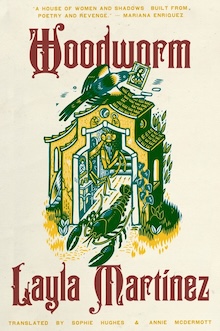
My second selection is Woodworm by Layla Martinez, translated by Sophie Hughes and Annie McDermott (Two Lines Press, 2024). There are many layers – social, political, historical – in this tiny, dark novel. Woodworm is filled with shadows and ghosts, stifled voices, family legends, a haunted house, and even hallucinations. The story is narrated by two women, a granddaughter and a grandmother, and the plot dances around the supposed abduction of a local wealthy family’s child for which the granddaughter has been blamed, but each page adds details about older members of the family, about a different missing person, about what these women have experienced, how the men have harmed or failed them, how society has cheated them, and all of this builds up around that central story until the novel is almost seething with rage.
Loosely linear and decomposed, though not quite written in verse, the prose of How to Leave the World by Marouane Bakhti, translated by Lara Vergnaud (Divided Publishing, 2024) feels appropriately raw around the edges, for this is content that cannot be smoothed out. Bakhti’s narrator (who both is and is not Bakhti) writes of a coming-of-age that has been fractured, in the sense that the different parts of his identity are never allowed to exist in any context. In France he is too Arab, in Morocco he is too French. His father cannot understand or accept his sexuality, and he himself struggles to reconcile his own feelings of anger, fragility, and shame. Grappling with more than just these feelings, the narrator gets the sense that these emotions could become an identity—and what would that mean? Something I particularly enjoyed about this novel was that although the narrator is drawn to observations of nature as a form of solace, the book overall remains uneasy with the idea that solace could be so easy. That honesty was both refreshing and drove the (slender) narrative.
A few other translations I enjoyed this year: Money to Burn by Asta Olivia Nordenhof, translated by Caroline Waight (Vintage, 2025); House of Fury by Evelio Rosero, translated by Victor Meadowcroft (New Directions, 2025); On the calculation of volume (Book One) by Solvej Balle, translated by Barbara J. Havelan (New Directions, 2024); and Eurotrash by Christian Kracht, translated by Daniel Bowles (Liveright, 2024).
+
Diane Josefowicz, books editor
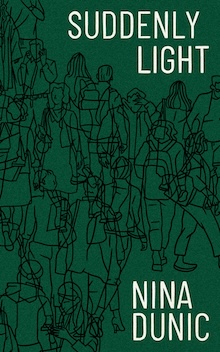
Suddenly Light by Nina Dunic (Invisible Publishing, 2025) brings together fifteen quiet stories that I savored this fall, like delicacies, over an equal number of elongating nights—and then wished for fifteen more. These quiet stories are so perfectly immersive, so sensitively paced, and so gorgeous in their detail that they banished the desperate noise of the daily news cycle and reminded me that other ways of being are possible. In Dunic’s hands, even a dull dinner party becomes an occasion for renewal as the narrator discovers her missing aliveness in mundane conversation with others, “brushing against their lives, feeling the immediacy of hers.”
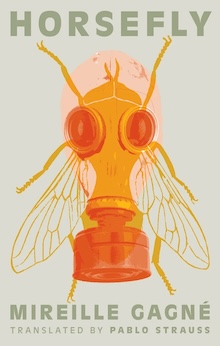
My next pick is Horsefly by Mireille Gagné, translated by Pablo Strauss (Coach House Books, 2025). In one strand of this fascinating braided novel, it’s 1942, and a military entomologist is stationed on a remote Canadian island where he’s tasked with developing a bioweapon for the Allies. In another, a young man bitten by a horsefly at the turn of the millennium kidnaps his grandfather, who is losing his mind to dementia. A third strand involves a swarm of horseflies born in 2025 on the banks of the Saint Lawrence River and is told from the point of view of a single, exceptionally malicious specimen who gleefully rhapsodizes on the delights of a blood meal. Gagné’s unhinged insect consciousness had me squirming and writhing—and making a note to double-check the window screens for holes before the warm weather comes round again.
Expertly translated by Jessica Moore, each story in Maylis de Kerangal’s Canoes (Archipelago Press, 2024) is a faceted and brilliant gem. Like Suddenly Light, this collection is something to be savored, though de Kerengal’s gustatory palette is more vivid and intense, suited to her characters as they find themselves in absurd, surreal, or impossibly difficult predicaments. Take the premise of one story, “The Light Bird”: After the death of his wife, a father must decide what to do about the outgoing message she left on their voicemail, which their daughter can no longer tolerate hearing when she calls, but neither can she bring herself to ask her father to erase the message. Circling around the painful subject with his grief-stricken daughter, the father observes “the ceiling seem[ing] to grow round like a cupola, more vast, more sonorous, and in this shifting light I saw my child stand, suddenly brought back to grief, and all at once find the way in.”
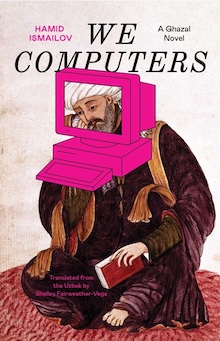
Finally, a word about We Computers: A Ghazal Novel by Hamid Ismailov, translated by Shelley Fairweather-Vega, (Yale UP, 2025). It would be easy to say that this sparkling and timely novel, by Uzbek writer Hamid Ismailov, is about an AI that can write poetry. But it would be more accurate, and interesting, to list the nuances that transform the premise into something much more. Ismailov’s novel is, among other things, an ode to the poet Hafez, a deep dive into the classics of Sufism, and an absurdist techno-tragicomedy that’s also a resounding high-five to the power of literary art.
+
Steve Himmer, editor-in-chief
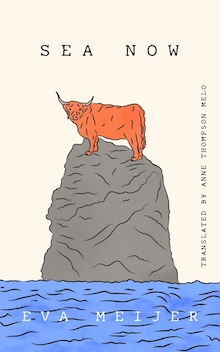
Eva Meijer’s novel Sea Now, translated from Dutch by Anne Thompson Melo for Two Lines Press, is a very funny, very sad imagining of a scenario in which the ocean rises higher and higher, stretching across the Netherlands with no sign of stopping. Rather than a high-concept thriller about battling the sea, Meijer shows us the bureaucrats and activists, among others, as they respond personally, politically, and emotionally. And in keeping with her other works in translation — both her fiction in the earlier and excellent Bird Cottage translated by Antoinette Fawcett, and in her scholarly writing on animal communication — Sea Now isn’t only interested in human experience as it asks, wryly and playfully but also seriously, how the catastrophe will be experienced by other creatures on the land, sea, and air, and even extends that question to the mute presence of dykes (as it does in one of my favorite passages which you’ll need to read the book to see for yourself).
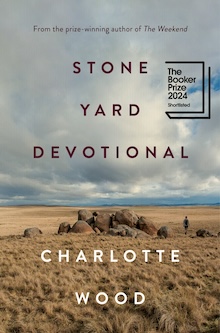
Stone Yard Devotional by Charlotte Wood (Riverhead) brings us a narrator who reaches a turning point in her life at a remote convent for a retreat that is both spiritual and personal. I won’t say too much more about the situation or events of the novel, not because it is plot-driven or full of twists, but because what I enjoyed most about it is how confidently it does not rely on those things. It’s a novel willing to offer up small shifts and astute observations, with enough story happening to stay engaging. And it’s a novel about how to be in the world, asking whether trying to be active and forceful about making change accomplishes more than withdrawing, and how we account and even atone for the impact we’ve already had. So it’s philosophical, yes, but so tangibly grounded in place and and in the labor of maintaining a home and a community and a life that it never drifts into abstraction.
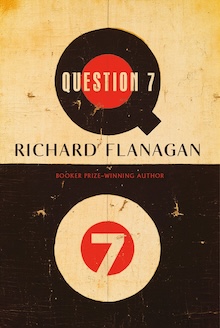
And while it’s pushing our focus on “fiction” a bit, Question 7 by Richard Flanagan (Knopf) is a book that’s going to haunt me long past the end of this year, likely more than any other I read. Too much description won’t do it justice but Flanagan’s book is a memoir with imagined scenes from other lives than his own (so, fiction enough for me to include it, I’ll say). It’s an inquiry into how turns of history far from ourselves have an impact on our lives — like a kiss that echoes across decades with unpredictable impacts, and a bomb that does the same — and the way a distant event might be the portal through which we enter the world. How do we live knowing we might not have happened at all, or that we might have already died in so many ways as Flanagan examines in his own life, but also knowing that by living we might be making possible so many things we can’t yet see? I’m hardly doing the book justice because the flow of it, the surprises from page to page, are so much greater than I’m conveying here. I’ve been reading Richard Flanagan for a very long time, ever since I just happened to be in his Tasmanian home when his first novel, Death of a River Guide, was newly published and popular among the hikers and conservation workers and kayakers among whom I was spending my time. He’s been a varied and ranging writer for years but this book, Question 7, feels like a kind of culmination of all things he’s been working with during that time, and like a truly special book.
+++