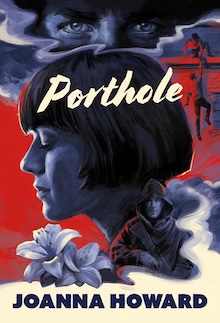
McSweeney’s Books, 2025
Early in Joanna Howard’s novel Porthole, famed art-house director Helena Désir recounts her childhood living with her uncle, Yiorgos, a painter, on a boat moored in Sausalito, California. The existence she describes is both transient and strangely static, their lives punctuated by the comings and goings of her uncle’s various lovers and benefactors, Yiorgos carefully choreographing each entry and exit to minimize the possibility of awkward encounters. “Never let the lovelies meet,” he tells his niece, advice she takes to heart. But as the novel unfolds, it becomes clear that there are other, more integrated and collaborative models for both creative and intimate partnerships.
Helena at first seems to do well by adopting Yiorgos’s approach. All this changes following the accidental on-set death of her most recent muse, the blank, mononymic Corey. The opening of the novel finds Helena, wracked with barely articulated guilt, arriving for a stay at Jaquith House, a luxury retreat, which her studio pays for in an attempt to salvage what is left of her mental health, not to mention their investment in her career. Alone, and showing signs of strain she acknowledges but doesn’t entirely recognize, Helena surrenders herself to the care of Dr. Duvaux and an entourage of inmate-caregivers who include a chef, a broker, twin Finnish masseuses, and a sound artist. Helena wanders the grounds, meeting the inhabitants, the environment hallucinatory and unstable, a heterogeneous mix of architectural styles, a constructed landscape more like a film set than a real place. “Jaquith House strives to embrace a kind of eclecticism of space and mood,” Dr. Duvaux insists. “The old with the new, the arcane alongside the ultramodern. But tasteful, Helena.”
The true action of the novel takes place in Helena’s memory, in her recounting of her struggles to realize her creative vision, and in her recollections of each leading man she has directed: Emile Laval, a Québécois circus performer; David Trevor, a British stage actor; the immaculate Corey. Porthole veers between the dreamlike environs of Jaquith House and the more realistic scenes of Helena’s memory. While Helena’s narration of the present comes as she is perceiving it, giving her no time to edit, embroider, or alter, she has, by contrast, had plenty of time to structure an account of the past. That she imagines reading historical fiction to be an ideal form of relaxation is not a coincidence, and similarly, her memories are easier to parse than her impressions of the present. As she recounts her past, Helena often begins speaking aloud without being aware that she’s doing so. “Was I speaking?” she asks out loud several times, her narration leaking into the action of the story. This eruption of the past into the present moves the reader between timeframes, emphasizing the depth of Helena’s disorientation.
There is always a risk for the writer in trying to move between realist and surrealist modes. Absent clear character motivations, dreamlike sequences can drag. More concrete narrative elements can seem prosaic in comparison. Howard mostly avoids these dangers through the strength of Helena’s personality, though her interactions with the inmates of Jaquith House do verge so closely on the surreal that the purpose of some scenes seems to dissolve. Where the novel succeeds is in the characterization of its key figures. The conflict between Helena’s need to control every aspect of her actors’ presentation and their desires for agency and for their own flourishing is rendered in sharp, clarifying, and often very funny dialog. For instance, when Corey shows signs of wanting more control, Helena asks him, accusingly, if he wants to work with someone else:
‘‘I want to have options,’ he shoots back.
‘Options! You want to put my projects on the back burner while you whore your way into… into… what? A superhero role? A rom-com?’
‘No.’
‘My film should sit by the phone while you film a video game tie-in?’
‘What film?’
‘My hypothetical next film.”
At its best, Howard’s writing is affecting and generous. Joy is particularly evident in her descriptions of the physical locales of the novel—grandiose, baroque interiors and ornate set-like spaces that evoke both specific periods in history and a sense of placelessness. There is the dining car, reachable only through “a little hidden door, papered into the contour of the wall,” of the dining room proper and which opens to reveal a passage that leads Helena “into a narrow carriage lined with windows and passenger seats. Helena continues: “Indeed, it did seem as though we had entered a train carriage, and there was even a bit of swooshing and rushing wind, and it seemed a slight vibration to the car, and a slight clickety-clack, clickety-clack.”
Howard has referred to Porthole as a fantasy in which women artists are able to dispose with men as easily as male artists do with women, and Helena’s relationships do bear echoes of noted, fraught relationships between male artists and their female ingenues. But, Porthole suggests, there are other, more integrated and collaborative models for both creative and intimate partnerships, ones that expand the possibilities for grounded, connected work, as opposed to foreclosing them. To the extent that Helena finds salvation, it is commensurate with her ability to understand this.
Curiously, Uncle Yiorgos bears more than a few similarities to Agnès Varda’s cousin Jean Varda, the subject of her 1967 documentary Uncle Yanco. A collage artist, Jean Varda lived in a converted barge in Sausalito with a rotating cast of young women he referred to as his “graces.” Joanna Howard deploys this character type to create a backstory for Helena, but more than that, the plucking of background material from one of Agnès Varda’s films also invokes Varda’s famously collaborative and open approach to filmmaking, helping frame the central question of the novel: What possibility is there for rootedness and relation in the context of a life spent fulfilling an artistic vision?
+++
Joanna Howard is a writer and translator from Miami, Oklahoma. Her work has appeared in Conjunctions, Verse, McSweeney’s, BOMB, Chicago Review, Brooklyn Rail, and elsewhere. She is the author of the memoir Rerun Era; the novel Foreign Correspondent; the story collections On the Winding Stair and In the Colorless Round; and Field Glass, a collaborative novel written with Joanna Ruocco. She also co-translated Walls by Marcel Cohen and Cows by Frederic Boyer. She taught in the Literary Arts program at Brown University for fifteen years before moving to University of Denver’s PhD program in Literary Arts, where she teaches prose writing and prose and poetry hybrids, narrative theory, and contemporary literature.
+
Martin Horn‘s writing has appeared in Passengers and Short Fiction Journal. He lives in Montréal, Canada.