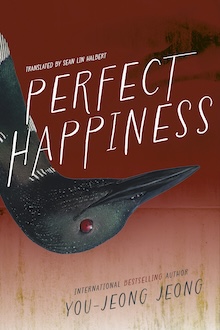
Creature Publishing, September 2025
Perfect Happiness by You-Jeong Jeong, translated into English from Korean by Sean Lin Halbert, weaves together the perspectives of different characters close to Yuna Shin, focusing on their knowledge of the events surrounding the disappearance of Yuna’s ex-husband, Joon-Young Seo. Altogether this thriller is a chilling look at a sociopath’s psychological abuse and its effect on those around her. The novel’s structure provides the reader with insight the characters lack, effectively pulling the line of tension so taut, it feels like it will surely snap at any moment.
The novel opens on the night of Joon-Young’s disappearance, when Jiyoo discovers her mother covered in blood. Yuna informs Jiyoo that Joon-Young has left without saying goodbye to his daughter, and that he won’t be returning. The author builds suspense not by asking the reader to decide if Yuna killed him—she most certainly did—but in leading the reader to wonder what else she might do as her family members fumble toward the truth.
Jiyoo, Yuna’s daughter, thinks of Yuna as Mother. Yuna’s current husband, Eun-ho, thinks of her simply as Wife. It is only through Yuna’s sister Jane’s point of view that Yuna appears as she really is. More than merely a domineering Mother or unpredictable Wife, Yuna is a violent-tempered narcissist feared even by her own family of origin.
That Yuna is a monster is clear from the first pages. What the reader does not know are the secrets of Yuna’s past. Using multiple points of view, the author builds tension as each character pieces together his or her memories of the day Joon-Young was last seen. Each new piece of the puzzle reveals an increasingly chilling side of Yuna and the extremes to which she will go in her quest for a perfect life.
As the characters’ disparate relationships with Yuna are uncovered, the reader begins to understand the lies Yuna has told to keep her family members from truly knowing that Yuna is “nothing but an animal wearing the skin of a human,” as Jane believes. The reader has the sometimes maddening sense that if the characters would just share with each other their sides of the story, all would be revealed, but the characters are connected to Yuna, not each other, and even stepfather Eun-ho and stepdaughter Jiyoo don’t know each other very well.
Unlike Jane, Jiyoo and Eun-ho find Yuna incredibly magnetic. Jiyoo, for example, sees in her mother “eyes that were like warm water that could melt away Jiyoo’s worries.” Eun-ho falls for Yuna quickly after meeting her, seeing her as a woman whose “laugh was so light and smooth that it tickled his stomach, as though he had swallowed a feather. This sensation spread through to the back of his neck, causing the hair there to stand up.” This automatic, almost ASMR-style response to Yuna when she’s happy is surely deepened by her volatile mood swings. When she’s nice, she’s very nice, but when she’s mean, she’s manipulative and emotionally abusive. Jiyoo and Eun-ho have learned from experience to be cautious around Mother and Wife.
Jiyoo, Eun-ho, and Jane’s lack of communication is not the only barrier to the truth. The characters often don’t know if they can trust their own eyes. Nightmares are used to great effect throughout the novel, as characters often witness the events in a half-awake state and then are later unsure what was real and what was a dream. Similarly, the characters hear voices in their heads, giving a schizophrenic feel to their perspectives.
The most notable of these voices is Mischievous Mouse, the voice heard by young Jiyoo that tells her to go against Mother’s wishes. It is Mischievous Mouse who encourages Jiyoo to take the finger puppet, labeled Dad, that she finds in the attic of Mother’s secret house. Dad Puppet becomes a calming presence for Jiyoo. “He protected her from long hours alone in her room, he protected her rekindled longing for Father, and he protected her from [. . .] the guilt of doubting what Mother said.” In Dad Puppet, Jiyoo finds the parental figure she desperately needs.
“Happiness isn’t addition,” Yuna tells Eun-ho early in their relationship. “Happiness is subtraction. It’s getting rid of the possibility of unhappiness until life becomes perfect [. . .] I’ve lived my whole life striving for that perfect happiness.” What acts of subtraction is Yuna willing to commit in order to preserve her own happiness? For the characters orbiting Yuna, this ia a central question. The novel shows family relationships through a new and unsettling lens: How does a person know if they can trust their own family?
+++
Known as South Korea’s Stephen King, You-Jeong Jeong is an award-winning and bestselling author of psychological thrillers and crime fiction. Her books have been translated and published in twenty-three countries, including the US, UK, France, Germany, Finland, China, Japan, and Brazil.
+
Sean Lin Halbert holds an MA in Korean Literature from Seoul National University. He is the recipient of the LTI Korea Aspiring Translator Award, the Korea Times Korean Literature Translation Award, and the GKL Translation Award. He lives in Seoul with his wife and daughter and teaches at LTI Korea Translation Academy. Perfect Happiness is his sixth novel in translation.
+
Ashley Cowger (she/they) is the author of two short story collections: On the Plus Side (Galileo Press) and Peter Never Came (winner of the Autumn House Press Fiction Prize). Their fiction and creative nonfiction have appeared in several literary journals, including Hippocampus Magazine and New Ohio Review. They work as an Associate Teaching Professor at Penn State Harrisburg.