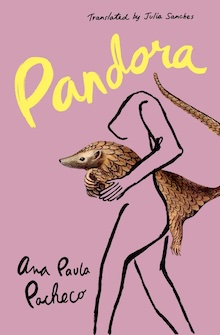
Transit Books, November 2025
Pandora begins with a pangolin clinging tightly to the right leg of a woman wearing a single high heel “to make up for the imbalance caused by the creature.” Within pages, the pangolin has decided and failed to become a professor, gotten himself banned from broadcasting on Facebook Live, and begun to domestically abuse the protagonist, a literature professor named Ana, by throwing cutlery across rooms and defacing her walls with “a dribble of blood and, in bas-relief, the word ‘Metagalaxy.’”
The novel only gets stranger from there.
Pulsating across genres, interrupting and surprising the reader at every turn, Pandora follows Ana through the medication-addled isolation of the Covid-19 pandemic, detailing, in dreamlike vignettes, the perils and stresses of being alone. In this difficult but rewarding novel, Pacheco expertly weaves the delusions, paranoia, and urban fear which defined the global lockdown period. In a series of sketches, Pacheco conflates consumption, abjection, and love—with a purpose. Five years after the appearance of the virus, the novel still feels prescient, intent on reckoning with the consequences of a part of our lives we have been perhaps too eager to forget.
The plot, insofar as there is one, revolves around Ana, a self-proclaimed “modern woman” confined to her apartment at the height of lockdown. Her lover, Alice, has died of Covid-19, and further details are impossible to ascertain. In fact, much of Ana’s day-to-day life appears through a mucosal veil of symbolism, allegory, and hallucination.
For Ana, nothing is above contradiction, and anything is possible. She oscillates between delusions: telling her therapist her grade school was run by a secret society of cannibals who ate her elementary-school boyfriend before wiping her mind with a solar eclipse; co-running a brothel with the now-dead Alice, selling virtual sex with starving women as a combined academic/social justice project and flirting with the idea of “sorting things by fetish and curating a text for each one, like pairing food and wine at a dive bar”; writing as a dolphin receiving labioplasty, a denture-wearing bear, and a compulsively molting eagle.
Ana wanders ceaselessly, inventing nonsensical syllabi on the connection between art and finance, worrying her beloved cat Felício has been replaced with an identical feline political operative—connected, of course, to the Society of Human Cannibals who ran her elementary school—and engaging in dodgy “marriages” with a number of animal companions: the aforementioned pangolin and a giant vampire bat.
Pacheco remains firmly planted in Ana’s unreality, never revealing what is truly going on in or around the apartment. She delights in evoking a skin-crawling nausea by constantly referring to the “bulging eyes” and “rotten smells” of the rotating cast of diseased animals who share that apartment, including, perhaps most upsettingly, an ever-present carpet of ants and termites who “crawl into the books and the flooring, into the doors and concrete columns.” By sticking with Ana’s point of view, Pacheco raises questions about Ana’s morality, especially in regard to the numerous incidents of sexual violence and bestiality which pervade the book. But she never condemns Ana or her actions, nor does she invite the reader to do so, regardless of how vile Ana may seem. After all, what use is morality when, as Ana writes in her diary, “[t]he elderly were dying, the poor were dying, unemployed artists were dying, nurses were dying.”?
All the while, Ana meditates on past, present, and future catastrophe, weighing a pervasive willingness to die against an equally pervasive desire to continue to live, even as the world collapses around her “I want to go to hell,” she says early on, “just not yet.” Ana repeatedly faces tragedy, sickness, and death on a personal and global scale; over and over, she expresses a powerless desire to “pull herself back together,” attempting to do so in illogical ways that are also deeply emotionally resonant. Through sex (mostly with animals), medication, and transformation, Ana desperately seeks an end to an all-consuming grief, a way to, as she puts it, “keep things light.”
The beauty and fluidity of Sanches’ translation never subtracts from the feelings of disgust and shame that the Anas (both the author and the character) seem intent to court; instead, the sensuality, texture, and affectivity of the language inspires an empathy that bubbles up almost despite itself. Pacheco unites her style and her characters in a spiral towards destruction which still, despite the revulsion Ana’s actions inspire, manages to feel strikingly human: odd, disgusting, desperate, hopeful.
As Ana says of the pangolin, “I felt sick to my stomach and I fell in love.”
+++
Ana Paula Pacheco is a professor of literary theory and comparative literature at the University of São Paulo, and author of the books Lugar do mito, about the work of João Guimarães Rosa; A casa deles, a collection of short stories; and Ponha-se no seu lugar!, for which she received the Seleção Cátedra Unesco prize.
+
Julia Sanches is a translator of Portuguese, Spanish, and Catalan. She has translated works by Susana Moreira Marques, Claudia Hernández, Daniel Galera, and Eva Baltasar, among others.
+
kay kemp is a 4th-year Ph.D. candidate in the Theatre and Performance department at Columbia University. Their research focuses on dramaturgies of the Real after the broadcast era, centering on documentary, museums, and political occupation through the lens of performance.