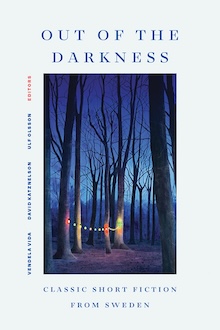
University of Minnesota Press, May 2026
“I need to travel to purge myself of Sweden and Swedish stupidity,” wrote August Strindberg in a letter to his editor in 1884. Renowned for his itchy feet, the celebrated Swedish playwright travelled extensively throughout his lifetime, living in dozens of different places in Stockholm and abroad. Yet he spent the vast majority of his life writing about Sweden, and indeed about Swedishness, including the three short stories featured in Out of the Darkness, a delightful, dynamic anthology of classic Swedish short fiction that hums with a cultural anxiety epitomized by this impossible wish to purge oneself of one’s own provenance.
Strindberg is perhaps the most well-known of the dozen-odd writers featured in the collection, who are generally concerned with their own pursuits of—and definitions of—freedom, circling broader questions about belonging. In the opening offering, “The Gates” by Agnes von Krusenstjerna, a Swedish aristocrat who cast off her title in favor of intellectual pursuits, and who suffered bouts of mental illness throughout her life, a woman who leaves an asylum only to find herself rejected by high society. She returns to her doctors, who readmit her the next day, putting an end to her experiment in self-determination. In Strindberg’s own “What the Tree Swallow Sang,” the prisoner-protagonist dreams of a perfect “green wood,” a fantasy of freedom that might provide a respite from his captivity.
For the characters in these stories, to flirt with this sovereignty is to flirt with the unknown. Whether it’s a product of deep piety, provincialism, or the strictures of society, a condition of unknowing pervades the collection. In “The Outlaws,” Selma Lagerlof spins a surrealist and increasingly claustrophobic tale of unlikely male friendship between a fisherman and a peasant that ends in a beheading which reads somewhere between erotica, sermon, and medieval dream poem. Similarly hallucinatory and haunting is Thorsten Jonsson’s “Fleeing to Water and Morning,“ in which a man on the run finds himself, altogether improbably, riding a moose through a lake.
Perhaps inevitably, Sweden’s long, dark winters also make repeated appearances in this collection, beginning with its title. Katrin Boye’s “Prelude” opens, “Darkness was beginning to fall.” In Hjalmar Soderberg’s “Drizzle,” “[i]t is autumn again and the days are dark.” In Victoria Benedictsson’s 1888 story, from which the collection’s title is derived, “[t]wilight prevailed in the room.” The collection is undoing two kinds of darkness, then: firstly in its intention to hold up unseen or unknown characters and worlds to the light, and secondly—more crudely, perhaps—to draw our attention to the fact these stories are products of a country that is itself so often very literally seasonally affected, steeped in dark.
But, as the introduction notes, “relative oblivion […] creates an opportunity.” Altogether these writers and their writing leave an impression neither of parochial gloom nor of narrow minds, but of a vast, capacious wilderness of imagined, or reimagined, lives and times. The stories lend an intense psychogeography to the local landscape, forging a portrait of Sweden as a cloying but fecund place.
Perhaps the most surprising story in the collection is “A Clown’s Catechism” by Hjalmar Bergman. In the 1920s, Bergman left Sweden for Hollywood and was prompted to write a horror-inflected meta-novel, from which the editors extract the first two chapters. Placed at the center of the book, the excerpt, set in the U.S., at first feels jarringly out of place. Formally, it mirrors the screenplay, with dialogue between an Announcer and a foreigner clown named Jac who is performing before a circus crowd. By far the longest piece, it unfurls, irreverently, to reveal itself as a linchpin of, if not a manifesto for this richly textured period of Swedish writing, walking “the slackline of emotion” for a broader audience. It’s a story of mistranslation—between announcer and clown, act and audience—suggesting that both storytelling and cultural exchange are varieties of clowning; that is, of performance or pretence.
Its presence prompts the question: What, apart from opportunism or obscurity, holds these stories together? What makes a story a Swedish classic? Broadly speaking, the writing here is all strikingly fabular, or philosophical, in one way or another. The period—the wide corner of the turn of the century—was one of immense and rapid change, in Sweden and elsewhere, and many stories deal with an abutment of tradition and technology. For instance, in Karin Boye’s searching “Streetcar and Paradise,” a painter, despondent over the arrival of the automobile in Sweden, is prompted to wonder what the whole point of culture is. This is the question that all these stories are turning over: How should a nation, a landscape, or a life be and feel? More importantly, how should one write about it?
The final story returns to Strindberg, for the totally beautiful (and very possibly autobiographical) “Half a Sheet of Paper,” which is barely longer than that itself. A man moving out of his apartment picks up an old notepad by his phone. He reads the various scrawlings, and “in two minutes, he’d lived through two years of his life.” This emotionally precise, and suitably meta, ending concerns what it means to be purged—to move on, to be moved, to keep moving— while preserving an identity and a tradition. Strindberg’s protagonist “took the sun-paper, kissed it, and put it in his breast pocket.” Out of the darkness, so much sun-paper.
+++
Vendela Vida is a founding editor of The Believer magazine and the award-winning author of six books, including Let the Northern Lights Erase Your Name, The Diver’s Clothes Lie Empty, and We Run the Tides. Two of her novels have been New York Times notable books of the year, and she received the Kate Chopin Award, given to writers whose female protagonists choose an unconventional path.
+
David Katznelson is a Grammy-nominated musicologist and record producer and publisher of the newsletter The Signal From David Katznelson.
+
Ulf Olsson is professor emeritus of literary studies at Stockholm University and literary critic for the daily newspaper Expressen.
+
Martha French is a writer and literary scout based in London. Her writing has been published in Polyester, TANK, and The Mays anthology.