Charco, August 2025
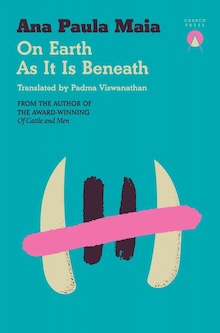
“In the end, we’re all free because in the end, we’ll be dead.” This fatalistic maxim is the epigraph of Ana Paula Maia’s slim novel On Earth As It Is Beneath, translated by Padma Viswanathan from the Portuguese. Linking liberation to death, the phrase is attributed to Bronco Gil, a prison inmate who first appears dragging a dead boar, attracting the attentions of another inmate, a guard, and the warden of the desolate penal colony in rural Brazil where the novel takes place.
By fashioning an epigraph from a character in the novel, Maia feeds the sense of dread isolation that pervades the whole. Throughout, both the scant few prisoners and the two government employees charged with looking after them are trapped, literally by massive walls and ankle monitors rigged to explode past a perimeter, and figuratively by madness and feelings of despair and indifference.
The penal colony is closing, but nobody knows what happens next. In this apparently modern but pre-internet setting, the phone lines are down, and the increasingly erratic warden, Melquídes, has shot the five horses that might have ferried messages. A state official is rumored to be coming to sort things out. But when?
Bronco Gil considers what pens him in: “These aren’t walls, to him, they’re ramparts like nothing he’s ever seen. Impossible to see what’s there on the outside, impossible to see what’s here on the inside.” Atop these impenetrable walls, even vultures perish, electrified by high voltage wiring. Because “no one wants to see what happens here on the inside,” the penal colony is isolated, cut off from the world.
If this penal colony is a world unto itself, it is also—as the book’s title declares—a world on earth as it is beneath. Which is to say: it is a hell, decaying into the underworld it exhumes. Accordingly, Maia’s narrative descends into trauma and pain. The warden Melquídes, a hunter who stalks dangerous game, gripes to one inmate that punishment lacks efficacy; eventually, everyone becomes “used to brutality.”
Even so, Melquídes innovates with his cruelty, and his methods demand that the dwindling inmates dig graves. They work carefully to avoid disturbing corpses that have been in the ground for centuries, the remains of enslaved people who were held, tortured, and murdered in ages of empires past. Still, sometimes their shovels break bones. They find an old box filled with something so horrible that its contents go unspecified as the men return to their barracks: “Along the way, they don’t mention what they dug up. They keep quiet, and quiet they will stay. The impact of what has happened has left them confused, their souls reeling.”
When such unspeakable violence, rendered in sparse prose, unfolds against an unforgiving landscape, comparisons with Cormac McCarthy are inevitable. Much credit is due to Padma Viswanathan, whose translation preserves a mythic vision that recalls McCarthy’s oracular intensity. For her part, Maia signals her debt with a stunning bit of characterization. Melquídes’s head is “smooth and white as an egg, glisten[ing] in the darkness.” The Judge, the chaos god of McCarthy’s Blood Meridian (1985), removes his hat to peer at his prey: “The great pale dome of his skull shone like an enormous phosphorescent egg in the lamplight.” Merging primal energy with end-times wrath, these glowing eggmen are twin agents of ruthless inhuman pursuit. Yet in Maia’s hands, the villain is more vulnerable, and the tone as a whole skews comic and absurd. The truer analogue is McCarthy as refracted through the Coen brothers in No Country for Old Men (2007), since Maia—who also writes screenplays—is attentive to how a character’s fate hinges on moments of bleakly understated farce.
The cinematic core of Maia’s storytelling also contributes to an intriguing tension. On the one hand, she is committed to surfaces, surveying scenes of unadorned action with the detached precision of a documentarian. In a 2023 interview, Maia explained: “My characters are direct and objective. They live lives free of subterfuge, without much choice, focusing just on what needs to be done. A construction of drawn-out reflexions filled with digressions would be out of place in a story where these characters are the centre.” Because her characters exist at the gritty margins of society—doing what she calls elsewhere “the dirty work of others”—they have time and energy only for what is in front of them. These plain men appear plainly, like rough textures captured by a camera.
Yet if Maia’s characters are “direct and objective,” if they live “free of subterfuge,” her narration nevertheless adopts a third-person omniscience with unfettered access to interiority. She dives into one mind and then the next, sometimes even grasping them collectively. This, after all, is how we know that “their souls [were] reeling” as the inmates walked away from the box they unearthed and its unspeakable contents. Writing characters who take the pitiless world as it comes, Maia reaches into inner lives that are as shallow—and as haunted—as the graves that litter the ground.
+++
Ana Paula Maia is an author and scriptwriter. Her novel Of Cattle and Men (2023), translated for Charco Press as by Zoë Perry, won the UK Republic of Consciousness Prize as well as the inaugural Cercador Prize for Literature in Translation in the US. Maia also won the São Paulo Literature Prize for Best Novel of the Year two years in a row: in 2018 for the novel On Earth As It Is Beneath (translated by Padma Viswanathan, 2025), and in 2019 for Bury Your Dead, out with Charco Press in 2026.
+
Padma Viswanathan is a Canadian-American writer and translator. She has published work in Granta, The Boston Review, BRICK , and elsewhere. Full-length translations include São Bernardo, by Brazilian novelist Graciliano Ramos, and Where We Stand, by Djamila Ribeiro. Her most recent novel, The Charterhouse of Padma, came out in 2024. She is Professor of Creative Writing at the University of Arkansas-Fayetteville, where she is Founding Director of the Arkansas International Writer-at-Risk Residency Program.
+
Benjamin J. Murphy is an Assistant Teaching Professor in English at Elon University, where he teaches African American literature and writing. His articles and reviews appear in publications such as American Literature, boundary 2, Chicago Review of Books, Configurations, Full Stop, Mississippi Quarterly, and Studies in American Fiction. Learn more at: https://benjamin-murphy.com/