Penguin Classics, July 2026
What drives a narrative, the author or the story’s inspiration? That’s one question absurdist-realist Indonesian writer Budi Darma explores in Olenka, a novel of literary obsession translated into English for the first time by Tiffany Tsao. While raising a classic question about the nature of fiction writing, Olenka suggests that the work of the fiction writer is to obsess and to fantasize.
Like Darma’s previous story collection People from Bloomington (2022), Olenka was written quickly and shaped by Darma’s time as a PhD student at Indiana University Bloomington in the late 1970s and early 1980s. People From Bloomington was also translated by Tsao, who won the PEN Translation Prize and the NSW Premier’s Translation Prize for that work.
Set in Bloomington, Olenka is a novel of writers and their books. Olenka‘s first-person narrator, Fanton Drummond, is obsessed with a woman, the titular Olenka, and also obsessed with books and writing. Olenka’s husband and Fanton’s rival, Wayne, is also a writer. When Olenka vanishes, it sends Fanton into a frenzy across campus and parts of the Midwest, rendered absurd through Darma’s lens. Olenka’s mysterious past is revealed to Fanton through a long letter she writes him, as the narrative fully shifts into her voice.
Olenka centers on one character’s obsessive fantasy, and while the narrator chases a woman who eludes him, Darma’s winking preoccupation is to imagine the many versions of the woman’s story. Olenka repeatedly is reimagined by her lover, Fanton, and her husband, Wayne. An early chapter in Part I, “The Olenka of the Story,” follows Fanton as he tracks down Wayne’s work in the library: “His short story was titled ‘Olenka.’ My supposition about Wayne had proven correct. In telling the story, he was talking to himself. For him the reader’s world didn’t exist, and if it did, then the reader was him.”
Wayne is charmed by Fanton’s praise. Although the story is well published—it appears in The Kenyon Review and then the O. Henry Prize Stories, no less—Wayne lacks faith in the literary establishment, which has rejected the rest of his work. Wayne later publishes a story in The New Yorker called “The Mute and the Books,” which Fanton recognizes is about himself, thanks to details Wayne only could have known through Olenka. This development does little to quell Fanton’s jealousy and paranoia.
Olenka too wants to be an artist, not merely the subject of art. The first time she and Fanton meet, she is sketching in the forest and calls out to him. Though Fanton has been observing her, he is surprised that she recognizes him. “I know you’ve been watching me, Drummond. Fanton, do you hear? I know that my movements have been etched into your brain. And I knew you would show up because I felt that you’ve been looking for me. And also, I felt it was high time you found me, Fanton.” She alternates repeating the first and last names of her lover, creating a hypnotic effect.
The original Indonesian version, available in IU Bloomington’s library, contains images clipped from the Indiana Daily Student and elsewhere. This collage lends accuracy to the place and time. An ad from an Indonesian newspaper for the film Breaking Away is reproduced in this edition as well, complete with pictures of the actors and student extras on location in Bloomington. In the English translation, however, no images are used, just descriptions. In both versions, Darma adds a note that inserts his character into reality: “When the director Peter Yates was shooting the film ‘Breaking Away’ in Bloomington, Fanton Drummond was employed as a location manager, arranging the locations for the bicycle race scenes. The film won six Oscars.”
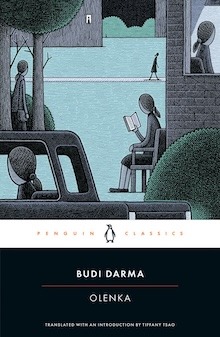
At the end are two sets of extensive notes, by the author and by the translator, providing context for the many literary and cultural references in the text. Some references are internal to Darma’s body of work, alerting the reader, for instance, to characters from People from Bloomington who also turn up in Olenka. The cover artwork by Tom Gauld, a shadowy tableau of featureless figures, adds an additional layer. In Olenka, questions arise over who is watching or being watched, who is writing or being written. Late in the novel, when Darma himself appears on the page to explain why and how he came to write Olenka, his account is yet another version of the many narratives surrounding the character of Olenka. It is also where Darma reveals who’s ultimately in charge.
+++
Bodi Darma (1937-2021) was a novelist, short-story-writer, and literary critic. He received several national literary awards, and his international honors include the Southeast Asian Writers Award and the Mastera Literary Award. He held a PhD in English literature from the University of Bloomington, Indiana, and was a professor at the State University of Surabaya.
+
Tiffany Tsao is an award-winning literary translator and writer. She has translated numerous Indonesian works, has written about literature in translation for Electric Literature, and is the author of But Won’t I Miss Me (2026), The Majesties (2020), and the Oddfits series. She holds a PhD in English literature from UC-Berkeley.
+
Sarah Layden is the author of Imagine Your Life Like This, a story collection that’s now an audiobook; and Trip Through Your Wires, a novel. She is co-author with Bryan Furuness of The Invisible Art of Literary Editing. She teaches creative writing at Indiana University Indianapolis.