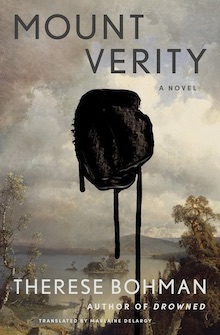
Other Press, April 2026
Mount Verity, the topographical namesake of Therese Bohman’s recent novel, is hallowed ground. A visitor who stands long enough on its plateau, or in the surrounding dark forest, might hear women whispering. Theirs are the muffled voices of those who died—or, as legend has it, disappeared into the mountain—during the seventeenth-century witch trials. If that visitor is Hanna Hallman, the protagonist of Therese Bohman’s Mount Verity, she might pause at the mouth of its cave in hopes of conjuring the fleeting memories of her teenage brother Erik, who vanished from the site on Easter Eve in 1989.
Growing up in southeast Sweden, in the shadow of a missing person, Hanna struggles to make sense of her place in the “awkward constellation” that is their new family of three. Navigating adolescent friendships is hard enough without having to protect her family’s grief from prying classmates seeking (or, in some cases, suggesting) lurid details of what really happened. Hanna finds solace in her art and in her childhood friend Marcus, a future religious studies Ph.D. candidate desperate to escape their native Kolmården. Where one ends, the other begins.
Mount Verity captures how grief and familial trauma shape a young girl’s coming-of-age while painting a portrait of an artist’s development, tracing Hanna’s professional trajectory as she outgrows the intimate line work that defines her pop culture-inspired intaglio printmaking and begins to experiment with oil painting. What connects the novel’s three parts—stretching from Hanna’s high school experiences to her quests for gallery representation and a workable co-parenting relationship—is Bohman’s provision of language for feelings that are nagging yet indescribable, or that have burrowed so far beneath the surface that they are no longer easily accessible. Late in the novel, Hanna articulates the tension she experiences when she thinks about the grief she still feels for her lost brother: “Sometimes I wonder if it is still Erik I am mourning, or if I am mourning the fact that time passes. The fact that every little moment, everything that combines to make up the majority of our existence, simply disappears, dissolves, is forgotten.” With Mount Verity, Bohman offers an original take on the familiar story of “you can’t go home again,” freshening it through Hanna, who returns home to pass the torch to the next generation.
Painting for Hanna is a deeply sensual and primeval act, affording her escape even as she is absorbed by her own psychological wounds. Hanna’s reflections on her art are highly self-aware. She clearly recognizes, for instance, why her parents are not the most vocal proponents of her work: “Of course they realize that everything I do is about Erik. Perhaps they feel I am exploiting something private, a grief that also belongs to them.” Hanna recognizes that what differentiates her from her parents is the fact that the trauma that informs her work—the story of her art—is a currency in itself. Her parents might have shied away from their fifteen minutes of fame, but now, their grief is “worthless from that point of view, literally without value.” Hanna, on the other hand, recognizes that because her “grief found an artistic expression,” it is “regarded as meaningful.” The novel raises important questions about art and the exploitation of trauma. Who should be granted access to a grief that is plural, that does not solely belong to the artist?
Bohman excels at naming complicated feelings tied to memory, aging, and trauma in ways that are concrete and vivid but also concise. Not only is this a difficult balance to strike, but her language also never feels forced, clichéd, or overwrought. When Bohman steps into her role as an art critic, these moments are refreshing and engaging, providing moments of reprieve from the novel’s sustained commentary on grief and growing up.
Bohman grants the reader broad and deep access to Hanna’s studio, her thinking, and her own, critical framing of her work: Hanna does not simply paint and weep or cross her fingers for someone to recognize her potential. The catalogue text that accompanies her first solo exhibition describes her depiction of a mountain that recalls Mount Verity, as “both naive and realistic […] simultaneously romantic and matter-of-fact.” This critical appraisal, offered by Hanna’s mentor, feels like an apt description of the novel itself.
+++
Therese Bohman grew up outside of Norrköping and now lives in Stockholm. Her debut novel, Drowned, received critical acclaim both in Sweden and internationally, and was selected as an Oprah Winfrey Summer Read. Her second novel, The Other Woman (2014), was short-listed for the Nordic Council Prize and Swedish Radio’s Fiction Prize, while her third novel, Eventide (2016), was short-listed for Sweden’s most prestigious literary award, the August Prize. Her fourth novel, Andromeda, was published by Other Press in 2025. Bohman is an arts journalist who regularly contributes to one of Sweden’s largest newspapers, Expressen.
+
Marlaine Delargy has translated novels by John Ajvide Lindqvist, Kristina Ohlsson, and Helene Tursten, as well as The Unit by Ninni Holmqvist and Therese Bohman’s Drowned, both published by Other Press. She lives in England.
+
Gabrielle Stecher Woodward writes essays and criticism highlighting the stories we tell about creative women. Her book reviews have been published in American Book Review, Film Quarterly, Harvard Review, and Woman’s Art Journal, among other venues. She holds a PhD from the University of Georgia. Explore her portfolio at www.gabriellestecher.com.