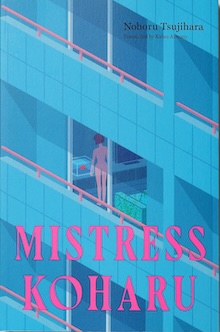
Honford Star, August 2025
Yano Akira is an editor for a Tokyo publishing house whose salaryman lifestyle has begun to bore him. Enter Koharu, a Hungarian love doll who comes to life upon moving in with Akira. Mistress Koharu, the second of Noburu Tsujihara’s works to be translated into English, follows Akira in the time after his purchase of this new toy, exploring the inner conflicts that create problems in intimate relationships and finally spill over into the larger world.
Akira is at first decidedly content with his relationship with his beautiful, patient love doll, certain that she is “the perfect match for him.” Her presence and conversation bring him profound comfort and peace, and seem to solve his problems with boredom and loneliness.
Koharu is not the only woman in Akira’s life. He has an ongoing affair with Chikako, a bar owner in Tokyo, whose many past and current love affairs preoccupy Akira. Akira decides to continue seeing Chikako but keeps Koharu’s existence from her, believing that Chikako would not be able to understand his new relationship.
The slow pace of the book’s opening suggests that Akira’s life might have continued in this way, split between Chikako and Koharu. It is at this point that Akaneya Kyoko arrives. Shortly after Akira buys Koharu, Kyoko moves into a neighboring building and begins spying on Akira. Kyoko’s sole interaction with Akira—a brief meeting, months before, through a mutual friend—had sparked an obsession, and she paid a detective agency to compile a detailed background check.
As part of her investigation into Akira, Kyoko follows his routine, which brings her to Chikako’s bar. Once the reader has all three women in view, the text follows them increasingly closely, and soon the most enrapturing episodes are those without Akira, when Koharu explores the city on her own, Chikako engages with her other customers, and Kyoko works on her investigative profile. Akira shifts from the forward-moving force of the story to a centripetal one, pulling the women together to create a collision of worlds that pushes the story to a darker place. At this point, the slowness of the first two thirds of the text pays off and the women lead the reader to a new world in the same novel.
The book is full of both explicit and tacit references to Sigmund Freud, popular culture, and Japanese history. In the translator’s note, Kalau Almony describes the painstaking translation of all the references throughout the text and the care he took to preserve their original meanings. Akira’s affinity for literature, movies, and museums shows up in paragraphs of somewhat tedious cultural analysis, though the topics are very obviously diligently chosen. Despite their dryness, any one of these analyses could be used as a lens through which to interpret the novel—and in this way, the text invites further study and rereading.
Certain references, unfortunately, fall flat. Koharu’s fascination with Catholic and Orthodox Christian churches, for example, is initially intriguing. But her the many accounts of her walks to churches and the welcoming churchgoers grow boring as the reader becomes excessively aware of the dichotomy of her perfect, almost angelic, appearance and her intended function as a doll.
Other, more detailed accounts of Freudianism serve the text better and provide insight into Akira’s psyche and his proclivity for unusually complex relationships with women. When visiting the doll store with a friend, the manager explains to Akira that the fundamental connection “between man and woman is a sort of relationship between self and other,” which lends itself to unhappiness. In contrast, he continues, in a kind of sales pitch for a doll, “one fully enjoys the feeling of eroticism when the woman is in a state such that her will has been deprived, when she has fallen into a position unable to take action on her own.”
Fascinated by Koharu, Akira questions the manager, asking whether it really is “impossible for people to see dolls as equal to humans, and build a loving relationship with them.” In fact, the manager’s description of the point of these dolls directly conflicts with how Akira feels about his relationship with Koharu. While his monthly visits with Chikako “drown [him] in a world of pleasure,” it is his life with Koharu that provides him “psychological relief,” with both being “necessary for him to continue his life alone.”
Mistress Koharu offers a thought-provoking account of a salaryman’s evolving relationships. The novel is rich in references, and though some might feel like an author’s indulgence and contribute to the slowness of the book’s beginning, other offer real insight into the characters’ inner lives, their relationships, and even their futures. The final third of the book is truly captivating, an artfully woven tapestry of four characters’ stories.
+++
Born in Wakayama Prefecture in 1945, Noboru Tsujihara has won several major literary awards including the Akutagawa Prize, the Yomiuri Prize for Literature, the Tanizaki Junichiro Prize, and the Kawabata Yasunari Literature Prize. His novel Jasmine was translated into English by Juliet Winters Carpenter.
+
Kalau Almony is a literary translator based in Kawasaki, Japan. His translations include the work of Fuminori Nakamura, Tahi Saihate, Shinya Tanaka, and Jose Ando. Born and raised in Kailua, Hawaiʻi, he completed his BA in Comparative Literature at Brown University and MA in East Asian Languages and Literatures at the University of Hawaiʻi at Mānoa. He is a 2025 National Endowment for the Arts translation fellow.
+
Mia Carroll is an engineer and writer. She lives in Manhattan with her husband.