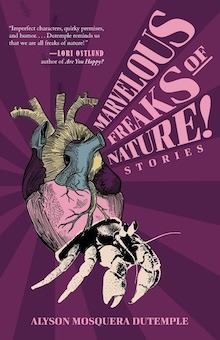
Cornerstone Press, October 2026
Alyson Mosquera Dutemple’s Marvelous Freaks of Nature! toggles seamlessly between the voices of children and adults who are behaving questionably, with the effect of reminding us how bizarre human experience can be.
Divided into three parts, each devoted to a different titular element—marvelous, freaks, and nature—the collection has a distinct Otessa Moshfegh energy. For instance, in the title story, a depressed, alcoholic young woman going through a bad breakup unrepentantly makes selfish and self-destructive decisions. Her roommate gives her a picture book, Marvelous Freaks of Nature!, featuring “disgusting photographs” of “fully functional people with cleavers stuck in their skills and skin pustules teeming with maggots.” The narrator becomes obsessed with the book because she identifies as a freak herself, possibly due to trauma surrounding her breakup. She feels emotionally deformed, like the babies in the book who are “born with hearts on the outside of their bodies, their love much too much to ever be contained.”
Dutemple begins her collection with this story, very much a Moshfegh-esque “weird girl” piece, in order to signal that the characters in the pages to come may be imperfect or disturbing, but they’ll never be boring. The narrator of “Three Season Room,” for instance, is another painfully stuck woman whose guilt over accidentally killing her fiance leaves her empty and unable to feel. “A Hill of Beans” and “Grand Old Duke” present the conundrum of men who are unkind to their women partners, but the women are so self-deprecating, desperate, or inept that it’s difficult for the reader to sympathize with them.
If Dutemple’s adults behave poorly, either because life has beaten them down or because they’re cruel and self-interested to begin with, Dutemple herself revels in kids whose characteristic weirdness—they’re just kids being kids—leads to bad decisions. One girl can’t prevent herself from transforming her feelings of desire into bullying; another stockpiles six-pack plastic rings so he can roll around in them like a trapped animal, more interested in the drama of struggle than in the environmental hazard they present.
These stories are powerfully evocative of the broad spectrum of childhood’s strangeness—how painful it is to lack control or to not understand, how quickly children grasp that they’re on the cusp of more complex experience. In “Sapling,” when a small child needing adult attention is sent out to the yard so the adults can have privacy, she exacts revenge on a newly planted sapling. In “Everything Must Go,” the main character recounts an exhibitionist game she played as a nine year-old, remembering “the sheer pleasure of doing the very worst thing I could think of. And of the confusing grown up feelings it gave me to give in to those dark impulses.” While the narrator of “Everything Must Go” is only slightly older than the character from “Sapling,” she already knows what social taboos are and that some things are forbidden because they are reserved for adults and lead to “grown-up feelings.” As an adult she can’t deny “the magnitude” of the game that led to those feelings.
The novelette “Touch-Me-Nots,” serves as an excellent, if harrowing, end to a work that oscillates between children’s and adult’s voices. Rodney and Rita, a couple who married in college after an unplanned pregnancy, take their two children, nineteen year old Kiera and elementary-school aged Scott, on a family trip to Bermuda. The vacation shows them evolving as a family, as older members usher younger ones into what is, for the latter, the great unknown of adulthood. Adulthood, at least to Rodney, is unfulfilling and characterized by “mov[ing] past one excruciating moment and into the next. And the next.” This generational tale asks if children are doomed to turn into the adults who raised them. The family isn’t just at risk of repeating the past; those cycles threaten to suffocate them entirely. As they become lost on their island excursion, Rita thinks, “They weren’t walking in a circle, no. They were walking in a corkscrew. With each step, their journey tightening around them.”
Dutemple’s choice to open with a story about a woman dealing with “grown-up feelings” by behaving poorly, and to follow it with stories about children being weird or flirting with mature experiences, suggests that adults come by their oddities and baggage honestly. It’s human nature, Dutemple suggests, to be strange, to want attention, to seek darkness. If we’re like that from the start, how reasonable is it to expect adulthood to be different? Marvelous Freaks of Nature! is less a diatribe against adults acting like babies and more a statement about how being human, this business of connecting and growing and feeling and surviving, is completely absurd—freakish, even.
+++
Alyson Mosquera Dutemple is a writer from New Jersey. Her stories have appeared in Alaska Quarterly Review, Colorado Review, and Passages North, among many others. She is a recipient of a fellowship from the New Jersey State Council on the Arts and has received support from Millay Arts and the Virginia Center for Creative Arts.
+
Brianna Thompson has a PhD in Literatures in English from Cornell University. She’s taught English to high school and college students; ask her about weight lifting, food, Voiceful Journals, or her TBR pile. She’s published scholarship on nineteenth-century American literature and contemporary authors like Octavia Butler. Her fiction has been featured in Fish Barrel Review, samfiftyfour, The Missing Slate, root smoke, and Wild Roof Journal.