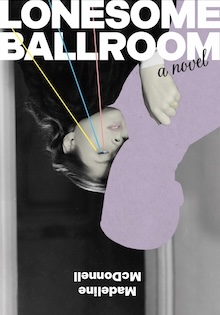
Rescue Press, March 2025
Set somewhere between the undifferentiated everywhere of girlhood and the specificity of contemporary New York’s art world, Lonesome Ballroom is a delightfully ambitious satire of the cultural legacy of femininity. Starting with a scene that’s a caricature of domestic discontent—upended plates of duck à l’orange, accusations of infidelity—the book balloons into an exploration of one woman’s life, always straddling the divide between the generic and the personal.
The novel’s hilarious heroine is Betty Block, née Bird, an ingénue turned gallery assistant turned housewife. For much of the book, she is recounting the story of her life to her fellow regulars at the Lonesome Ballroom, a local bar in the nondescript “New England pseudocity” of X. The story that unfolds is a familiar one: girl grows up, goes to college, discovers boys, falls into a competitive and codependent friendship, finds full-time employment to be less fulfilling than anticipated, falls for an older man with an air of permanence, encounters mundane disappointment and rote betrayal. The narrative self-consciously hits all the Hollywood beats: Betty Bird’s life makes her something of a stock character, yet within the contours of her stereotype she brims with personality and originality.
McDonnell’s prose is vibrant, alliterative, playful, and pleasurably self-conscious of form; the author’s fun becomes the reader’s fun. Betty’s age is “twenty-ugh,” undesirable adjectives are struck (many events are said to have occurred “several some not so many years ago”), Betty’s college lovers are referred to as Boyfriend A, Boyfriend B, and so on. Lonesome Ballroom is a collage as well as a novel, interspersed with image—films stills as well as photographs by McDonnell—and the acknowledgements page takes the form of credits of the kind you’d see rolling across a film screen.
These stylistic experiments speak to the novel’s interest in the legacy of art, particularly of film. Betty is from a lineage of creatives: her mother is an artist, her grandmother a singer. Betty grows up watching old movies with her grandmother and fixates on the film Gaslight, identifying Ingrid Bergman with her grandmother. Yet when she arrives at college (“the U”), her focus turns to being a muse. She dates pretentious film bros and poses for figure drawing classes. Her roommate is the intelligent E, whose successes in the art world eventually overtake Betty’s own, providing a foil to Betty’s ennui.
Working as a receptionist at an art gallery in the town of X, a first job Betty obtains through a nepotistic connection, Betty’s boredom and oppression speak to the meaninglessness of inhabiting the “art world” without an artistic practice of one’s own: “It was at those moments when she realized she herself must seem an art object, a performance artist or static installation, the single piece (Betty Got a Job!) stored within that strange white cube.”
Rather than cultivating a talent like her grandmother’s singing or her mother’s painting, Betty’s chosen art form is the performance of femininity itself. McDonnell positions Betty as the culmination of a hundred years of representations of the ideal American woman’s life; her artistic heritage is literalized through her mother’s and grandmother’s professions. Each of these predecessors’ lives were transformed when they got their “love story” moment—meeting a man, falling in love, and achieving their life’s purpose through motherhood and wifehood, their art practices becoming corollary to their status as beloved women. Betty accordingly spends her time waiting for her own love story, performing requisite depression and hurt when the college boyfriends disappoint, and eventually fixating on a professor named Henry who lives next door. Boyfriend H eventually becomes Husband H, yet by the fateful night that leads to Betty’s breakdown in the Lonesome Ballroom, Husband H has proven himself to be a stereotypical Hollywood husband; that is, unfaithful. Betty has become the beleaguered, belittled, beautiful wife—the inevitable end for the Hollywood heroine. This predicament drives her to her drunken recounting of her story-so-far at the bar and ends with her realizing she can start a new chapter of her own accord.
The book’s closing act, “How I Got Here,” is written more soberly and details what becomes of Betty after she leaves X, and H, behind. Having moved to NYC, taken a job at an indie movie theater, and liberated herself from the patriarchal vise of romance, Betty pawns her appreciation for the film Gaslight into an essay that becomes her graduate school application. Betty’s analysis of Gaslight also sheds light on McDonnell’s mission for Lonesome Ballroom: writing of the theme of departure throughout the film, Betty suggests that “the heroine will be freed from the past’s dominant narrative strategies: she will be left alone with her mind—in silence, without hero or script—but still expected to engage the viewer, to perform and provide dramatic action, narrative comment.” So too, does Betty perform for the reader throughout her novel. But by stepping into the role of critic and analyst, Betty is freed from that dichotomy of artist-or-art-object that limited her ambitions before. No longer an ingénue herself, Betty becomes “a scholar and defender of the ingénue […] a damsel in defense of the least deserving damsels in distress.”
But McDonnell has one last subversion before the book is done. Independent, city-dwelling, professorial Betty is not at the end of her road yet. With just a few pages to go before the book’s close, Betty meets another man, this one with real happy-ending potential. Forever self-aware, Betty defies the reader to protest, to root against her happiness: “Disappointed? But after so much reinvention, could I really revise the fundamental plot?” Continuing the theme of updating Hollywood tropes for the twenty-first century, McDonnell allows her heroine a dual ending; she gets both a divorce story and a love story. These last pages feel the most personal and probable, as Betty settles into a life she can fully inhabit without reservation or escapism.
Lonesome Ballroom is bizarre and brilliant, if busy, and composed of dense and delightful prose. McDonnell’s book is both a nostalgic homage to norms of femininity as handed down from decades of pop culture, and an imaginative inquiry into what may lie beyond.
+++
Madeline McDonnell is the author of three books of fiction: Lonesome Ballroom, Penny, n., and There Is Something Inside, It Wants To Get Out. She has an MFA from the Iowa Writers’ Workshop, where she was an Iowa Arts Fellow, and has taught creative writing, literature, and composition courses at many places, most recently the MFA program at Portland State University. She lives in Oregon with her family.
+
Grace Novarr lives in Brooklyn and works as an assistant at a literary agency.