Curbstone Press, May 2026
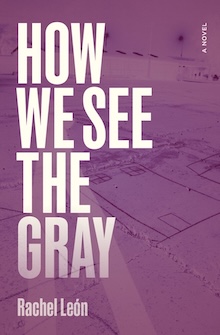
How We See the Gray, Rachel León’s debut novel, immerses the reader in the child welfare system. At one point, the team of social workers looks at mugshots online and plays a game to guess what each person did to end up in jail. The team genuinely cares about their work; they are just blowing off steam. But the game stops being fun for Meredith Metzger, a veteran at Children’s Social Charities, when she recognizes her mother in one of the mugshots.
The scene points to what this novel screams out in all its details. Set over the course of a year in Rockford, Illinois, the novel depicts the complexities of the child protective services system through detailed, realistic descriptions. Drawing on the author’s experience—León has worked in the foster care system for nearly two decades—the novel delves into the inner workings of social workers’ jobs. At times, it feels like a mix of nonfiction and fiction.
It’s easy to make judgments from afar, to gloss over the full story, to think of someone’s worst moment as something that could never happen to you. Early on, León explicitly lays out this moral dissonance, writing:
No person is perfect, either. Everyone knows this, and yet. We judge relentlessly. We hold others to standards we’d never reach ourselves. Sometimes it’s less about impossible expectations—more about inability, or unwillingness, to see the gray. A person cannot be categorized as ‘good’ or ‘bad.’ Sorry, but people are much too complicated for such labels. Too much nuance at play, too many extenuating circumstances.
The story focuses on Meredith as she’s increasingly stretched between her work, caring for her young son, and being haunted by her past trauma. Her mother was a mean, neglectful alcoholic. Meredith also shuts out her son’s father, deeming him not a good enough parent. As the weight of her work catches up with her, she finds escape in alcohol, repeating the pattern her mother laid down. Léon brings in other characters who show many sides of the child welfare ecosystem—a teenage lesbian named Ebony navigating foster care, a mother who has lost custody of her two young children, and a black social worker fighting a white-dominated world.
In addition to these stories, a chorus of voices representing the social workers opens each chapter, sometimes including case notes. The social workers take pride in where they live, as a place where they raise families, work in the community, and enjoy their favorite bar. As the chorus observes: “We don’t claim to be storytellers, but we specialize in stories. Our job involves collecting them, watching them unfold, and interfering to change their course. […] Because we look from every angle, we believe we know the truth. Easy to forget we only see what people show us . . . or get caught doing.” Each section of the novel also begins with newspaper clippings that suggest the political and cultural atmosphere of Rockford. These clippings cover sports news, weather events, political changes, and acts of community violence and racial injustice. The characters discuss their community’s flaws but also bond over support for the local teams.
The story remains compelling even though León takes care not to rely on sensationalist material. Instead, León focuses on the daily realities: the social workers who burn out and quit, leaving others to pick up a heavy case load; the parents who miss court dates or visits with their children; kids who leave only to end up in the system again. People’s lives are hard. It is easy to make mistakes. The system works against both parents who have made mistakes and the people who try to help. This structure, along with the wide variety of voices and the specific details of place that León uses throughout, make this novel a community story. What happens to these characters affects everyone.
The novel doesn’t suddenly zoom toward a grand conclusion. Not everyone overcomes their addiction. Not every family is reunited. Not all relationships remain intact. There’s no Hollywood ending here. Instead, it’s the relatively small actions of both Meredith and Ebony that carry the weight. Their actions suggest that positive change, though it happens in small ways, can and does occur when people don’t give up on each other and the community lifts them up and pushes them forward.
+++
Rachel Léon has worked in the foster care system for nearly two decades. She serves as managing director for the Chicago Review of Books and fiction director for Arcturus. Her work has appeared in Catapult, The Rumpus, Electric Literature, Foglifter, Publishers Weekly, and elsewhere. She hails from Rockford, Illinois, and is the editor of The Rockford Anthology.
+
Emily Webber is a reader of all the things hiding out in South Florida with her husband and son. A writer of criticism, fiction, and nonfiction, her work has appeared in The Rumpus, the Ploughshares Blog, The Writer, Hippocampus, and elsewhere. She’s the author of a chapbook of flash fiction, Macerated. Read more at emilyannwebber.com.