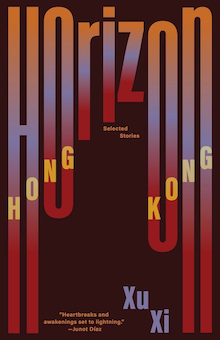
Gaudy Boy, July 2026
The latest short story collection by Xu Xi, Horizon Hong Kong features Hong Kongers forging relationships and means of survival in their evolving home city and abroad. Split into five sections, the collection depicts the changing shape of Hong Kong, particularly in the years before and after its handover from the British to the Chinese on July 1, 1997. The flux of Hong Kong does not impact these characters in the cinematic ways that political movements often evoke. Instead, these characters continue to work, to learn, and to support their families, even as intensifying social divisions complicate these endeavors.
Most stories in the first section are told from the perspectives of children living in Hong Kong. Especially in these stories of youth, the author deftly balances lightness with tragedy. “The Yellow Line” is a brief, haunting story about a Cantonese boy living in an abusive and poor household. After he learns to take the train by himself, he visits the wealthy, white neighborhood of Kowloon Tong. The story is devastating in its subtlety, while the child’s thoughts, from his obsession with the train to his constant, simple yearning to play, feel true to life. This story focuses on the separation between the boy and the “foreign devil children with golden hair,” whom the boy knows are rich because “gold mean[s] lots of money.” By showing this stratification through the eyes of a young boy, Xu highlights its conspicuousness and arbitrariness.
The characters of this wide-ranging collection persevere in their mundane duties, despite the tensions around them, particularly as Hong Kong’s social class structure persists along the lines that the British have drawn. The highest ranking schools are the Christian ones, and English proficiency allows characters social mobility—a goal that repeatedly troubles the characters as they abandon creative ambition for reliable income sources.
“Insignificant Moments in the History of Hong Kong” follows Lam Yam Kuen on his visit to his uncle’s restaurant in Hong Kong. The story is demarcated by two timestamps. The first is Monday, June 30 1997, which places the setting at Hong Kong, BCC (British Crown Colony). The second timestamp, on the following day, labels the city: Hong Kong, SAR, (Special Administrative Region). Despite the change, work at the restaurant continues. Locals and tourists dine, and one woman tells her young son that a “white rabbit lives on the moon.” This comment reminds Yam Kuen of his first visit, at age six, to his uncle’s house, where his uncle told him about that same creature, giving readers a lasting image of a larger continuity that transcends political battles.
These stories altogether suggest that the change in political control of Hong Kong is not the only shift influencing the city. The effects of China’s Cultural Revolution and the region’s recent rapid economic development continue to shape Hong Kong’s society. The parents that suffered famines and extreme poverty are now able to provide for their families and in some cases send them abroad—a frequently referenced indicator of success. As time goes on, the Hong Kong of these stories come to seem split not just temporally, but more deeply by class, generation, and the geography of its diaspora.
In the collection’s later sections, as characters travel between Europe, the U.S., and back to Asia, the focus remains on their inner worlds. Like Hong Kong, these characters adapt and change, and as part of their evolution, they sometimes feel the need to leave Hong Kong in search of new opportunities.
When a reporter returns home to Hong Kong in “Off the Record,” he views Hong Kong as a “hellish swamp,” a city “only good for making more money than he could make anywhere else in the world.” His frustration with his birthplace is nonspecific, widespread, and heightened by the ongoing Umbrella Movement, a series of protests that took place in 2014 in which protesters used umbrellas to shield themselves from chemical agents deployed against them by police. Like Xu’s other characters, this reporter finds truth and comfort in the notion that despite the chaos, “there’s still life to be lived, work to be done, and that’s what [he] should be doing.” As a character in a later story observes, “the affairs of state didn’t matter. What mattered was what you had for breakfast and dinner and whether the table settings were correct for a Chinese or English banquet.”
Horizon Hong Kong’s diverse characters and straightforward prose come together to create a cohesive collection that challenges the common reduction of Hong Kong to a political hotbed. Xu’s characters, at all stages of life, navigate delicate divisions without engaging in protests or even direct political conversation. By featuring characters who care for themselves and their communities, Xu provides a deeply enjoyable read that functions both as a portrayal of the subtle, divisive effects of political strife, as well as an homage to the quiet resilience of Hong Kong and its people.
+++
An Indonesian-Chinese-American from Hong Kong, Xu Xi 許素細 is the author, most recently, of Monkey in Residence and Other Speculations (2022), This Fish is Fowl: Essays of Being (2019), Dear Hong Kong: An Elegy for a City (2017), and the novel That Man in Our Lives (2016). A diehard transnational, she now lives between New York and the rest of the world.
+
Mia Carroll is an engineer and writer. She lives in Manhattan with her husband.