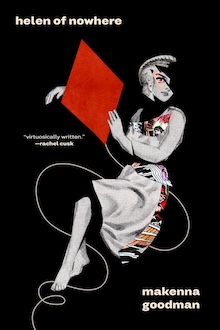
Coffee House Press, September 2025
Makenna Goodman’s Helen of Nowhere is a comedic indictment of male entitlement. Its middle-aged protagonist, known only as “Man,” is a professor grappling with his own irrelevance. His wife has left him, and he’s lost his job at his university, thanks to new female colleagues who critiqued his scholarship and confronted him about his laziness. Besieged on all fronts, and craving solitude, Man decides to buy a house in the middle of nowhere.
Although this rich novel is steeped in literary history, readers need not know all its references to enjoy it. Its title evokes Helen of Troy, the archetypal beauty at the center of the Trojan War, and its story parodies the Iliad, the ancient epic of that war. Man considers himself to be a fallen hero, and he wants to be important again. In addition to these classical allusions, the novel is self-reflexive. Man is a writer, and he ridicules the novels that women write, especially those featuring unreliable narrators and competing “true” accounts of events.
The irony, of course, is that Man is an unreliable narrator. He insists that he is observant, and that his life’s work has been “all about paying attention” to nature. However, as readers sift through his stream of thoughts, they understand that Man is capable only of limited insight. For instance, when he meets Realtor, the young woman showing him the house he wishes to buy, he recounts her rambling conversations about the house’s owner, Helen. Some of Realtor’s stories contradict one another. For instance, she describes Helen as a friend and “healer,” capable of “a kind of all-encompassing love,” while simultaneously admitting that Helen cruelly wanted nothing to do with her. Man barely registers these inconsistencies, however, as he is too busy basking in her praise of him and hoping she’ll sleep with him once they’ve completed the walk-through. Eventually, he realizes that he may not be listening to her closely, but he immediately becomes defensive, assuring himself that “I had gotten good at listening. But did I hear? Yes, I heard. I heard, and I was listening.”
Superficially, Man seems like a funny, if pathetic character. But as Man reveals more of his thoughts, it becomes clear that he’s predatory. His wife was a former student, one whose intelligence and beauty so enraged Man that he decided to marry her as “the greatest revenge against her brilliance.” He never refers to his wife by name, or even by “Woman,” which would suggest they have equal footing. Instead, she’s merely called “Wife,” suggesting that she’s subordinate to him. He admits to slapping her and to believing that “she was the woman who ruined me.” These moments of violence and rage are threaded into the text casually, and this subtlety works exceptionally well because it reinforces how men rationalize misogyny.
Eventually, readers understand that the position Man lost wasn’t just his university job, but rather his position in the world. Man is angry because he’s been asked to make space for smart women. The novel’s explorations of displacement and privilege are especially timely now, given the current backlash against workplace diversity. Man perceives every woman’s accomplishment as a threat, and he’s especially repulsed by those “women, who were critics, and who encouraged others to be critical too” because their criticism destabilizes his sense of self.
Despite Man’s obliviousness and casual cruelty, his thoughts are compulsively readable because some of his struggles are relatable. Man wants to find happiness and erroneously believes that he can purchase it. Realtor warns him that other potential buyers have sought happiness in the house he tours, only to be disappointed. She offers him an alternative path towards happiness; namely, by “removing the power of the ego from the soul.” She presents Helen’s lifestyle as an alternative, as Helen purportedly was “filled with satisfaction” once she separated herself from society and its demands. Of course, Realtor admits that because Helen sequestered herself at the house and became self-sufficient, her lifestyle was beautiful but “also tiring,” suggesting that the work of finding happiness is just that: work.
Near the end of the novel, Man finally meets Helen, who appears suddenly at the house, like a ghost. Facing her, he purges his deepest fears, even though he’s not sure she’s even listening. He explains, “I was speaking inside of myself. […] But it didn’t matter, because the words existed, and they had a witness.” In the midst of discussing his feelings with this woman who may not be alive or even fully listening, Man realizes he hates his wife because she punctures his self-deception. He likens her to an oracle who “can reveal the meaning of life” to someone who doesn’t want to hear the truth. She’s found his Achilles’ heel, so to speak: she knows he craves approval and attention above everything.
There is far more to discover in this novel, such as its explorations of beauty, authorship, and academe. There is also more to admire. Helen of Nowhere is lyrical but succinct, and it’s playful without being pretentious. Undoubtedly, Man will stay with readers for a long time, something that would make him quite happy.
+++
Makenna Goodman is the author of two novels, Helen of Nowhere (2025) and The Shame (2020), and has written for international publications including the New York Review of Books, the Los Angeles Review of Books, Harvard Review, The White Review, BOMB, The Common, ASTRA Magazine, and Mousse Magazine. Also an editor, she is based in Vermont.
+
Emily Hall holds a PhD in contemporary Anglophone fiction from The University of North Carolina at Greensboro. Her fiction, creative nonfiction, and criticism, have appeared, or are forthcoming, in Portland Review, Passages North, 100 Word Story, The Plentitudes, Cherry Tree, and Blood Orange Review. Her academic essays, focusing on queerness, disability, and literary experimentation, have appeared in South Atlantic Review, The Journal of Medical Humanities, and Pedagogy.