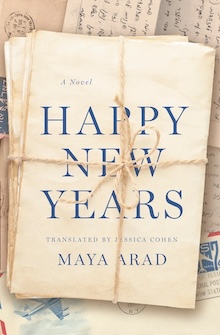
New Vessel Press, 2025
In Happy New Years by Maya Arad, translated from the Hebrew by Jessica Cohen, the narrator, Leah Moskovich, writes an annual Rosh Hashanah letter to her college classmates. These letters cover fifty years from 1966 to 2016, most of which Leah spends in the United States after she moves there from Israel to take a teaching position. Her letters are filled with updates—the births of children, changed relationships, a new job. After each newsy letter, Leah attaches a more honest accounting written to her particular friend, Mira, who remains in Israel, and these attachments reveal more of Leah’s truth.
It’s challenging to write an epistolary novel and have it not sound like a series of Facebook posts. At their best, such novels are wittily compelling and vividly alive, like a correspondence between true friends (who might also be rivals). A paradigmatic example is the eighteenth-century French classic, Les Liaisons Dangereuses (1782; Dangerous Liaisons) by Pierre Ambroise Chodoros de Laclos (1741-1803), but Happy New Years is a very different book. Leah lacks the wicked energy of a character written by Laclos, and whereas some epistolary novels include correspondence from multiple parties, in this novel Leah writes most of the letters. Told mainly from her perspective, her account feels curated and cautious, like a social media feed but wordier.
Early on it becomes clear that Leah is a poor judge of character. With the exception of Mira, Leah’s correspondents don’t like her at all. They look down on her background and spread gossip about her romantic interests that portrays her as promiscuous. They rarely respond with letters of their own. This doesn’t stop them from turning to Leah when they need something from the U.S., and Leah is always friendly and obliging. Leah’s romantic relationships are generally even worse—married men, a husband who abandons her and their kids, an older lover who refuses to marry her and leaves her next to nothing in his will despite her absolute commitment to him. In one letter to Mira, Leah reveals some of the truth about her ex-husband, saying: “If it’s true what they say, that what doesn’t kill you makes you stronger, then I’m the strongest woman in the world.”
Leah may be strong, but she doesn’t learn from her mistakes. They don’t really care about you becomes the reader’s constant mental refrain. It is hard not to want to write a letter of one’s own to Leah, telling her to wake up and get some boundaries. Fortunately, Happy New Years is introduced by a fictional preface from her publisher which sets the stage for a deeper understanding. Here we learn that the novel’s letters are important for showcasing the ways that “women and minorities have profoundly internalized the oppressive norms to which they are subjected.” The writer of the preface notes Leah’s “relentlessly optimistic verve” (so true) and suggests that the reader will be “astute enough to read between the lines,” hinting that Leah’s vulnerability is a response to trauma or perhaps to an accumulation of microaggressions. Some of this is confirmed in Leah’s final and most honest letter, in which she reveals important truths she had previously concealed.
Despite Leah’s flaws, it is interesting to follow her progress from a young and untested Israeli woman to an expatriate confidently navigating her new home in an ever-changing world. Leah is a woman who marvels at small things that turn out to be watersheds, from the wonder of disposable diapers in 1971, to her first computer in 1985, to her offer to send her annual letter by email in 2005. Historical events intrude as well, from the Yom Kippur War in Israel in 1973 to the events of September 11, 2001, in the U.S. Large and small, these events mark the passage of time as Leah ages, her sons become adults with lives of their own, and family and friends move on or die.
The author, Maya Arad, is herself an expatriate Israeli who lives in California and teaches at Stanford University. Happy New Years is her second book to be translated into English. Her first, The Hebrew Teacher (2018), is also about Israelis living in the U.S. Both books have been translated into English by Jessica Cohen, whose translation of Happy New Years is seamless, fluent, and idiomatic.
Despite some superficial similarities between author and her main character, it is good to know that Arad is no Leah Moskovich. As she says in an interview with the Jewish Book Council, “Optimism isn’t my strong suit. If anything, I am the opposite.” Leah maintains her optimism until her death. It is perhaps her curse, but it is also essential to her flawed but ultimately touching story.
+++
Maya Arad is the author of twelve books of fiction in Hebrew, as well as studies in literary criticism and linguistics. Born in Israel in 1971, she received a Ph.D. in linguistics from University College London, and for the past twenty years she has lived in California where she is currently a writer-in-residence at Stanford University’s Taube Center for Jewish Studies. She won a National Jewish Book Award for The Hebrew Teacher.
+
Jessica Cohen shared the 2017 Man Booker International Prize with author David Grossman for her translation of A Horse Walks into a Bar. She has translated works by Amos Oz, Etgar Keret, Dorit Rabinyan, Ronit Matalon, Nir Baram, and others.
+
Shara Kronmal is a writer, and literary translator from French to English. Her fiction and creative nonfiction writing, translations, and reviews have appeared in a number of literary journals. She is the associate editor for longform creative nonfiction at CRAFT and a translation reader for The Adroit Journal. Shara is a retired physician and lives in Chicago.