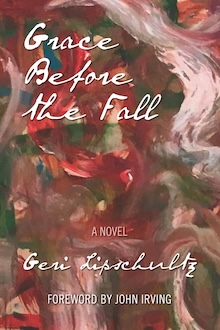
Dark Winter Press, August 2025
Geri Lipschultz’s Grace Before the Fall is a book of madness and wonders. The foreword, by John Irving, invites the reader to think of the book as “magical realism meets Alice in Wonderland.” But magical realism is grounded in realism in ways that Grace Before the Fall is not and doesn’t aspire to be. This novel defies description, categorization, and evaluation. To enter it is to enter a world in which dreams, nightmares and reality are entangled.
Although the novel is set in a specific place and time—Lower Manhattan in the late spring of 1980—and even as it bears the emotional and mental marks of that setting, the only thing realist about the narrative is its utter unreality. The year and season are established through events specific to the historical moment. Young gay men are dying of a disease as yet unnamed; the Three Mile Island nuclear accident of 1979 is fresh in memory; the Ayatollah Khomeini’s Iran is still holding American hostages, and President Jimmy Carter’s Operation Eagle Claw has recently failed in its effort to free them. But the novel’s action unfolds on another plane altogether.
Grace Rosinbloom, in the course of her mundane if unlikely job, assessing computerized records in an unidentifiable city office in order to schedule derelict housing for demolition, gains access to a trove of ostensibly secret federal government data. The absurdity of the plot surrounding this massive list—what it seems to be, what Gracie decides to do with it, what she imagines she’s accomplishing by doing what she does, and all that she will be punished for—echoes the absurd origin and consequences of Tyrone Slothrop’s intimate foreknowledge, in Gravity’s Rainbow (1973), of the precise London locations where German missiles are about to fall.
And indeed Grace Before the Fall has more in common with Pynchon’s paranoid postmodern cartoon worlds than with the magical realist worlds of Gabriel Garcia Marquez. Grace spends more time with a crew of hallucinatory familiars (a bookish, sometimes glowing worm; a phantasmagoric green goddess or warrior woman; an avuncular pedant in plaid; a queen bee) than with her various living friends. The dialogue is shaped by artifice, as is the narration: a seance of voices echoing James Joyce, Samuel Beckett, and Shakespeare, along with a great deal of music and the occasional song or poem. The plot line is paranoid and its logic thin; every character’s name is worth parsing for meaning and puns.
In an early scene, in a club in the Village, Grace, her friend Em, and Em’s boyfriend Bruce, a filmmaker and impresario of their shared mixed media act, give an impromptu two-part performance. First, Bruce’s mostly silent film features Em miming her longing for him and also her own power; then, on stage not film, Grace as the voice and Em as the miming body together perform “a living epilogue.” As their performance reaches its climax, Em collapses, and reality begins to unravel, so much so that a skeptical reader may question whether the novel will turn out to be hallucination from start to finish.
Is Em really just an aspect of Grace? (Is Grace an aspect of Em?) Is Grace’s sudden impassioned love for Em’s doctor, Starlinsky, no more than spiritual enactment of Em’s therapeutic dependence and transference? (Does Starlinsky even exist?) If the two women are one, which of the two is “real”? And what is to be made of Bruce, formerly Grace’s lover, whose persistent pursuit Grace is now unable to shake?
In a conversation in which Em tries to persuade Grace to have sex with Bruce one more time, Lipschultz crystallizes the larger arc of the enmeshed relationship between the two women:
‘We’re one,’ Em says.
‘We’re individuated,’ Grace says.
‘We’re all the same.’
‘I have a self, and you have a self,’ Grace says.
‘I am self-less,’ Em says. ‘Please—for me.’
While the many narrative teases about what is real and what is not serve primarily as lures, and Grace’s story develops and advances mostly through her dream world, both the novel’s mysteries and its lyricism keep a reader following her with curiosity and wonder.
In “Cassandra Float Can” (2016), Anne Carson writes of Priam’s prophetic daughter, “like spacetime, she is nonlinear, nonnarrative.” “Everywhere Cassandra ran she found she was already there,” Carson continues, and “everywhere Cassandra ran she found she could float.” Like Carson’s Cassandra, Lipschultz’s Gracie Rosinbloom lives outside of time—and she can float.
+++
Twice a Pushcart Prize nominee, Geri Lipschultz has published in Terrain, World Literature Today, the Rumpus, Ms., The Toast, The New York Times, Black Warrior Review, College English, and many others. Her work appears in Pearson’s Literature: Introduction to Reading and Writing and in Spuyten Duyvil’s Wreckage of Reason II. She holds an MFA from Iowa and a Ph.D. from Ohio University. She received a Creative Artist Public Service (C.A.P.S.) fellowship from New York State. Her one-woman show, Once Upon the Present Time, was produced in New York City by Woodie King, Jr. She is one of three writers for the children’s book of poems, Did You Kiss a Cat Today??? She teaches writing at Borough of Manhattan Community College.
+
Catherine Gammon’s recent collection is The Gunman and the Carnival, from Baobab Press. She is the author of four novels: The Martyrs, The Lovers; China Blue; Sorrow; and Isabel Out of the Rain. Her 2025 chapbook, What is your work? is available from Almost Perfect Press. Find her at catherinegammon.com and @nonabiding on Substack and Bluesky.