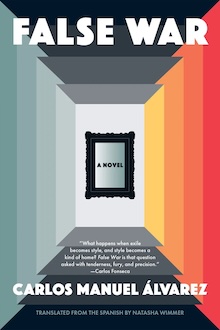
Graywolf, August 2025
Carlos Manuel Álvarez’s hard-hitting False War, rendered perceptively in English by Natasha Wimmer, is a disorienting novel of narrative destabilization and polyphonic translation. Eschewing a linear plot, Álvarez’s montage of fragmentary portraits reveals the fraught heterogeneity of Cuban emigrants’ experiences.
This disunity of perspective is evident in the novel’s structure, which comprises short sections with subheadings or captions: “Usual Suspects,” “Fanboy’s Choice,” “Sewer Rats.” Each section presents a different first- or third-person perspective; and although captions and characters recur, they defy organization into narrative arcs. Instead, the sections offer glimpses of struggle that interrupt and fracture one another. The characters reckon with their situations using the fragmented gaze and uncertain language of those whose sense of identity has been broken by the trauma of dispossession.
Of different generations and economic circumstances, and committed to different political ideologies, the characters’ only commonality is having left Cuba, and this breeds among them more conflict than sympathy. In “Usual Suspects,” young Barber, starving in communist Cuba, stares indifferently, uncomprehendingly, at his neighbor “[a]s if instead of seeing him,” Barber is “sketching him with [his] gaze,” when he is arrested for owning a small business. Decades later, in Miami, when a young recent immigrant visits a much older Barber’s shop, the two men come to blows over the awfulness of Guantánamo, so different were their experiences before and during their border crossings. “Actually, [Guantánamo] doesn’t sound that bad,” Barber says. “What do you mean it doesn’t sound that bad!” the client shrieks. But Barber insists: “You were on solid ground, you were sleeping in a safe place.”
It’s on such post-traumatic perspectival distortions that Álvarez’s novel pivots, twisting along a “trail of misunderstandings.” Fanboy is economically stable in Miami with his girlfriend Elis, but his perspective is so confused that he cannot determine his priorities. Dazzled by the spectacles, like major league baseball games, that crowd life outside of Cuba, he’s also chronically agitated by a feeling of unbelonging that impels him to seek affirmation everywhere and permits him to trust no one.
Dashing from Miami to New York and Paris, Fanboy chases empathy, always fearful that he has left behind what’s most important. When he loses Elis in the Louvre, existential instability overwhelms him. He mistakes the crowd around the Mona Lisa for a “mob scene, parade or protest.” Whatever it is, he thinks, it is “bad stuff.” Inundated by images (masterworks, postcards, selfies) that claim to represent life, he searches for personal resonance, an acknowledgment of his struggle as an exile. Ancient aboriginal statues seem “friendlier” to Fanboy, “like the art was asking you for help. It came from the heart of the unknown […] saying come, Fanboy, come, my friend, see yourself in me.” Yet he sees Chinese tourists, fellow foreigners who might understand his discomfort, through the very racist lenses he resents. He can’t determine where he stands in relation to others, not even Elis. Lost in the Louvre’s maze of worlds and eras, his inability to discern which reality is his own becomes terrifying. He starts confusing people in his life with the subjects of the artworks: “You don’t know who’s what.”
Reading False War is like visiting a gallery of wounded souls, whose wounds are not entirely intelligible and thus can only be partially portrayed. Álvarez’s prose, in Wimmer’s translation, dances a “false war” between languages amid the characters’ internal conflicts. Wherever they find themselves, the place gets under the skin in the form of an unfamiliar language that exerts destabilizing but sometimes enriching influences. Wimmer brilliantly conveys this complexity by transliterating some of Fanboy’s Spanglish while leaving other elements untranslated. “I’d brought her to the Louvre,” he says. “What foquin mierda more did she want? Cool it, Fanboy, I said to myself […] Teikitisi, bro.” Exiled from Spanish, Fanboy isn’t at home in English either. His voice amplifies the porosity of his condition, as Spanish and English permeate each other.
Similarly, a Cuban conference delegate visiting Germany thinks in long, lush sentences, whose compound words and rambling style Wimmer indulges; the result could resemble “Spanish as spoken by a German.” This third-person narrator, an unnamed anti-communist “dissident,” reflects on German identity by considering the country’s history and its citizens’ varying degrees of sympathy for refugees. But his own history of marginalization inhibits his engagement with Syrian refugees who fled to Germany to escape violent repression. In a magnificent 250-word sentence, he observes his own unwillingness to revisit his feelings of dispossession, demonstrating that trauma can encourage but may just as easily prevent empathy from arising between those who suffer:
[I]f the individual the dissident is can’t forget the bottomless-abyss feeling, the diametrically-opposed-worlds feeling, that made him dream of Berlin from his rural village […] and if the individual the dissident is knows it’s too late to separate himself from those same conditions, conditions that shaped him, and if those conditions include, among other things, a lack of human rights, why, after all this, should the individual the dissident is complain […] now that he’s different, now that he’s who-knows-what?
Amid ceaseless human migrations across xenophobic political landscapes, the question of identity exacerbates fearful distrust. But for Álvarez, this question’s unanswerability also energizes the formal and linguistic pluralism that defiantly empowers False War.
+++
Carlos Manuel Álvarez is the author of The Tribe and The Fallen. He has been included in Granta’s “Best of Young Spanish-Language Novelists” as well as Bogotá39’s best Latin American writers under 40. He lives in New York City.
+
Natasha Wimmer is the translator of nine books by Roberto Bolaño, including The Savage Detectives and 2666. Her recent translations include Nona Fernández’s Voyager and Álvaro Enrigue’s You Dreamed of Empires.
+
Mandy-Suzanne Wong’s novels and essay collections include The Box and Daughter of Mother-of-Pearl, as well as the forthcoming The Quiet Upwelling, all published by Graywolf. She is a regular contributor to Asymptote.