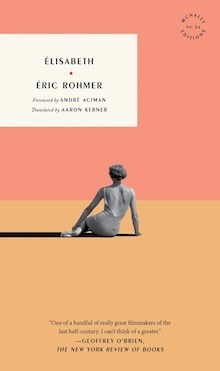
McNally Editions, July 2026
The name Éric Rohmer conjures up, for fans of French New Wave cinema, images of lush lawns and beautiful young people, the sounds of their halfhearted flirtations and of waves crashing against sand. His legacy as a filmmaker is built on a sixty-year career that mixed these hallmark elements with a candid visual style and an uncanny insight into the vagaries of desire. His first and only novel, Élisabeth, published in 1946 and recently translated into English for the first time by Aaron Kerner, contains all the signature elements of his screenplays. The effect of reading his novel as someone familiar with his filmography is to have the curious experience of feeling that one medium has been flattened into another.
But Rohmer’s fiction foray deserves to be considered on its own terms, as it was when it was first published, two decades before his film career truly began. The titular figure of Élisabeth is Élisabeth Roby, wife of Dr. Roby and the mother of teenage Bernard and seven-year-old Marie-Thérèse. It’s August 1939 at the Roby house in the countryside town of Percy, and summertime drifts by as the Robys spend time with the cousins they are hosting, the adolescent Claire, and the early-twenties engineer Michel. Michel’s summertime visits to Percy are the scenes of his affair with the older, widowed Irène, an affair that he contemplates terminating. Over a few days, immersed in the suffocating heat, Rohmer’s characters swim in the local river, take slow drives into town, pick each other up, and steep in their desires. The only direct concession the novel makes to the temporal specificity of its setting—that is, the impending invasion of the Nazis—comes through newspaper headlines that Élisabeth pages through while waiting at a dentist’s office.
The novel’s dialogue is oblique; the characters are coy even when seemingly candid. The more arresting passages are those in which Rohmer turns the camera inward, portraying the uncomfortably raw doubts that a person may privately entertain about a lover. As Michel sits at dinner across from Irène and her mother, after spending an afternoon embracing and caressing Irène in a garden, he sinks into anxious rumination: “I chose her, and she’s as good as anyone else; love is a habit you stumble into, never something you choose; choosing is idiotic. I love her, everyone accepts it, everyone approves of it now. I love her, it’s true.” In the next moment, the narrator intrudes to show Michel contradicting his own last thought: “But [Michel] knew that wasn’t really what he thought; what he really thought was that it wasn’t love so much as the decision he’d already made that compelled him to watch her out of the corner of his eye, waiting for that expression, for one of those expressions, that he hated more than anything in the world.”
Michel and Irène are ambivalent about their affair, and Rohmer’s characters’ actions are as irresolute as their thoughts. The next morning, when Michel returns to visit Irène, their conversation devolves into an argument in which she admits “we don’t love each other anymore,” which offends Michel despite his own uncertain thoughts of the night before. He departs, but a couple of days later, as the novel ends, he is paying another visit, and she is admitting to having called on him as well.
Often, Rohmer narrates a scene using only the “he” pronoun to illustrate the character whose perspective we inhabit, obscuring the character’s identity in a way that contributes to the novel’s hazy, dreamlike effect. We are following either Bernard or Michel, but we don’t know which, until another person addresses them by their name. These men are blurred together like one of the “oil smudges” that Michel’s engineering labor involves.
This device has its payoff in the novel’s third act. Jacqueline, a teenager needing a lift to a rendezvous at a local swimming hole, is offered a ride by a young man who introduces himself as Bernard. He joins the party at the lake, and as he drives Jacqueline back, he pulls the car over, attempting to kiss and fondle her. She pushes him away, persistently, and she eventually laughs off what they both seem to understand to be an attempted assault. The reader suspects that this man may not really be Bernard, but Rohmer’s characters are enigmatic—we know as little about them as their lovers do. It is in fact Michel who picked up Jacqueline, but a few miles away, Bernard is also entertaining a new acquaintance, Huguette, who likewise resists the script he wants to write for their afternoon. At the day’s end, Bernard and Claire share a kiss in the garden, while Michel returns to Irène. The dalliances of the day have effectively been carried away as though by the river to which the characters devote their days.
Though set on the cusp of the Second World War, Élisabeth conjures a perpetual present, an affair that never ends, a seduction never consummated. The effect is to show that desire creates an eternal moment that prolongs itself infinitely, postponing the future that we know to be on the horizon. The novel ends with a scene of a teenage girl, Claire, momentarily free of her copious suitors and finally getting to sit down in the sunlight with the novel that she’s been trying to steal a moment to read. It is an apt illustration of art mirroring lust in its potential to absorb, to distract, to ensnare.
+++
Éric Rohmer (1920–2010) was born Maurice Schérer in the province of Lorraine. After moving to Paris and befriending cinephiles and future directors Jean-Luc Godard, Jacques Rivette, Claude Chabrol, and François Truffaut, among others, he began writing, editing, and publishing film criticism under a pseudonym. Rohmer went on to direct more than twenty acclaimed feature films, including My Night at Maud’s, Claire’s Knee, and The Green Ray.
+
Aaron Kerner completed an MFA at Emerson College and lives in Cambridge, Massachusetts, where he works as an English teacher at the Commonwealth School. His other translations include Augusto Monterroso’s The Rest is Silence.
+
Grace Novarr lives in Brooklyn and works as an assistant at a literary agency. She writes poetry and criticism.